
2025 Working Seminar
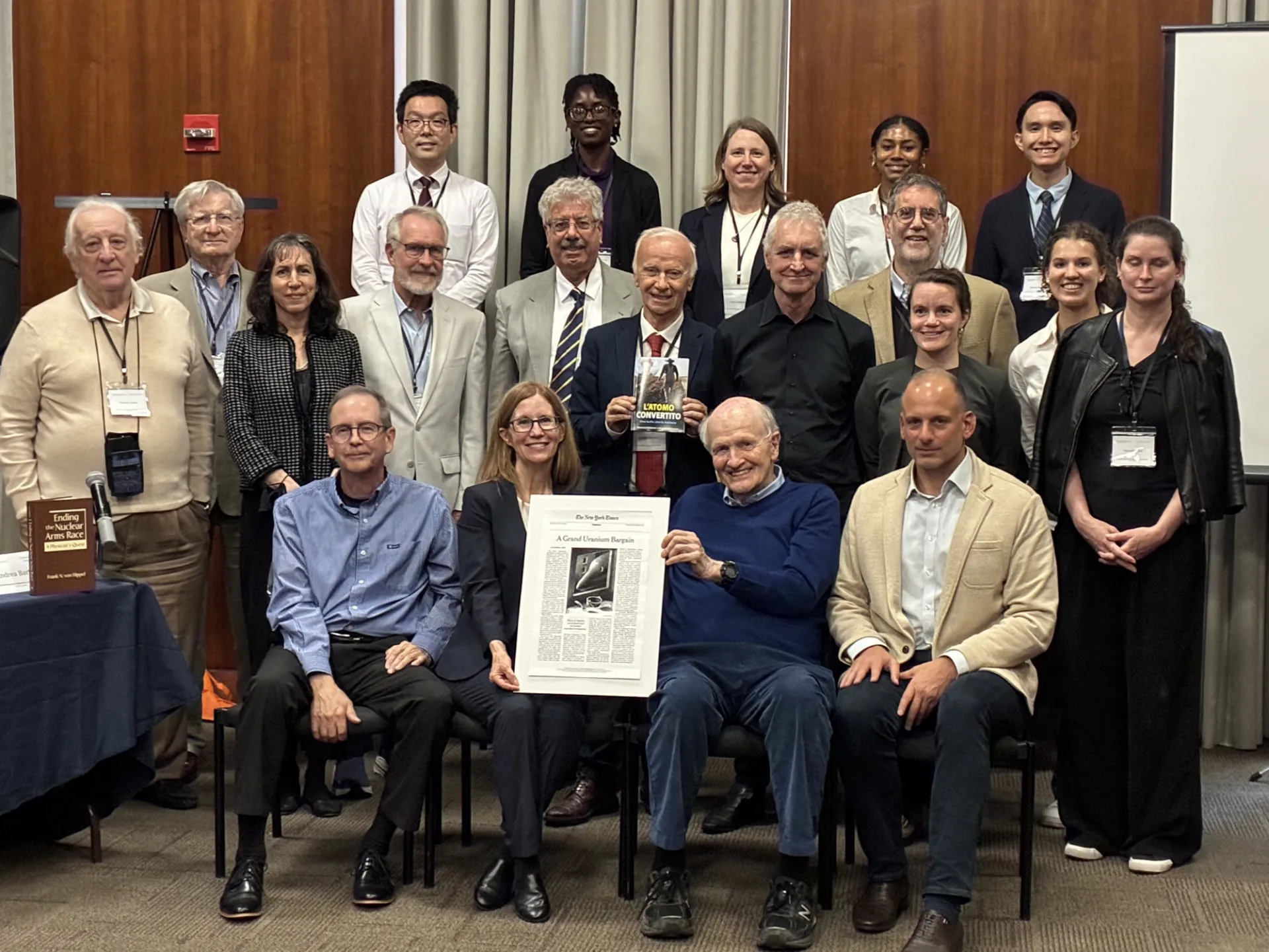
Columbia University, June 16, 2025
AC4 – CNDSI Working Seminar 2025: Summary Overview
The Cooperative Nuclear Disarmament and Sustainability Initiative (CNDSI) held its 2025 Working Seminar at Columbia University, the first in a three-year series dedicated to evaluating the Megatons to Megawatts (M2M) program. This inaugural seminar focused on the conditions that enabled the conception and implementation of the program, with particular attention to scientific cooperation, technical feasibility, and political motivations in the years leading to its launch. A summary overview follows, using Chatham House Rules. Some separate slide presentations used in various sessions are posted separately, with permission of the presenters. The agenda, participant bios, and other information regarding the seminar are also posted separately.
Presentation Slides
The U.S.-Russia “HEU Deal,” subsequently branded as “Megatons to Megawatts” (M2M), achieved dramatic results from 1993-2013:
- Eliminated 500 metric tons of highly enriched uranium (HEU), taken from Russian nuclear weapons, the equivalent of 20,000 nuclear bombs
- Made use of the greatly diluted HEU for use as fuel, contracted by the U.S., for civilian nuclear reactors, producing about 10 percent of U.S. electricity over the period.
This swords to plowshares agreement helped prevent nuclear chaos in Russia after the collapse of the USSR, provided needed revenues desperately needed by Moscow, demonstrated sustained nuclear cooperation was possible between former arch Cold War rivals, and defined an energy pathway for nuclear threat reduction driven by the market with the ecological benefit of reduced carbon.
The 2025 seminar revisited the origins of this initiative to understand and further document how such a large-scale cooperative effort became possible, and to explore lessons for future nuclear disarmament and energy security challenges. The seminar combined structured presentations with open discussion, including randomized interventions to ensure wide participation. This format encouraged a diversity of perspectives, blending historical reflection with forward-looking analysis.
To address the many aspects of the Megatons to Megawatts story, the seminar was divided into four sessions. The first revisited the history and lessons of the program, the second highlighted the role of scientific cooperation, the third examined the diplomatic and economic negotiations that shaped the “Grand Uranium Bargain,” and the fourth expanded the conversation to the broader ecosystem of security, energy, and climate. Together, these sessions offered a layered understanding—historical, technical, political, and global—of how large-scale disarmament initiatives, under the right circumstances, can succeed and what they mean for today’s challenges.
Session One: History, Lessons, and Future Scenarios
The opening session examined the origins and legacy of the Megatons to Megawatts initiative. The concept, proposed by physicist Thomas L. Neff in 1991, was discussed by Presidents Bush and Yeltsin in 1992, signed into a 1993 agreement endorsed by Presidents Clinton and Yeltsin in 1993, and carried out through cooperation over decades between Washington and Moscow, represented a unique convergence of political, technical, economic, and environmental factors.
The session highlighted how this agreement eliminated the equivalent of over 20,000 atomic bombs, utilizing market demand for fuel for civil nuclears. Over the life of the program, it generated an estimated $17 billion in commercial value, supported both governments’ security objectives, and required 13 formal amendments ratified by the U.S. and Russian governments to adapt to shifting conditions.
Discussion also explored the complex institutional and political challenges that had to be overcome—such as the evolving role of the newly formed U.S. Enrichment Corporation, natural uranium market pressures faced by Western companies, and the tensions within Moscow over the revenues earned by the Russian nuclear complex during a period of dramatic transformation in Moscow. Despite these hurdles, the initiative demonstrated that cooperative frameworks between former adversaries could achieve lasting disarmament results.
Participants further reflected on gaps in public awareness, noting that despite its significant achievements, the program remains relatively unknown outside policy and scientific circles. Questions were raised about how issues like nuclear waste were addressed at the time, and how dialogue even between U.S. and Russian scientific counterparts, which was vital to the original Deal, has been frozen since 2014 and especially after 2022.
Looking ahead, the session examined the potential for variations of future arrangements that might benefit from the demonstrated benefits and success of Megatons to Megawatts. The simplest replay of a variant of the HEU Deal would be a post-Putin successor regime seeking a way to earn its way back into western trade, given its lagging economy distorted by its war economy. More broadly, the legacy nuclear threats since 1945, the growing climate threat made clear in recent decades, and the dramatically emergent, consequential, and energy intensive Artificial Intelligence race could converge in a variety of arrangements, which were outlined in preliminary form, to incentivize arrangements to reduce excess nuclear fission stockpiles (measured in many hundreds of tons) to use them in reactors to produce carbon free energy, particularly if fusion energy becomes a reality.
Questions proposed for future examination included:
- Analyze the HEU Deal to consider how, under various future circumstances, excess nuclear weapons stocks can be consumed in nuclear reactors and/or put into forms less usable for weapons, thereby reducing the nuclear security threat while also contributing to the challenge of surviving climate change: for the US, our global partners, the international economy, and for human welfare generally
- What additional analyses help contribute to discerning, laying the groundwork for, or advocating for how the goals of reducing nuclear danger and mitigating climate change by producing carbon free energy could be mutually reinforcing, in the context of evolving national and international needs and pressures?
Session Two: Scientific Cooperation as a Prerequisite
The second session explored the central role of scientific collaboration in advancing arms control and nuclear disarmament, tracing both historical milestones and contemporary challenges. The conversation began with the Russell–Einstein Manifesto of 1957, which called on scientists to confront the existential risks of weapons of mass destruction. This document inspired the Pugwash Conferences on Science and World Affairs, which from their first meeting in Nova Scotia, brought together experts from across geopolitical divides to imagine alternatives to the arms race.
The Pugwash movement contributed to significant agreements over the following decades, including the Biological and Chemical Weapons Conventions, reductions of conventional forces in Europe, and confidence-building steps that laid the groundwork for the Anti-Ballistic Missile (ABM) Treaty of 1972. Efforts such as Gorbachev’s unilateral moratorium on nuclear testing in the 1980s, and seismic monitoring initiatives that demonstrated the feasibility of verification, underscored how scientists helped to turn political openings into concrete arms control measures.
The discussion highlighted how the so-called “Star Wars” missile defense initiative of the Reagan era served as a test of the credibility of scientific critique. Skepticism from technical experts played a crucial role in exposing its limitations, showing that ambitious political projects could be tempered by sober analysis. This reinforced the principle that technical expertise and scientific diplomacy were indispensable in advancing practical agreements.
Attention then turned to the Megatons to Megawatts program, presented as a tangible example of scientific, technical, and political collaboration producing measurable outcomes: thousands of nuclear warhead equivalents dismantled, hundreds of tons of weapons uranium converted into reactor fuel, and electricity supplied to millions of households. This achievement was framed as both a success story and a reminder of the ethical responsibilities inherent in nuclear science.
Throughout the session, participants emphasized the ethical dimension of disarmament. Beyond treaties and technical verification, questions of morality, responsibility to future generations, and the role of civil society were seen as essential components of progress. Scientists were described not merely as advisors but as active agents of change, shaping policies, challenging assumptions, and maintaining dialogue across adversarial lines even during tense periods of the Cold War.
The session concluded by reflecting on the lessons for the present. Renewing cooperation between U.S. and Russian scientists remains urgent despite geopolitical divides, particularly as the risks of miscalculation persist. Engaging younger generations of researchers and the broader public was identified as critical to sustaining long-term progress. The legacy of past scientific collaboration offers both a model and a challenge: to find ways of keeping channels of communication open and ensuring that ethical considerations remain central to disarmament efforts.
Questions proposed for future examination included:
- How can the moral and ethical imperatives that motivated earlier generations of scientists be passed on to younger generations, given that many are now employed in weapons-related sectors?
- What lessons can be drawn from initiatives that failed, such as the KEDO, SALT II, ABM Treaty, & CTBT, and how do they compare with M2M?
- How can dialogue and collaboration between U.S. and Russian scientists be rebuilt under current geopolitical conditions, rather than waiting for a “better” time?
- What role should international agreements like the Treaty on the Prohibition of Nuclear Weapons (TPNW) play in today’s discussions?
Session Three: The Motivations Behind the Grand Uranium Bargain
The third session examined the origins and evolution of the Grand Uranium Bargain, an idea first advanced in the early 1990s to convert highly enriched uranium from dismantled Russian nuclear warheads into fuel for civilian power reactors. The proposal sought to serve both disarmament and economic objectives—reducing the nuclear threat while stabilizing uranium markets and providing electricity.
The initiative faced many obstacles in its early years, including bureaucratic resistance, a lack of interagency mechanisms to handle such an unconventional proposal, and unrealistic financial expectations on the Russian side. Persistence, however, kept the concept alive. Initial outreach, including a widely read newspaper op-ed, helped spark interest in Washington and Moscow, setting the stage for more serious negotiations.
Trust-building proved essential. Direct engagement between scientists and policymakers on both sides created the credibility needed for progress. Informal meetings, personal relationships, and scientific exchanges helped overcome skepticism and paved the way for Russia to advance a proposal that could be taken up by U.S. authorities. Over time, with the involvement of additional partners such as European and Canadian counterparts, an additional agreement was signed in March 1999 that resolved difficulties that had repeatedly emerged in marketing the natural uranium track of the Deal, for which Russia was owed compensation.
The session highlighted how scientific engagement was central not only to technical problem-solving but also to diplomacy. Anecdotes from the negotiation process illustrated how patience, creativity, and persistence enabled progress despite moments of impasse. Participants emphasized that the program’s success rested on a delicate balance between commercial viability, government oversight, and the trust developed among individuals committed to reducing nuclear dangers.
Looking ahead, the discussion suggested some lessons for the future. These included the importance of intergenerational participation, as younger scientists and policymakers will need to carry forward the work of disarmament. The conversation also touched on broader technological issues, such as the daunting challenges of fusion energy and the risks of pursuing unworkable solutions without critical scrutiny. At the same time, new opportunities were identified—whether through future uranium conversion initiatives, potential applications in countries like Iran, or exploring how disarmament can align with sustainability goals.
The session concluded that the Grand Uranium Bargain exemplifies how bold ideas, nurtured by persistence and trust, under the right conditions can be transformed into practical agreements with global security and economic benefits. It also underscored that the next generation of leaders and scientists must be engaged now to carry forward the work of nuclear disarmament in an era of new challenges.
Questions proposed for future examination included:
- How might a future “Grand Bargain” work in a post-Putin Russia? Could incentives such as reversing brain drain or creating jobs for returning scientists play a role?
- How can public trust be built in such programs, given skepticism about nuclear energy and mistrust of adversarial states?
- What parallels exist between undoing nuclear threats through M2M and the need to “undo” emerging risks like military uses of artificial intelligence?
- How realistic are proposals linking fusion energy or other technologies to disarmament efforts, given technical and economic constraints?
Session Four: M2M as a Cooperative Ecosystem
The final session broadened the conversation from the history of Megatons to Megawatts to its relevance for current global challenges. The discussion connected nuclear disarmament with pressing environmental issues, emphasizing the intertwined nature of security, energy, and climate.
Participants reflected on the role of the oceans, which absorb roughly 40 percent of human-produced carbon dioxide. While this process mitigates atmospheric warming, it also drives ocean acidification with profound effects on marine ecosystems. Climate change was described not as a distant problem but as an unfolding crisis requiring immediate and collective action.
Building on this context, the session explored how the cooperative spirit that enabled M2M might be applied to today’s complex issues. The program was presented as an example of “divine serendipity,” where political, scientific, and economic factors aligned to make disarmament possible. The conversation compared the relatively cohesive international climate of the 1990s with the fragmented, polarized environment of today, where lobbying, financial interests, and entrenched policy networks often steer nuclear policy.
Despite these challenges, opportunities for innovation were highlighted. Ideas included developing multi-national fuel leasing programs that would simultaneously enhance nuclear security and contribute to cleaner energy, and exploring new ways of framing disarmament to resonate with current global priorities. The arts and storytelling were seen as particularly important for engaging wider audiences, alongside sustained interdisciplinary collaboration.
Historical lessons were also revisited. The successes of public activism in the 1980s—when millions rallied against the nuclear arms race—were seen as reminders of the power of civil society to counterbalance institutional inertia and the influence of the military-industrial complex. Participants noted that similar forms of engagement may be needed again to spur political change.
The discussion also touched on the financial and energy implications of nuclear modernization, raising questions about cost, priorities, and whether international organizations such as the UN could play a larger role in shaping cooperative solutions.
The session concluded with a call for reflection on how to extend the M2M legacy into new domains: strengthening collaboration between scientists and policymakers, exploring creative forms of public engagement, and reframing disarmament within the broader context of sustainability and global security.
Questions proposed for future examination included:
- How should nuclear threat reduction be framed in relation to climate change, given that nuclear war could end civilization within minutes, while climate change unfolds over decades?
- What role can public movements, cultural storytelling, and the arts play in reshaping global awareness and political will?
- Could multinational fuel-leasing programs or other market-based mechanisms create new incentives for both security and sustainability?
- How can “serendipity” — the alignment of actors, timing, and opportunity — be more intentionally engineered in today’s fractured geopolitical landscape?
- How can international cooperation be fostered without endangering scientists or participants in restrictive political contexts?
Participant Reflections
Participants praised the seminar’s open and innovative format, highlighting the diversity of perspectives and the opportunity for everyone to contribute. The combination of structured presentations with randomized interventions was seen as both refreshing and effective. Many valued the chance to revisit the Megatons to Megawatts story in depth while also connecting it to present and future challenges. Suggestions for future seminars included involving more young people and students, ensuring a wider diversity of views on nuclear energy, and dedicating additional time to answer questions raised in discussion. Attendees also emphasized the importance of continuing the initiative as “M2M 2.0,” with renewed focus on eliminating remaining fissile materials and aligning disarmament with sustainability goals. Overall, the event was described as engaging, insightful, and a valuable step in deepening collective understanding of nuclear disarmament and cooperative security.
Conclusion
The seminar concluded with reflections not only on the legacy of Megatons to Megawatts but also on its relevance for today’s interconnected crises. While the program ended in 2013, its achievements demonstrated that nuclear disarmament can deliver tangible benefits for security, the economy, and the planet. Looking forward, participants emphasized that the cooperative spirit behind M2M must now be extended to challenges such as climate change, the global energy transition, and the governance of emerging technologies. Public activism, cultural storytelling, and scientific collaboration were identified as critical tools for building political will in an era of fragmentation.
The 2026 seminar will examine the practical implementation of the program, and the 2027 seminar will evaluate its outcomes and enduring lessons. Taken together, this series aims not only to reassess history but to chart pathways for cooperative ecosystems that can address the security and sustainability challenges of the 21st century.
For more information please write to [email protected]