
Gerald W. Grandey Oral History
Commercial Foundations and Market Challenges of the US–Russia HEU Agreement
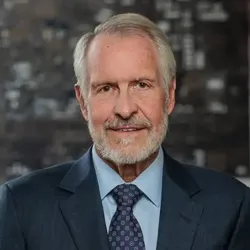
Gerald W. Grandey — Former President and CEO of Cameco Corporation; Uranium Industry Leader and Contributor to the HEU Agreement
For clarity, this transcript includes minor edits made by Gerald W. Grandey and footnotes provided by Columbia University, AC4 research institute.
Andrea Bartoli
Welcome all. Welcome, Jerry Grandey, welcome Jeff, and Kentaro Shintaku.
Gerald Grandey
Delighted to be here.
Andrea Bartoli
I'm glad that we continue this conversation on Megatons to Megawatts. The Columbia Cooperative Nuclear Disarmament and Sustainability Initiative is delighted to work on this topic, and we definitely think that this interview will be particularly relevant. There is a dimension of the process that is extraordinarily interlinked with Jerry Grandey’s experience and Jeff Hughes is going to be our leader as always, and we are going to learn together.
Jeffrey L. Hughes
Well, thank you again Jerry, for joining us today for this series of interviews we're conducting on the history of what is known as “the HEU Deal,” or interchangeably, the "Megatons to Megawatts” agreement, which for a new listener or reader, is an agreement that the US government and the Russian government signed in 1993 that went to 2013 that rid of the equivalent of over 20,000 nuclear weapons worth of highly enriched uranium from Russian nuclear weapons and diluted it in Russia into fuel suitable to be used in civilian nuclear reactors. That Deal which was completed over 20 years in what turned out to be a very complex set of agreements, producing roughly 10% of the US electricity over that period, without carbon. So while it rid of roughly a third of the Earth's weapons materials, there's still a lot left. And whether or not this is a model that could ever be followed in the future, I guess time will tell.
To say just a few words about Jerry (there will be a more detailed bio of him posted on the website next to his interview) for high level context, Jerry was born in the United States, in California, he became a geophysics-engineer at the Colorado School of Mines that was followed by service in the military in the tumultuous 1960s for a couple of years. He then got his law degree at Northwestern and he had forays into the nuclear area, dealing with reactors. I'll let him speak to that. But then he got into the US uranium industry, before going from there to become the Senior Vice President at Cameco in the 1990s dealing with some of the most difficult challenges for the HEU deal in that period, and then becoming the CEO and President of Cameco in the 2000s period, helping steer the interrelated agreement, which was running on smoother basis for the balance of the HEU deal.
So with that, I'll just start right into it. Jerry, I don't know if you have anything that you'd like to say about how you got into the uranium business, even before we get into some of the details of the challenges of the uranium market in the United States, as well as the challenges of dealing with surprises like the collapse of the Soviet Union.
Gerald Grandey
You bet. So, thank you. Jeff and Andrea. I’ll start out with a little embellishment. My dad worked on the Manhattan Project in Los Alamos, and he and my mother lived there. In fact, if I do the math right, I was conceived in Los Alamos, and then my parents moved to Long Beach, California where I was born, I became interested in geology, and, after graduating from high school, wanted to leave home. So, Colorado looked attractive: I wanted to engage in skiing, so the Colorado School of Mines was a logical choice near the ski slopes. I obtained a School of Mines degree in geophysical engineering, and then served two years of military duty, principally on the DMZ in South Korea, probably about as hazardous as being in Vietnam. But at any rate, I came back and went to law school. And there's a very interesting intersection. For three years at Northwestern, I was on the GI Bill, but I still had to work to pay for rent and food and whatnot.
So, in my first year of law school, I went to work for a public interest law firm called ”Businessmen and Professionals for the Public Interest,” or BPI,[1] and they were challenging the licensing of nuclear reactors around the Great Lakes. They, also, had been engaged in the Calvert Cliffs decision,[2] which basically established the principle that NEPA[3] applied not just to government projects, but to projects that the government was going to license or approve, which changed the whole field of environmental regulation. My principal mentor at BPI was a gentleman by the name of David Comey.[4] Comey was also a mentor of Tom Cochran.[5] Tom and I never intersected when I was working at BPI, but over the ensuing years, when Tom and I would interact, we would talk about David being a mentor. So, from one perspective, I worked for BPI for the three years while I was in law school, and it was basically opposing the construction of nuclear plants for a number of pretty legitimate reasons back then – principally related to thermal pollution of the Great Lakes. Nobody could answer the key questions, like the design of high-pressure pipes that went under plant control rooms and these kinds of things. So, we had a good time. I graduated and decided to return to Colorado to ski. I landed a job with the largest law firm in Colorado, Holland and Hart. And because of my resource and technical background, they put me in the mining and environmental areas of practice. I had a range of clients from big mining companies – most of whom have since disappeared, like Anaconda, Asarco, etc.[6] – and a number of more entrepreneurial junior mining companies. Coincidentally, a lot of the senior partners at the law firm decided that they were going to go do something else. One, for example, became an editor of the Telluride Times. So, within two years into my practice, I was one of two senior mining lawyers [in the firm]. I found that I enjoyed working with the small clients a lot more than with the big ones, because the small ones would bring me into strategy, development, goal setting, objectives, fundraising; you got the whole perspective of what they needed to be successful. Large clients basically had more discrete issues: a tax issue, a smelter issue, or whatever.
So, at the end of four or five years, I left the law firm and went with a junior mining company called Energy Fuels, which was founded by one of the early pioneers in the uranium industry, back when uranium was purchased only by the US government at a regulated price of $8 a pound. It was a time when independent geologists and explorers were out looking for uranium deposits in the West. The founder, the entrepreneur in this case, of Energy Fuels, Bob Adams, had been a pilot in World War II. So, he would fly his airplane over the Red Desert of Wyoming,[7] with his Geiger counter suspended from the cockpit, record an anomaly, drop bags of flour to mark the location, and then go back and stake his mining claims. He successfully built a company called Western Nuclear that was later purchased by Phelps Dodge.[8]
After the sale of Western Nuclear, Adams started over again. First he started in the coal mining business with a coal mine outside of Steamboat Springs, Colorado. And then, once that was successful – and that's about the time that I joined him as General Counsel – we were doing the first permitting under the Surface Mining Control & Reclamation Act[9], and getting coal leases in the interim, despite President Carter’s moratorium on all federal coal leasing. There were exceptions to the moratorium that we took advantage of. At the same time, we established a sister company called Energy Fuels Nuclear. And the idea was, if you go to southeastern Utah, and you build a mill, the presence of the mill, would rejuvenate many of the mom and pop uranium mines that operated under the AEC (Atomic Energy Commission)[10] buying program back in the 1950s and 1960s that shut down when the US government was no longer buying. So if you built the mill, you'd reactivate those mining operations that would feed the mill, and, then, you were back in the uranium business.
Recall in the mid-1970s, uranium prices began to increase because the commercial nuclear power sector was beginning to take off, and Westinghouse was caught short of supply. They had sold a number of reactors guaranteeing supply, but then, for a lot of reasons, including an international cartel, they didn't have the uranium to deliver. So, uranium prices went from about $6 a pound to $42! We obtained a construction license from the Nuclear Regulatory Commission and the mill was up and running around the end of the decade. An interesting fact, and one relevant to the HUE deal’s evolution, is, at the time, Bob's personal financial advisor, was Oren Benton[11]. I was working for Bob Adams and Benton was a colleague. He had come out of Arthur Anderson,[12] and he was, again, the full-time financial advisor to Bob. So indeed, building the mill, reactivating the mines, all of that worked fine. We ended up discovering some very high quality mines in Arizona. And even though, after Three Mile Island,[13] the uranium price began to decline, we ended up being quite successful. In 1992 Bob Adams passed away from a massive heart attack while in New York. We were about ready to have meetings with our Swiss utility partners who owned 40% of the uranium mining and milling assets that we had accumulated in what was known as “the Four Corners area.”[14] Shortly after [Adams’ death], his senior people, who had been my mentors, decided they'd seen enough of the ups and downs of the uranium industry and departed. They had made their own personal fortunes along with Bob, and, as a consequence, I became president of Energy Fuels at the age of about 36. My remaining Energy Fuels colleagues were about the same age. And Bob's son, John Adams, who had little history in either the coal industry or the uranium industry, took, as part of his share of the inheritance, the company. So, importantly, we had that continuity. And at that time, Benton left and, a few years later, he bought the uranium trading company, Nuexco, from former General Electric people who had founded it. That acquisition will become important a little later. But when Oren Benton left, we discovered that he had “borrowed” some of our Swiss utility partners’ share of uranium inventory. Unbeknownst to anybody, Benton sold the Swiss’s share of uranium to purchase a 40% interest in the Denver Bronco’s on behalf of Bob Adams shortly before Bob died.
All of a sudden, John Adams also owns 40% of the Broncos!. And that was fun. Lots of stories there, which I will skip. So, time goes on, we [at Energy Fuels Nuclear,] become the largest [uranium] producer in the United States. And we keep hearing about uranium deposits in Canada that are – 2% to 20% in grade– which would only mean that, if and when they went into production, their cost of production would be considerably lower [than the current US producers, and thus were], viewed as a threat.
Under Benton’s ownership, NUEXCO, in the mid-1980s, begins working with the Russians on sourcing their “non-military” uranium for sale to western utilities. The market price was declining after the Three Mile Island (TMI) accident, and a number of utilities had uranium inventories they no longer needed because they were no longer going to build previously planned nuclear plants. Nuexco borrowed the excess uranium inventory from the utilities, selling it, for example, at $20 a pound, knowing that it could repay it later with much cheaper Russian uranium, which is exactly what Nuexco did. Obviously, doing that drove the uranium price down even lower, and ultimately ended up prompting the uranium “dumping” case brought against the former Soviet Union.
Now, because the price of uranium was going down, and nuclear was out of favor, and Jane Fonda[15] was having a lot of fun opposing nuclear plants, most of the oil companies were exiting [their uranium investments]. A lot of uranium producers were beginning to put their uranium production on standby, like IMC and Freeport. And being president of Energy Fuels [Nuclear], I became the last man standing in the industry with US operating properties. Since no one else wanted the positions, I became the head of the Uranium Policy Council of the American Mining Congress, and the President of the Uranium Producers of America (UPA). I went on the board of the Uranium Institute[16] in London. So, just by being the last person standing, I found myself in these leadership positions. And of course, the US industry was whining for help, because it couldn’t survive the onslaught of the Russian uranium being brought in by NUEXCO. And Canada had begun to produce uranium at a very low cost, and then, you had other producers outside the US that continued to produce and sell. So, we went to the US government, and begged for some kind of help,
Jeffrey L. Hughes
I was just thinking that this was [initially all] Soviet uranium…
Gerald Grandey
Yes, absolutely.
Jeffrey L. Hughes
And so the case was filed, I think, in October 1991, just shortly before the collapse of the Soviet Union…
Gerald Grandey
The case, actually, in my recollection, started earlier than that. One avenue the US uranium industry had was protection under the Atomic Energy Act which said if the industry is not viable then the US Government could limit the import of foreign source uranium. So, we went to Congress. We argued that that was the case. We went to the agencies. In the process, of all that, I ended up meeting a lot of people in the US Congress and DOE, wearing out a lot of shoe leather, but ultimately, nobody really listened to us even though the DOE did find the US uranium industry non-viable. So, we brought a lawsuit to force the government to act, and we won at the trial court level: mandating the US government limit the import of foreign source uranium. The district court decision was upheld by the appellate court, and the US Government appealed to the Supreme Court. There, we lost nine-zip. Wow.
We, then, faced the negotiation of the Canadian Free Trade Agreement, or, back then, referred to as NAFTA,[17] long before Trump got involved. The US uranium industry wanted to protect the import limitation provision that we thought we were going to prevail on, and have the ability to exclude foreign source uranium, including Canadian, which was beginning to be sold in the US market, as a very significant competitor. Here again, we lobbied hard in Congress, lobbied with the USTR, lobbied with the DOC [Department of Commerce], etc, etc. We aligned ourselves with the farmers union because they too were trying to keep out Canadian products. The last issue settled at the 11th hour on the Canadian Free Trade Agreement, was the uranium issue, and we lost. NAFTA overrode the provision in the Atomic Energy Act, basically saying that Canadian uranium could not be restricted or limited. There were, you know, some commitments in terms of US industry consultation, but there wouldn't be any actions taken by the US government that would hurt Canadian uranium production and imports. This became important later with respect to the HEU Deal.
So, as head of the UPA, the Uranium Producers of America, and seeing the price of uranium continuing to decline because of imports of uranium by NUEXO from the Soviet Union, we initiated the dumping action. There had been one previous successful dumping action against the Soviet Union with respect to fertilizer, or urea, which had been brought by Freeport as a producer of phosphate and urea. Freeport was also a uranium producer as a byproduct of their phosphate deposits, and they urged the UPA to bring a dumping action against the Soviet Union. We hired legal counsel in DC. And the name of the firm, I think, was Aiken Gump. It was Val Slater who had been an associate on the urea dumping case and she led the effort on the uranium case. As we took this forward, we ultimately prevailed – and that restricted uranium imports from the Soviet Union and all of its production centers.
So, that brings us to around 1990-1991. Oren Benton buys Energy Fuels, the company I was President of. NUEXCO is still owned by Benton. Based upon my previous experience with Benton, here's a gentleman you cannot trust. I committed to stay for about a year of transition to make it seamless, and then I'm going to do to something else. I'm going to ski or do whatever. So, by that time the Suspension Agreement[18] resulting from the dumping case had matured enough that in the summer of 1991 Benton wanted me to travel to the Soviet Union and visit all of their uranium production and fuel fabrication sites to help them prove they weren't dumping. Well, it was an opportunity to see a part of the world that I hadn't been to since a “People to People” tour in 1968, so I went, and the visit spanned a two to three week period of time. I did this over two summers – similar trips. I went to every uranium production site in the former Soviet Union, and oftentimes was the first Westerner, or maybe among just a few, that had ever been there. Included were sites in Russia proper, Ukraine, Tajikistan, Kyrgyzstan, Uzbekistan, and Kazakhstan. At each site, I met the leaders of the enterprises producing uranium and received in-depth tours, studies, secret books, production schedules, costs – all of which were under their five-year, meaningless plans. Produce your production quota, we'll send you rubles, and nobody had a clue what it cost to produce the uranium.
Jeffrey L. Hughes
And this is a period when the Soviet economy is collapsing… I mean, there was a coup attempt in August, 1991 and there was desperation to sell, to get hard currency, such as from uranium. And so it was kind of a downward spiral of sales effect on price.
Gerald Grandey
And every place I went, the kombinant wanted to enter into a joint venture so they could sell uranium directly to the West and get out from under the bureaucracy of the Ministry of Atomic Energy, and perhaps the rest of the Soviet Union. We did enter into a joint venture [JV] with one production center over the objection of the Minister of Atomic Energy.
Jeffrey L. Hughes
Wow! They were then called MAPI.
Gerald Grandey
We did the JV with Krasno Kamensk,[19] and the leader was a gentleman who became a very good friend, Stahl Pokrovsky. His name appears in the HEU deal history once in a while. Stahl, of course, means steel, and he was every bit of that. But he wanted this joint venture, and he was the potentate for Siberia, basically, and able to overcome whatever objections the Minister of Atomic Energy had. Of course, it all became meaningless with the collapse of the Soviet Union. But I can remember sitting in the celebration of the joint venture in Moscow, where Pokrovsky was in charge and the Minister was just sitting there. In any event, because of those trips – and repeated visits in 1992 to yet other sites we toured, studied and researched, and there was no way that one could conclude the Soviet production centers were not dumping. But then, they had no idea, and they were being taken advantage of by Benton. He was their sole source of cash – hard currency. And he was investing a lot back into those enterprises, turning them into toothpaste factories, and on and on and on. It was an interesting time.
Jeffrey L. Hughes
In the timeframe we're talking about now, the HEU idea, the op-ed by Tom Neff[20] was in October 1991, and then by early 1992 the historical record now shows that Yeltsin[21] was made aware of the concept, and Velikov accompanied him to the Camp David summit with President Bush 41 in February, at which the rough concept of HEU sales, or plutonium sales, came up. And [Secretary] Baker followed up on that quickly, and a team was initiated to start talking with the Russians over the first half of 1992.
Jerry, I'm curious, when was the first time that you were made aware of the HEU deal concept? Did you hear anything about that in your visits over that period in Russia? Did that start to affect some of the background music for uranium sales and cooperation going forward? It was a long, long time ago, I recognize…
Gerald Grandey
I'll try to remember… But no, Jeff, there was really no hint of that in the 1991-1992 visits I had [to the USSR]. There were rumors in the industry in 1992 that something like [the HEU Deal] was going to be coming. There were always rumors. But as we've already discussed, the industry, particularly in the US, had already been completely pummeled by the import of or the dumping of the “civilian” Russian or Soviet material. So, okay, there's going to be more for another 10 to 20 years: We're already dead. There was always that [perspective] in the background. And then probably in 1992 – but again – it was just from an industry observer perspective: Okay, something's going on. Maybe there's going to be [even] more Soviet material or Russian material… Is there really any difference, you know, is there some confusion about what was going on? We have the Suspension Agreement. How does that play into all this? Maybe there's protection there. Maybe we have to reinforce it. But now remember, Energy Fuels is owned by Benton or NUEXO – actually by Benton – and I had to resign my position as President of the UPA because of the conflict of interest between a producer of uranium and a trader of the commodity.
So now, as an emissary of Benton, I’m trying to figure out, is there really [Russian] dumping or not? And is there any defense, and can we work out a deal with the members of the UPA or the US producers, that gives the Russians a little bit more room in the market, but also protects US producers? But the UPA had already won with the Suspension Agreement. There was no interest in compromising with Benton or NUEXCO, so they basically told Benton to pound sand.
The important fact coming out of all of my trips to the Soviet Union, and meeting all of these leaders in the various production sites, was I would then return to Moscow and brief the senior leadership in the Ministry of Atomic Energy, or back then, what was MAPI on the economics of their uranium production. So, I ended up meeting the minister of the time, also [[Mckerin][ Vinagrodov and [[Titchkov,[[ and many people that were more on the commercial side. I did not, at that time, meet Mikhailov.
As a result of being the former head of the UPA, and involved in the negotiations on the Canadian Free Trade Agreement, and because of my trips to Moscow, etc., I ended up with contacts in the US government, State, DOE, Commerce, and the Soviet Union. Of course, the Soviet Union was unraveling in the 1992 period of time. And, you know, it unraveled. And then we were dealing with not just Russia, but the CIS republics. And what did the unraveling mean under the Suspension Agreement?.
Jeffrey L. Hughes
As an historical benchmark, it was President Bush in August of 1992, based on earlier spade work assess whether there could be an HEU deal, and what would it begin to look like, that President Bush announced that the Department of Energy would be seeking to arrange a contract over the following year to buy some of their HEU. The amount was unspecified, but that was sort of out there publicly. And soon became enmeshed with compensating Ukraine for their HEU and getting their weapons out. So that was a whole another tangle to be sorted out. So it wasn't until February 1993 that the deal that had been worked on over 1992 came to fruition, and was signed by the new minister of MINATOM, Mikhailov, as well as his counterpart, General Burns….
I'll pause there and ask you to ponder: Well, what were you going to say to Congress in that same 1992 period, when they passed legislation seeking to privatize the US enrichment capability, and create the US Enrichment Corporation (USEC) – a government corporation to be followed perhaps by privatization – as well as the specific mention, the HEU agreement, as a possibility. And so there was some sense [that the legislation] intended to marry up the future US enrichment capability with the HEU deal [in a way that was compatible]. I believe the idea was to allow the imports of Russian uranium, pursuant to the HEU deal, but then keep up some of the Suspension Agreement walls around other civilian uranium commerce…
Gerald Grandey
Exactly, and all of those elements were at play for a number of years, as you well know… the uncertainty of just how broad the Suspension Agreement was, needed to be clarified. Did it include enriched uranium or not, or just uranium itself? And what about uranium conversion? And what is the role of DOE, and what's the future of the US enrichment plants, and ultimately, what happens if and when USEC becomes an independent entity a little bit later? What are the [the obligations of] that entity? How is its behavior going to affect the uranium market, etcetera, etcetera?
Jeffrey L. Hughes
So USEC having commercial incentives, not simply federal government incentives, [raised questions] for you…
Gerald Grandey
So, back to the timeline. I leave Energy Fuels and Benton behind. I spend a bit of time skiing, but then I'm recruited by Cameco to come to Saskatchewan – I barely knew where it was – to be the Senior VP Marketing and Corporate Development. After consulting with my wife and family, we thought it would be a great adventure – not realizing that in the wintertime, it's 30 and 40 degrees below zero Celsius – good training for trips to Russia! I started with Cameco in January 1993, and it wasn't long into that new role that the concern over the potential HEU deal was elevated among the industry. And of course, the conversation that we were engaged in at Cameco focused on uranium and conversion from HEU and how much of a threat to the market it presented, and how much of a threat to the business and our viability more generally. So, yes, USEC’s commercial incentives and market discipline were concerning.
At Cameco we were then producing uranium at a pretty low cost out of two mines. But we were getting ready to invest in two more mines that contained extraordinarily high-grade uranium deposits, but which were much more difficult to mine. And so we had the future to worry about – our ability to make these investments to bring on additional production – which both the province and Canada were very interested in because it was Canada's level of production and involvement in the world market that gave Canada a seat at the international table when nuclear matters were being discussed. Canada had forgotten building enrichment capability on nonproliferation grounds. But, you know, they had participated in the Manhattan Project, and they had supplied uranium to the US in the 1950s from Canadian sources for US military purposes. So Canada’s hands were not completely “clean” …..
Jeffrey L. Hughes
Deriving from a period when uranium was so scarce, such a controlled kind of weapons-usable material, as in the competition between the US and Germany and so forth…
Gerald Grandey
Soon, I found out that Tom Neff[22] had been a consultant to Cameco. I knew Tom, though not well, from his attendance at various seminars or symposia over the years. In my tenure at Energy Fuels, and with the UPA, I never engaged Tom in any official capacity, but, when I joined Cameco, he was already a consultant on the uranium market. I think he consulted with other uranium companies as well,
So, I very quickly, in January of 1993, began to talk with Tom about the HEU deal and what it meant potentially for the market. And Tom's great concern was that nobody really understood how the deal could be implemented. How is all this uranium going to be absorbed by the market - the enrichment, the conversion, and the uranium. How's all that going to be absorbed in the market and still meet Russia's expectations to get paid billions of dollars for selling their national patrimony? And Tom was noodling on how that could be orchestrated. And he and I chatted probably three times a week as things evolved, about the dynamics, the changing positions, the overtures, the consternation within the US government. And these conversations went on for several years, though there were periods when it just went quiet.
Many people were advancing ideas in discussions about what the deal meant for the Suspension Agreement. What efforts were underway to change [[Deputy Assistant Secretary of Commerce] Spetrini’s[23] mind about the breadth of the Suspension Agreement? What was the Russians’ reaction to allegedly being hoodwinked on not being paid for the uranium component, while expecting that they would get paid? Would they get paid only when the uranium component got used or sold? How many US enrichment plants were going to be sacrificed? Was “over feeding” [of the enrichment plants] possible; wasn't that even more economic [due to the resulting electricity savings at the plants] compared to purchasing the Russian enrichment component by DOE? Was it even economic to operate the enrichment plants? All of these questions were extant for the first few years after the deal was announced.
And so, Tom encouraged us to get involved with the Russians immediately, or as quickly as we could, to begin talking to them about how Cameco could help, at least, with respect to the feed and conversion components, Could the Russians come into the market without having the global uranium producing industry completely opposed, and doing everything they possibly could to block the implementation of the HEU deal, while at the same time, meeting Russian expectations that they would get paid for the uranium and conversion components of the HEU material. And, of course, there were issues about contamination [of the Russian HEU from weapons]: could the blended down material actually be sold to utilities for fuel fabrication? Or did it have too much uranium-232, or too much uranium-236? Could Cameco help meet the specification by blending with uranium concentrates from our own inventory? We explored all of this in great detail.
Jeffrey L. Hughes
Do you still have some of your memos from Tom in a file folder?
Gerald Grandey
You know, I don't have too many memos. I've got copious notes. I made it a practice during most conversations with others, of just writing down what people were saying. Now, you know, not 100% foolproof. Tom did not produce [many memos for me], which, now, would be residing at Cameco. I'm sure, over time, there were a number of analyses, memos, and drafts of things that he was going to send to the State Department, Energy, or to the Russians about, you know – here are some possibilities – trying to run it by us. Because Tom, I think, properly viewed Cameco as the only western producer – outside of government owned ones like, French owned, Cogema –that had the financial resources to meaningfully invest in a transaction with respect to the HEU deal. And, at the time, the thought was, well, somebody's going to have to invest in a huge stockpile of feed component that can't be sold too quickly because of the Suspension Agreement, and you're going to have to pay the Russians as it's delivered to them. So you’d have a huge investment in inventory, but not get a return on that investment till much later, when you could begin selling it. And of course, the big issue was, well, who owns the feed component? Does DOE own it? Do the Russians own it? You know, all of those things were at play. But Tom was convinced that a deal could be done that would satisfy the Russians’ interest in getting paid and support the overall HEU Deal, which was his primary objective: to make sure this idea goes on for 20 years and succeeds.
Jeffrey L. Hughes
I think you likened the Russian uranium to an above ground mine, which you had to kind of do a trade off between developing those two new Cameco mine sites you mentioned…
Gerald Grandey
That concept came up very early between Tom and me. I don't know who raised it first, but you know, in effect, the feed component stockpile represented a very high grade mine, and the rest of the industry was going to have to adjust. It all needed to be transparent. Every uranium producer needs to know the market rules so that they can make their own investment decisions, including Cameco and our partners up here in Saskatchewan, the French owned company at the time, was named Cogema. (Every time they came close to bankruptcy, they've gone through name changes, “rebranding” as the French government has recapitalized them, a luxury we didn't have…)
Jeffrey L. Hughes
Well, that's a good point. You mentioned DOE a moment ago. It's the DOE that owned the enrichment facilities until USEC was stood up beginning in 1993 by the legislation, which created this government corporation with a glide path to become private. And so this whole question of ownership [over uranium stockpiles] couldn't have been more complicated than it was in that transition period to work out some of these contractual things.
Gerald Grandey
There were a lot of statements made to other actors in the industry, and indeed, by USEC itself, that USEC was going to be selling this material as best they could. But if you realize that USEC was not a uranium producer and had no interest in the price of [natural] uranium [as compared with enrichment services], they just wanted it to be sold at any price. [24] Hence, any sales by USEC as nothing more than a natural uranium broker/trader were viewed as a huge threat. There were comments from USEC’s leader [William] Timbers, when he appears on the scene, saying he's going to become the biggest uranium trader in the business. Well, you can imagine that it sent shock waves through the global uranium producing industry.
Jeffrey L. Hughes
Another Oren Benton, basically, right? Well, that stems from utilities having to provide the natural uranium to USEC… they become the sort of handler of natural uranium for the purposes of enrichment in the United States.
Gerald Grandey
Yes, yes. And then you’ve got the issue, [the uranium is] delivered by the utilities, so US uranium producers, or producers generally, [in this timeframe, would] no longer need to produce as much because of the existence of the HEU feed component. What they did produce and deliver to USEC for enrichment was notionally swapped with the feed component. Well, then, what is the origin of the feed component? Is it Russian? Is it Canadian? Is it Australian? So it was complicated, and all of that needed to be clarified. So, we had a number of meetings in Moscow. For the very first one, I flew over there, I think in March or maybe June, 1993.
Jeffrey L. Hughes
That makes sense, right after the HEU agreement was signed.
Gerald Grandey
Yes, yes. And I met with Valerie Bogdin, and then with Mikhailov.
Jeffrey L. Hughes
Who was just in the process of being appointed to be the new minister of the MINATOM between February and March.
Gerald Grandey
And, I said, look, here's the threat to the market posed by the HEU deal. And nobody has a clue about how this can get solved, so that you can get your money. And even then, I don't think they realized who would own the feed component and how they were going to get paid? They just knew from prior experience related to the dumping of their “civilian” material that too much material in the market was not good, and that needed to be addressed somehow, and that was partly true for LEU, as well as for uranium conversion.
And of course, we were there to talk about the feed component. We proposed to them a joint venture where we would invest in the pile of feed component as it was being built up in the US or wherever. Well, I don't know how many trips we took to Moscow, or met them in [Washington] DC, or wherever: they nodded and said, we'll get back to you. And then they raised the fact that other competitors were interested as well, and that our terms and price we were willing to pay isn't the magical $28.50 per kilogram that they said they needed[25]… But the price I think at the time was about $13 per pound, which meant you couldn't ever make money unless you believed the price of uranium was going to substantially increase. So, we were haggling over terms. The discussions never got to be that serious, but they kept encouraging us to come back as they entertained overtures from traders and brokers, including NUEXCO, Allied Nuclear Fuel Services, Babcock and Wilcox, Cogema, and others who were trying to address the issue, but basically in a trading or brokerage capacity.
Jeffrey L. Hughes
So I might ask here. I think by this time, the previous Oren Benton transactions and then bankruptcy left him shorting MINATOM by about roughly $100 million.
Gerald Grandey
Yes, Benton goes bankrupt in 1995 or thereabouts, with hundreds of millions of dollars owed to utilities that he had borrowed uranium from, promising to pay them back with much cheaper Russian uranium, which was no longer available to him because of the Suspension Agreement. The result was bankruptcy, leaving utilities in Japan, Europe and the US owed substantial sums. He also stiffed the Russians for the uranium they had delivered to him so he could repay the utilities. The bankruptcy, in total, was about $500 million. When he went bankrupt, he had about 65 different companies purchased with the profits from shorting uranium.
Jeffrey L. Hughes
Wow, that's a whole another story. But I didn't recognize at the time that Benton overlay, and how it might have affected Mikhailov's willingness to trust the commercial operations market, because they had been shortchanged.
Gerald Grandey
And of course, I had been affiliated, in the Russians’ view, with Benton. So that was always in the back of my mind as an issue. Is that previous association somehow jading their view, coloring their view, of my capacity now with Cameco? It would have been understandable.
Jeffrey L. Hughes
And you mentioned their interest in a joint venture, and it reminds me that, going back over the records, Mikhailov wanted to have joint ventures with USEC, as well as apparently with you. And I think part of the problem of realizing that sentiment [for partnership] was that things like the absence of a US Agreement for Nuclear Cooperation with the Soviet Union, and later with Russia, because of our persisting disagreements over nuclear commerce with Iran, so you couldn't even execute the kind of joint venture that he wanted to do at the time. And so I think that probably increased his frustration. But I'm wondering if Mikhailov seems to have arranged matters so that MINATOM would receive the proceeds from the enrichment component of the HEU agreement, while the natural uranium component proceeds would go, eventually, to the finance ministry. Then he could always complain about the natural uranium component. I'm wondering if you think he had a sense and understood that there were US domestic objections and market problems on uranium. So he would get what he could, when he could, most immediately. And then he would use the natural uranium component as a club, but would later even try to capture, perhaps, the revenue from that part of the deal as well?
Gerald Grandey
You're triggering a recollection, because Tom and I talked about that a number of times. Did Mikhailov have the authority [to make decisions on uranium,] which was an issue in Russia, and who is entitled to the value of the feed component? And I think he assumed, Yes, the Ministry would get the value of the enrichment component. But who in Russia was going to get the value of the feed component? And that had to be worked on by Mikhailov over a period of time. Ultimately, [I understood ]from Tom, it got sorted out. I’m not quite sure I remember, but I think it was the Ministry of Finance that ultimately was entitled to the revenue from the feed component
Jeffrey L. Hughes
That jives with my recollection around 1997…
Gerald Grandey
Perhaps, well, my recollection is that the resolution in Russia, and maybe it wasn't final, would have occurred sometime in 1994, or Mikhailov gets the authority in writing, and then he's sorted out his internal fights about who gets the value of the feed component? And maybe that got undone later.
Jeffrey L. Hughes
And I think you're right, there was a decree in 1994 that tried to write down some of these rules of the road. I believe it was also based on the premise of their own internal document of full compensation, which they would call the original agreement, from the US, even though they would sign an implementing contract in January 1994 that kind of split the components and gave USEC the freedom of action to decide when to compensate them on the natural uranium component – potentially when used, or, you said earlier, when used or sold – but certainly by the end of the agreement, but that could be 20 years.
Gerald Grandey
Those were the magic words that kept getting thrown back to the Russians. The uncertainty about the feed component was driving Tom crazy, and was elevated because he did not trust Nick Timbers or the motivations of the to be privatized USEC.
Jeffrey L. Hughes
Say, did you remember when you first met Phil Sewell,[26] who was threaded throughout this agreement, as you are, from the commercial side, from DOE into USEC.
Gerald Grandey
Phil comes on the scene late 1993, 1994, and he's assigned to the enrichment corporation, USEC, as a representative. Tom's view of Phil – He's a little bit kinder to Phil than he was to Timbers, but he viewed Phil as basically just doing the bidding of USEC and Nick Timbers.
Jeffrey L. Hughes
A note that Phil was actually part of the DOE team that engaged with the Russians in the early part of 1992. So he was a Deputy Assistant Secretary in DOE and then made the jump over to USEC, as you say, in the beginning of 1993 when USEC was stood up. So it was that familiarity with the actors in Russia and the DOE complex that then followed him to USEC.
Gerald Grandey
So, speaking of Phil, I was traveling to Moscow once every three months in the early part of [the emergence of the Deal], and less frequently later, every six months. But almost every time I was in Moscow, there was Phil! We both stayed at the Penta hotel, and, when our paths crossed, we'd say, Hi. Or, likewise, going into MINATOM, the building, the Ministry. Oh, Phil's exiting, or I'm exiting - Hi, Phil, making any progress? And then it became [[Yves Coupon]] with Cogema, the French company, Hi. Are you getting anywhere talking to the Russians?
So, you know, back to the first couple of years [as the nascent deal emerged], Tom and I were talking three times a week, Saturday, Sundays, about what is transpiring and all the confusion, what needs to be done, how we should approach it. And then sometime in 1993, and you're gonna have to help me here, maybe 1994, the Suspension Agreement was modified to bring in the matching [uranium sales] program to help quiet down the US producers who were still suffering from low prices. And, I think the US government was also concerned about, will there be any US uranium production at all? We’ve got to throw them a lifeline. The US Government designed a matching sales program that said, for every pound of Russian material coming into the US,, if a US producer had a delivery contract with a utility, the producer could purchase the low cost Russian uranium and match it with its own production increasing its sales margin Obviously, that riled, Canada and every other producing country, Namibia, South Africa, Australia, etc.. Were you at DOE at the time? Because, if you were, they probably all came to visit you.
Jeffrey L. Hughes
Yes, I was at DOE, beginning late 1993 – early 1994, transitioning from the State Department.
Gerald Grandey
Everybody was going to the US to whine about this matching program as being unfairly preferential. But nobody except Canada had a leg to stand on, because Canada had NAFTA. I haven't gone back to look at it, but representations were made to Canada, which had negotiated free access to the US market for Canadian uranium producers, that the US wouldn't take any actions to diminish or hurt that access. And of course, the matching program did exactly that; it gave US material preferential treatment through matching sales over Canadian uranium that could not be matched. Cameco began to work the issue diplomatically by briefing the Canadian government about how the matching program violated NAFTA.
Jeffrey L. Hughes
My recollection is that the price would be matched only if it hit a certain price target. And then that tended not to happen. So the proposed fix didn't, even from the US standpoint. And then that led to another effort to address this issue by Domenici[27], if I recall, in legislation around 1995, and that's the one that awarded ownership to Russia of uranium at USEC, which had consequences, and it allowed an increasing scale of [natural uranium] sales over time, over 10-20, years, that I think, increasing by 2 million pounds or something per year. But it was this awarding title to Russia, upon deliveries, upon payment to USEC [for enrichment] in St Petersburg, automatically created Russian uranium in the United States at USEC, their feed component, which was became consequential for trying to keep the HEU agreement on track, because it really still couldn't be sold into the market, nor could it yet be sent back to Russia. I think Mikhailov called it orphan uranium. And so that was a challenge in and of itself. And then USEC privatization, which actually did occur in July 1998, that had consequences in terms of revelations about their [natural uranium] inventory, which I'll leave to your recollection, which must have been more shocking.
Gerald Grandey
Yes, so you're right. I think it was 1995. And again, Tom [Neff] and I were talking about all of these issues, including questions about ownership. And you're absolutely correct, the Russians were under the impression that the feed component could not be returned to Russia, and so we were picking up on the idea that, for the uranium market, you had to make the sale of feed component look like a new mine coming into production. And we needed to resolve the issue once and for all of who owned the feed component, and keep it out of USEC’s clutches, because they wanted to become the world's biggest trader and broker with free use of this material, paying for it only when it was used [for overfeeding] or sold. Tom Neff was desperate and then worked with Senator Domenici’s people to advance legislation to clarify those issues and have a quota that made it look like a new mine coming into production.
Jeffrey L. Hughes
Working with Alex Flint[28] and the Domenici staff…
Gerald Grandey
Yes, Alex and Domenici’s staff. And coming back to us [at Cameco]. What should the [permitted uranium] sales schedule be in the legislation? You know, what would a new “mine” look like [from a market perspective]? What would Cameco need to know? How would Cameco react to that transparency in terms of future investments in MacArthur River, Cigar Lake,[29] which were very high grade mines, 20% uranium, unheard of, beginning to be developed and coming into the market?
Jeffrey L. Hughes
I think ultimately you ended up increasing Cameco’s uranium world production from 10% up to like 16 or more percent over your tenure.
Gerald Grandey
So, yes, exactly.
Jeffrey L. Hughes
Against this backdrop, then of this new the1995 legislation, and some challenges between USEC,, MINATOM and their executive agent, TENEX, in agreeing on prices, even for the enrichment component, that led to some interruptions of the whole agreement overall, as well as an effort among Cameco and Cogema, and NUKEM to perhaps come to a deal with Mikhailov on how to market the feed component. I think such negotiations picked up in the 1996, 1997, 1998 period, with some prospect of success until USEC privatization.
Gerald Grandey
Yes, but there's a component here that I pointed out earlier that comes back to the Canadian Free Trade Agreement. One, Canada was unhappy about the matching deal. But more fundamentally, Canada was very concerned about what was going to happen to the feed component under the HEU deal. So, in 1994, there was an overture by Canada to DOC,. USTR, State (DOE was not in that meeting), to talk about the matching program and how it violated NAFTA, and oh, by the way, what are you [the US Government] doing with this HEU feed component that, once again, will destroy the market? And the US response was, we hear you on matching sales. We'll look at its impact. We'll try to make sure Canada is not hurt, (whatever that meant), but we're not authorized to talk about the HEU feed component. In fact, we're not the knowledgeable State Department people about the HEU deal. That conclusion got reported back to me, and also back to Tom, and then, ultimately, we convinced the Canadian government to pursue a complaint under NAFTA about the matching program. But we didn't care that much about the matching program, because, as you pointed out, it didn't look like it was going to work anyway. What we wanted to do was to get the US’s attention on what Cameco could offer vis a vis the HEU agreement and the feed component. And, so, a complaint was filed by Canada.
And then that led to another meeting that I attended in Washington where DOE was engaged, and Jim Timbie[30] from the State was there, and an individual that kept track of US production from DOE, I think, or maybe DOC, I can't remember. But anyway, there was a cast of about five people from the US government. We were with representatives from the Canadian government, and we began to explain the implications of the HEU deal, the feed component in particular, and the enrichment component, as we saw, their pending impact on the market. Number one, enrichment plants in the US were at risk. Two, conversion is at risk. And three, the feed component needs to be managed, as does conversion in a way that looks like a new mine coming in. And we're prepared to work on a solution.
Jeffrey L. Hughes
Was that the first time you met Timbie
Gerald Grandey
Yes.
Jeffrey L. Hughes
Jim had been threaded throughout the whole deal up to this point, so the fact that he was at the meeting suggests the right people were starting to align from the commercial and the government.
Gerald Grandey
Exactly. And, of course, Tom was not in the meeting and not mentioned.
Jeffrey L. Hughes
But Timbie and Neff had been graduate students [in physics at Stanford] together.
Gerald Grandey
Yes, exactly. I mean, Tom said, okay, now you're beginning to get the attention of the right people in the government. And he was ecstatic. Then he knew, now there's an avenue to basically advance the [constructive] role that Cameco could play.
You know, this was back in 1994; ultimately, the Free Trade Agreement complaint was resolved, I think probably after the 1995 Domenici legislation was enacted, because Canada was very supportive of that as a resolution from a commercial perspective, Generally, in free trade agreement complaints, governments trade off one commodity, such as uranium, for some other commodity, like eggs or bacon or something. And we said, that's not going to work; we need a commercial solution tied to the uranium market. So the enactment of the Domenici legislation, I think, was the solution to the Free Trade Agreement complaint.
And by this point in time, we [at Cameco] were interacting with State, as Tom was as well, on getting people creative about how do you solve this, and what we all needed to do. We then knew that the Russians owned the uranium,[31] and we knew that it was going to come into the US according to this quota, and we didn't have to argue about the breadth of the Suspension Agreement any longer. There was another important thing – sorry, I just keep going back and forth – but there was another important decision made before the legislation by Spetrini and the DOC, because somebody in the US government had really pissed him off about the Suspension Agreement. I can't [recall the exact details that] Neff related, and I’d have to go back into my notes, but Tom came back from a meeting with a very aggressive Spetrini who, according to Tom, said the Suspension Agreement is the Suspension Agreement. It isn't going to be altered. It's not going to be circumvented, and LEU from Russian HEU is subject to it. And whether that was a [formal] DOC position or not, that was a big and uncertain issue. Was the LEU from Russia [in the HEU Deal] subject at all to the Suspension Agreement? And that had to be clarified. And Tom was adamant that it needed to be [subject to the Suspension Agreement], or otherwise, the Deal falls apart because all this material comes in to the market not subject to the Suspension Agreement, and the Russians never get paid what they expect, as the uranium market gets destroyed. So, somewhere along the way, that decision by DOC was absolutely crucial to the ultimate design of the feed component deal, as was the Domenici legislation on the ownership issue, and Mikhailov ultimately getting permission to take some [of the feed component] back to Russia, if need be. The return to Russia issue got worked out later. All these components had to get fixed, and Tom's hand was in all of it.
Jeffrey L. Hughes
Your comments remind me just of how complicated all this was… to even get a kind of a baseline of understanding. You're having to deal with the Department of Commerce, State, USTR, DOE, and the other commercial parties. I could imagine whoever agitated Joe Spetrini, who was the Deputy Assistant Secretary of Commerce for these uranium issues and others… It may have been someone in the US Non-Proliferation realm that was worried about nuclear security in Russia – that we need to get them money, you know, [to prevent loose nukes,] without the detailed understanding of all these sensitive domestic uranium market issues and constituencies and so forth. So there's a lot of room for misunderstanding, even within the government trying to coordinate amongst itself, let alone to understand the commercial, indeed the esoteric commercial aspects, of all this.
Gerald Grandey
Yes, you would know better than me, but all the reports I got from the industry and people in DOC was that Spetrini was under intense pressure, for a variety of reasons, to relax, to change, to amend the Suspension Agreement. He's also under pressure from Russia… but then from the CIS states after the dissolution of the Soviet Union. Were the newly independent countries going to get included in the matching deal as well or not? What about their uranium production and competition with the HEU material, since these restrictions need to be lifted, because now they're also market economies. So yes, in some respects, I felt sorry for him, [amidst all these pressures].
Jeffrey L. Hughes
So that's the backdrop on NAFTA being solved by the Domenci legislation. There your involvement stepped up another notch, in trying to come to an agreement with TENEX and MINATOM on the feed component.
Gerald Grandey
And there were meetings in 1994, 1995, where Tom and I actually went to meetings with the Russians together. And, we tried to persuade them that a joint venture or some similar construct would work, and we were quite flexible about what needed to be done to address their concerns about getting paid for the feed component. So, I went to at least one meeting in Moscow, one meeting in DC [in the 1995 period] with the Russians. I think I had met with Alex Flint on Domenici staff. But somewhere in the 1995 period of time, as I was going in and out of MINATOM, seeing the French also going in out of MINATOM, and because Cogema was a partner of ours in the mining and milling operations in Canada, it dawned on me that, look, we got all kinds of people competing for this feed component material. It's unlikely anybody's ever going to make a lot of money on this. But we need to get it stabilized. We need to get it controlled. If there's ever a hope that the market will recover even enough to cover our uranium production costs, let's invite Cogema to be a partner in the discussions with the Russians about the feed component.
So I went to my boss, who dislikes Cogema, and said; this is what we're going to do,, and, after some reflection, he agreed. So, then I went to Yves Coupon at Cogema, and said: Let's create a partnership, and we will stop this nonsense. Instead of MINATOM having us compete against one another, we'll present a united front. And, together, financially, we'll be able to handle any investment that needs to be done to make the HUE deal work. And they readily agreed.
By then, Fletch[32] was my translator. Fletcher had worked for me at Energy Fuels, and then he became independent, or was working for Oren Benton. Previously, I had another translator, by the name of Sergei Breus, and, all the while this was going on, I was negotiating with Kazakhstan to obtain an interest in the world's biggest uranium ore body, like a billion pounds of uranium. So, I sent Sergei down there and hired Fletch to be the interpreter. There's so much in my notes that are intertwined between worrying about Kazakhstan's ability to sell and entering into a joint venture with them, and the meaning of how the Suspension Agreements affects Kazakhstan anyway, working on all these at the same time.
So, we invite Cogema to partner with us: they agree. Then the issue was, Okay, so who speaks for the partnership? And you know how the French are, it was going to be their show. But after the first meeting, Fletch became the interpreter for everybody, and Cameco took the lead. But of course, each company had their cast of five people. In one meeting, in particular, in Moscow, and it was the meeting where we advised the ministry and TENEX that Cogema and Cameco were now partners, the Russian unhappiness was evident.
We were getting nowhere with our negotiations. It was Evgeny Egorov[33] who was the principal negotiator along with the TENEX people, and Egorov was always unreasonable about his price expectations and ignored lots of issues such as where you could sell [the uranium] under the Suspension Agreement, and its impact, and how much risk the companies needed to take. This would be after several meetings that just came and went, where we had folded our papers and walked out because it was just so frustrating. And the pattern was, the Ministry would call us up in our hotel room, and say please come back, or ask us to come back a few months later. So, in one particular meeting with Yves Coupon sitting next to me, and the unreasonable demands from Egorov, I lean over to Yves and I say, fold your papers: we're leaving. He replied: Oh, we can't do that. We can't do that. That would be insulting. I said, Yves, fold your papers- we're leaving. We did, and we walked out. One meeting later, perhaps five months later, we're in a meeting in DC, and again TENEX and Egorov are being unreasonable. Yves leans over to me, he goes “time to fold our papers…” So, Cameco became the lead negotiator, as you know, and basically detailed how the negotiation was going to transpire. And the [consulting] relationship that Cameco had with Neff, was never disclosed to Cogema. They were probably talking to Neff as well, but his name was just never mentioned except to acknowledge his passion for the deal. Okay, everybody knew how instrumental he was as the father of the deal, but now, as the companies’ were trying to implement it, we're focused on our own transaction. In the meantime, I'm still constantly communicating with Neff, because our negotiations are going nowhere. And now the German trading company, NUKEM, appeared as a competitor. Being a trader/broker- that's the worst of all possible worlds. Then, NUKEM got married with Shustorovich,[34] representing a competing deal and making all kinds of promises to MINATOM and to TENEX about what they could do in terms of raising money, and selling the feed component. And you know, God knows what role Shustorovich actually had in the competing proposed transaction. There are lots of ideas about that, but we saw absolutely no reason why he needed to be in the picture. There were also demands from Mikhailov to interject Sushterovich as an agent to assist the parties in any deal on the feed component. Again, the western companies saw no reason and only risk in having an agent involved.
Jeffrey L. Hughes
A brief comment here. One thing that became more clear to me, after looking back in history, was how contorted Moscow itself was in competition amongst the oligarchs. When set against the backdrop of the Cold War, you think: the Soviet Union knows how to act as a state in its own interest. But I think some of what Mikhailov was maneuvering about wasn't simply as it was portrayed at the time in various press pieces, that he was out looking out for his own economic interest. I think he was trying to protect MINATOM against the predations of the oligarchs and their banks… [in a state that could no longer muster a clear national interest].
Gerald Grandey
All the banks, Alpha bank,[35] and Lebedev,[36] and on, and on, and on…And, you know, we were quite aware – and TENEX was quite honest about all of these machinations going on in Russia – about [questions over] who's going to control the revenue stream, where is it going to end up? And, of course, Mikhailov is scared to death, and trying to maneuver, so that the HEU revenue goes to MINATOM, right. It's supposed to support his scientists and industries. But that was a big, big issue. Yes, absolutely.
Jeffrey L. Hughes
So the irony was that the enrichment component that Mikhailov had kind of a lock on its deliveries to the US, were paced by the ability to sell that orphan uranium created in the US. Because of the [Russian] customs constraints, you couldn't ship out the HEU, the enrichment product, without somehow dealing with the feed uranium component.[37] As a result, the whole deal started to buck and stop and start again with an effort to resolve the feed component, which remained difficult and then would soon even get harder after USEC privatization.
Gerald Grandey
Yes. So, we continued to meet with the Russians. But then, as you point out, that prompts a whole new chapter. USEC is privatized, and now you get a revelation that they ended up with lots more uranium of their own [than previously understood,] some 40 million pounds…, I think that's right, equivalent of ….
Jeffrey L. Hughes
I think that's right, that amount revealed in their [July 1998] IPO S-1 filing [to the SEC].[38]
Gerald Grandey
Yes, which was a shock to the industry. Well now you have another source of uranium, in competition with producers, but also in competition with the HEU feed component as well.
Jeffrey L. Hughes
And if recollection serves, before that the negotiations with your partner companies and TENEX and MINATOM, were beginning to hone in 1998 on an agreed price, while the bottom fell out of the Russian economy under Yeltsin in that same period. And the new prime minister, Kiriyenko,[39] approved this uranium price that you hoped would go forward with TENEX just prior to the USEC IPO revelations, which you mentioned. And so then you've got this approved benchmark that MINATOM and TENEX says is okay, but also it makes it more politically to move off of that down the road, so you can't adjust with market conditions. And so then we're all in even more of a corner.
Gerald Grandey
Yeah, and then, the [pending commercial] deal unravels, and Tom's apoplectic. I remember, he sees this as we at Cameco do, as destabilizing and a threat to the overall HEU deal. How are you going to really deal with all this and make it predictable?
Jeffrey L. Hughes
Mikhailov was out by that point. He was out in March 1998 so we got a new MINATOM minister.
Gerald Grandey
Adamov came in…[40]
Jeffrey L. Hughes
With Ryzhov.[41]
Gerald Grandey
With Ryzhov and Vinogradov.[42] I'd known Vinogradov for a decade or longer. Ryzhov was, I think, new to me. I may have met him once before, but Vinogradov was a very interesting guy – always unruffled, but bright as hell. But you know, before the change in Ministers, we had to address the Shustorovich engagement. We were saying to everybody, we don't see any reason why Cameco and Cogema would need an agent in the middle of this deal. And it would have been Shusterovish and GNSS,[43] or later It was to be Shustorovich and GNSS and NUKEM in combination. There was absolutely no reason why we needed an agent. And then the concern was payments for the feed component: where were they going to go? We needed assurance that they're going to the intended entity, and for the intended purpose, which perfectly aligns our interest with MINATOM. So ultimately, for whatever reason, Mikhailov gets shuffled aside, and Adamov comes in [in March 1998]. And Adamov soon refuses to meet with Cameco and Cogema. And why? Not sure, other than the departure of his predecessor may have had something to do with it in terms of being careful who you deal with.
Jeffrey L. Hughes
What I learned well at the time, and reminded myself more recently, was from a Neff memo he sent shortly after Adamov was appointed. Neff was able to meet with Ryzhov and learned, as Tom reported this back to me and others in the US government, that he learned that Ryzhov was charged by Adamov to review what all this commercial competition was about and whether there could be a return to the “original deal” or not. And so Tom had to walk them through the history, and why the US government couldn't just buy [the feed component] out of their budget and so on. And so I think part of the explanation for Adamov not meeting with you at the outset was this review period, and he was kind of stepping back and putting the monkey on Ryzhov’s back to sort this out for a while.
Gerald Grandey
That may be true. But there was a trip by the Canadian Minister of Natural Resources, and that'd be Ralph Goodale,[44] who's a Saskatchewan person whom you might know quite well, and [Secretary of Energy ]Bill Richardson.[45] It was a joint trip to Moscow. Canada, and presumably Richardson, were fully briefed on the status of all of this. I know that Goodale was. And they both met with Adamov. And shortly after that meeting, we reconnected, re- engaged, with Adamov and TENEX. According to Goodale it took some assurances that Cameco was okay to deal with as a Canadian company and was serious about trying to solve this feed component issue. What Richardson said? I have no idea.
Jeffrey L. Hughes
I think perhaps by that point, had appointed his one and only Under Secretary, Ernie Moniz,[46] to be the point person to work with Adamov to try to reconcile all of this. I think it was September 1998 that Yeltsin complained to Clinton, at a summit in Moscow, that the HEU agreement wasn't working and he might have to pull out. And that led to a charge to Richardson and Adamov to fix this, to get it done.
Gerald Grandey
Yes… Again, the sequence of events here is escaping me, but at some point in time, I think, after the meeting of Richardson, Adamov and Goodale, Shustorovich was still in the picture. And there was a meeting to be held with TENEX in Washington, DC, with Cogema and Cameco. And we kept being told by the Russians that NUKEM was now a competitor, that the German [parent company of NUKEM] was offering a better deal. Tom Neff was reporting all this back to us; and we just couldn't quite understand it. But it was this ceaseless competition the Russians kept trying to interject into this deal with players that talked a good game, pretended they could address the issues, but didn't have the financial wherewithal to do it, just proved to be quite bothersome and time consuming getting in the way of getting something done.
So, I called up Kurt Schreiber,[47] after consultation with Cogema, and said: cut the nonsense, Kurt. I said, why don't you come into the deal for 10 percent, and just get out of the way… And again, nobody believed that the deal was going to be profitable. It's just that we needed to get the market stabilized, predictable, and beyond all of this... nobody could argue with the objective to dismantle 20,000 Russian nuclear warheads. And that was said repeatedly to virtually everybody we talked to. But lots of people [in the market] would say: well, you know, let the HEU deal crater. Just let it die. And, you know, [the deal is all] too complicated, and you know, then you'll go back to a market where there's the overhang, but you're not having to deal with it immediately.
But we knew this deal was going to come and it needed to be done properly, and nobody was going to stand in the way of dismantling the weapons, and ultimately having this material find its way into the market. So, Schreiber agreed, and then there's three Western companies [in unison], but nobody had yet told the Russians that this had transpired. So, soon, we were in a meeting in DC [to advance all this]. Egorov was still a principal, but Schusterovich was the only one authorized to speak. The meeting was in the bowels of the Weston hotel. Cameco had arranged the room, so we arrived well ahead of the meeting. Then down the stairs comes Shustorovich with Gregoriev and TENEX, and I promptly say to Shustorovich: we rented the room, you're not welcome, and you can't come in. So, he hems and haws and he leaves. But afterward, in the room, Egorov and TENEX had no authority to say anything…
Jeffrey L. Hughes
Somewhere in a much later interview, Vinogradov is quoted saying: the HEU Deal was like a fairy tale: The further it went, the darker or more terrifying it got![48]
Gerald Grandey
That's true. In any event, that meeting was completely counterproductive. We outlined the fact, now we had three Western Companies that were prepared to move forward. You [, that is Russia, Minatom, TENEX,] just need to begin to be responsive on the terms of the deal that we've outlined to you. So, then, after that unproductive meeting, Shustorovich disappears, and we no longer need to deal with him; now we're really just talking with TENEX and Ryzhov and Vinogradov.
But then, a series of meetings in Moscow, Paris and DC – and ultimately culminating in the meeting in Paris [in December 1998] – with you and Ernie [Moniz] – where we're hammering out the details of the transaction. You know, the option elements, the stockpiles, the withholding of material from the marketplace – all intending to support the price of uranium, so that the risk is reduced to the Western Companies, and, ultimately, so the Russians will get the value out of the feed component they expect as part of the overall transaction.
You know, the structure of that deal turned out to be a lot different from the notion of a joint venture we had originally proposed. The Companies ended up with options [to buy the uranium], and literally out of that, no commitment to purchase anything. The price of uranium was quite low, and the Russians understood that, and had the understanding that, to the extent the Western Companies didn't buy the uranium, they could return it to a stockpile in Russia. There were to be controls on that, as to what the returned uranium could be used for.
And then there was the prospect of the US government stepping in with a second piece of Domenici legislation[49] that dealt with buying the 1997 and 1998 [backlog of accumulated, unsold Russian uranium in the US] material, subject to, and this is important, the Russians entering into a partnership with commercial partners –, which was code for Cameco and Cogema, and then NUKEM, for the balance of the Deal. And that's when the game was over. You know, again, Tom [Neff] was all over that with Domenici and Alex [Flint]. Once [MINATOM] was put in that box, you're not going to get paid the appropriated $325 million, unless you enter into a partnership. Once that was in law, then basically it was game over. And it was, then, how do we come to the terms of how this is going to work over a 15-20 year period of time? Because duration was always an issue, too. The Russians only wanted a five-year deal. After that, they wanted to market the feed component on their own. That was always a big issue in the early days, too.
Jeffrey L. Hughes
It was surprising to me at the time how long it actually still took to get agreement with that $325 million card. Because, as you mentioned, there were meetings in Washington [in November], ultimately, one in December of 1998 in Paris at which there was a handshake agreement at least on the commercial terms, which still had to embody that in the full final contract by what turned out to be March 1999. But there were still issues about the title to the uranium, and I think you were in the forefront of trying to get maximal legal protections going forward by getting clarity from the Russian Government about who had the authority to buy and sell commercially under this new commercial agreement. More broadly, this new governmental agreement kind of mended the HEU deal overall, by putting together the feed component deal with the enrichment deal.
Gerald Grandey
Well, I think both the US government and the Western Companies needed the decrees, if you will. And literally, Cameco wanted them from the Russian and US governments so that we knew, under all the laws that Cameco needed to pay attention to – Foreign Corrupt Practices Act, the Canadian equivalent, and all of these things – that the money and people we were dealing with had the authority they represented. And I think the US wanted decrees as well. And then, there were parallel pronouncements by the US government [in the March 1999 agreement]. It was understood that every [commercial contract] amendment, of which there were, something like 13, would have the same kind of approval treatment. And, indeed, over the implementation of the commercial agreement, every time the Russians wanted to engage in an amendment, we went back to the Russian government and got a decree. We had to deal with the US stockpile as well, to make sure that was held off the market for 10 years. Again, our intent was on supporting the price of uranium in our interest and in the Russians’ interest; but you had three competitors sitting around the table agreeing with a fourth competitor, i.e. Russia, that we're going to withhold material from the market, and Cogema and Cameco saying among themselves, we will delay the development of the Cigar lake mine so it does not compete with the implementation of the HEU deal, all of which could be considered antitrust violations [absent framing by governmental agreement]. And you'll remember my intervention, maybe at the final hour, when I burst into your final meeting with the Russians, saying this doesn't go anywhere without something from the US government that says all of these “manipulations” of the market, which are in this commercial agreement, they all need to be blessed by the US government, because such a blessing provides immunity under US antitrust law. When you're directed to do so by the US government, then that's a defense.
Jeffrey L. Hughes
And the hoops that the US government was jumping through as to how to get the Russian uranium back [to Russia] that wasn't sold by the companies in the US or into the market, back to Russia in the absence of a 123 agreement for nuclear cooperation.
Gerald Grandey
And after all of that, you guys figured it out. So, here again, the Russians saw some material return to Russia under specific conditions. I think the right to return some feed component was important politically. It was important for down blending HEU and for domestic use. From a market perspective, it was important that anything going back to Russia wouldn't reappear, except through the hands of the Western Companies, which was the agreement and that was positive for the market.
Jeffrey L. Hughes
Do you remember by chance where Primakov[50] was flying to Washington in March 1999 with the decrees, and his plane gets turned around in the middle over the Atlantic, while Adamov is left all alone in Washington? Well, I'll let you pick up the tale from there, because it must have been kind of a shock…
Gerald Grandey
To all of us. A shock to all of us, yeah. So, Primakov was going to come to Washington to sign the deal. We're all there. Cogema, NUKEM, Cameco, State Department, and DOE. The ceremony, I think, originally was going to be at the State Department, but it was moved to DOE for some reason. And Primakov’s plane gets turned around, and the question was, now, what's going to happen? And then, we're told that Adamov has been given the authority to sign. That's my recollection. And so, we engaged in the signing ceremony with Secretary Richardson, Adamov, and the three Western Companies. And the catalyst for the aircraft being turned around was that the US bombed [Yugoslavia].
Jeffrey L. Hughes
Serbia and Kosovo… The US [and NATO] initiated airstrikes, and it was just too politically dicey for Primakov to visit Washington. And so all … it was to be a successor to the Gore-Chernomyrdin Commission[51] meeting, and so all the other ministers were in town for this big meeting. And they all left town, following Primakov; but Adamov was given license to stay. But the operational consequence was that the ceremony you mentioned got accelerated, yet there were still some details in the commercial contract to get copies, and Kuchinov[52] and I were working on some of the final details of the government agreements, and so we were up all night. But there was this recollection by one of the company's representatives, or maybe a Russian one. It was like, in the middle of the night the world's leading uranium companies were running around Washington, DC to try to find a copy machine. Anyway, I didn't know if you had any recollections from that period?
Gerald Grandey
A little bit. I think we sent Fletcher [Newton][53] out to do something like that. And I will say, in those final negotiations where we had the US, we had the Russians, and the three Western Companies, everybody then began to rely on Fletcher; we just cut out the other translators that had been attending because he was, by then, so trusted by the Russians that when they wanted to understand something that was being said, they wouldn't turn to their translator. They'd ask Fletch. And I have to hand it to Fletcher’s demeanor and his capability. It became extraordinary, really, on how much people relied not just on the words but on the conveyed emotion as well. So, you know, when the Russians were getting excited, or I was, that came through in his translation. It wasn't just words, it was the underlying emotion. And I can remember when I was asking for too much in that final negotiation in Paris, Moniz took me to the woodshed and said, Be reasonable. You’ve got enough.
Jeffrey L. Hughes
He said more than that, didn't he? I'd be interested to know what he said.
Gerald Grandey
Yeah, he did, Jeff… he said more than that. The implication was, get it done.
Jeffrey L. Hughes
He never told me exactly what he said, but I got the gist of it.
Gerald Grandey
Well, he said a lot. But the message was abundantly clear. We went back and concluded the negotiations. But in that back and forth, Fletcher was representing and translating the emotions of the Russians and ours, which were escalating, I remember that to this very day. But how important- it wasn't just the words, it was the emotion behind the words.
Jeffrey L. Hughes
Well, it's interesting you say that because we interviewed Fletcher recently, and he noted, when he was first taking Russian in college it didn't resonate that well with him. But then he went to Vermont to a language school at which he met Solzhenitsyn,[54] and he heard him talking, and realized, oh, that's different Russian from what I've been learning. And so, I think then he really got into it, and went over to St Petersburg to study. And so I think that was an important moment for him, and sort of capturing emotion behind the language.
Gerald Grandey
I traveled with Fletcher, you know, to Moscow many, many times. We'd be taking a walk, getting some fresh air. He'd engage one of the street artists or whatever to do portraits with charcoal. And I'd ask, well, where do you think Fletch is from? Or perhaps we're at the flea market in the middle of December or something. Now, they'd think about it and reply, well, he's got a little bit of an accent, maybe Estonia, perhaps Georgia. Never would they guess that he was from Denver, Colorado! So, a remarkable talent.
Jeffrey L. Hughes
Well, I was gonna say, Jerry, we've been going for over two hours, and we, I mean, what we might propose to you to do is come back at a later time to pick it up after March 1999 with perhaps a briefer discussion of how this moved into the to the 2000s and your role there.
Gerald Grandey
Good, I think that's a good suggestion. Yeah, I've taken you on way too many tangents already.
Jeffrey L. Hughes
No, no, no, they're very good!
Gerald Grandey
I think that, after 1999, the interview will go much faster. But let's work out the timing for that at a later time.
Andrea Bartoli
I think that it is important for us to have what you describe as tangents, which perhaps are not right? This observation about Fletcher and emotions, for example, for those who are working on conflict resolution negotiations, are very important. I picked up on a few things that you said, for example, about this overall overarching awareness that the 20,000 bombs were actually present all along, that there was this very, very serious issue of an agreement that is not just a piece of paper that you signed, but defines an enormous work that goes into it to make sure that the agreement stays together, is conceived correctly, and remains viable. So we'll definitely have more to talk about. But what Jeff is suggesting is wise; it's good to close for today and then reengage subsequently.
Jeffrey L. Hughes
I might point out that some of the details you went through at the beginning, they actually continued to play a subtle role that we didn't have time to get into, such as the GNSS enterprise that you mentioned, which was sort of an additional commercial arm to TENEX which had been established years before. The struggle over the ownership of those shares by Pleiades was part of the ongoing story going forward for control of GNSS under Adamov and other problems that arose from that. So those details get threaded through the whole Deal.
Gerald Grandey
Yes, not to mention the arrest of Mikerin, who was the son of, again, a very good friend in the Ministry of Atomic Energy, Evgeny Mikerin, his dad. So I knew the dad and I knew the son who ultimately went to jail.
Jeffrey L. Hughes
And some of those were later exonerated too, like Adamov himself, who gets tied back to that tangle.
Gerald Grandey
Fletch and I actually went over and visited Adamov while he was in jail [in Russia]. Did Fletcher mention that?
Jeffrey L. Hughes
No, okay, well, we'll save that as a teaser for going forward.
Gerald Grandey
But [Adamov] became a very good friend, reliable. We didn’t understand why he's incarcerated, but we go to see him.
Jeffrey L. Hughes
I mean, the very quick version is, is that Adamov had circumvented the Russian government [in the early 1990s] to get nuclear Safety payments from DOE to go to his NIKIET lab before he was minister, which is very hard to explain later in Russia, to defend, even though he was exonerated in a US court. And I believe that later in the struggle to keep control for MINATOM over GNSS they had to buy that [legacy Benton bankruptcy] stock, and that, again, could all be made to look suspicious. And yeah, anyway, he was ultimately exonerated by Russian courts, and more recently, was given a medal by Putin, and he's back working on his fast reactors for NIKIET. So, yeah, it's a complicated
Gerald Grandey
Really, oh, I didn't know that. and a strange story. Do you think you'll ever be able to interview some of the Russian actors on this?
Andrea Bartoli
We were actually exploring this. I think it would be also a sign, in many ways, that the situation is moving in the right direction, right one of the things that is quite surprising in these interviews that is very, very clear that the level of exchange and relationship in the 70s, 80s, and 90s between Soviet Union and the US was actually better than now. It's a very interesting complexity. So we have some contact in the US, and of course, Jeff has contact in Russia too. Ideally, it would be good. But for the moment, we are focusing on the American side.
Jeffrey L. Hughes
Well again, Jerry, thank you so much. Your generosity in making your time available, and I'm sure as you reflect more, perhaps we would come back for an interview sometime after the June 2026 workshop, depending on your attendance there or not. But there'll be more exposure to more information [through our interviews], and you may have more memories that may click, just by refreshing the material you were recalling things today in real time.
Gerald Grandey
Very good. I look forward to it.
[1] Businessmen for the Public Interest (BPI)
Later renamed Business and Professional People for the Public Interest, BPI is a nonprofit organization focused on public interest law and policy, particularly in housing, environmental protection, and social justice. (https://impactforequity.org/who-we-are/)
[2] Calvert Cliffs Coordinating Committee, Inc. v. Atomic Energy Commission
A landmark 1971 court decision that required federal agencies to comply strictly with environmental review requirements under NEPA, significantly strengthening environmental regulation in the United States.
[3] National Environmental Policy Act (NEPA)
A 1970 US law requiring federal agencies to assess the environmental impacts of major projects before proceeding, establishing a foundational framework for environmental protection.
[4] David D. Comey (1934–1979)
An environmental lawyer and activist involved in major environmental cases; he died in 1979 at the age of 44 in a car accident.
[5] Thomas C. Cochran
A nuclear physicist and policy expert known for his work on nuclear arms control and his role in the Highly Enriched Uranium (HEU) agreement. See Thomas C. Cochran, “Thomas C. Cochran Oral History Interview,” Academic Commons Columbia University, Columbia University, https://ac4.climate.columbia.edu/content/thomas-c-cochran-oral-history.
[6] Anaconda Company / ASARCO
Major US mining and metallurgical companies involved in copper and uranium production; both played significant roles in the development of the American mining industry.
[7] Red Desert (Wyoming)
A high-altitude desert region in Wyoming known for its unique ecosystems and history of energy development, including mining and extraction.
[8] Phelps Dodge Corporation
A major American mining company historically involved in copper and other mineral extraction, later acquired by Freeport-McMoRan.
[9] Surface Mining Control and Reclamation Act of 1977 (SMCRA)
A U.S. law regulating environmental effects of coal mining and requiring land restoration after mining operations.
[10] Atomic Energy Act (US)
A foundational law governing nuclear energy and materials in the United States, including provisions affecting uranium imports.
[11] Oren Benton (1934–2006)
American businessman and uranium trader active in the late 20th century; former partner at Arthur Andersen and founder of ventures including NUEXCO and joint uranium enterprises with Soviet entities.
[12] Arthur Andersen
A major global accounting and consulting firm (now defunct following the Enron scandal) that once provided auditing, tax, and advisory services.
[13] Three Mile Island Accident
A 1979 nuclear accident in Pennsylvania that significantly reduced public support for nuclear energy in the United States.
[14] Four Corners area
A region in the southwestern United States where the borders of Arizona, New Mexico, Utah, and Colorado meet; historically significant for uranium mining and energy development, particularly during the mid-20th century nuclear boom.
[15] Jane Fonda
An American actress and activist who became a prominent public opponent of nuclear power, especially after The China Syndrome and Three Mile Island.
[16] Uranium Institute (now World Nuclear Association)
An international organization representing the nuclear fuel cycle industry and promoting nuclear energy.
[17] Canadian Free Trade Agreement / NAFTA
A trade agreement between the US and Canada (later expanded to include Mexico as NAFTA) that reduced trade barriers and governed cross-border commerce.
[18] Suspension Agreement (Uranium)
A US trade agreement that suspended anti-dumping investigations into uranium imports from former Soviet states while imposing limits and conditions on imports.
[19] Krasnokamensk
A major uranium mining center in Russia, central to Soviet and Russian uranium production.
[20] Thomas L. Neff (1943–2024)
Thomas L. Neff was a physicist at MIT’s Center for International Studies who proposed in an October 1991 op-ed that the USSR convert highly enriched uranium (HEU) from dismantled Russian nuclear warheads into fuel for American power plants.
[21] Boris Yeltsin (1931-2007) First President of the Russian Federation (1992–1999), under whom the HEU Agreement was initiated.
[22] Thomas L. Neff (1943–2024). Thomas L. Neff was a physicist at MIT’s Center for International Studies who proposed in an October 1991 op-ed that the USSR convert highly enriched uranium (HEU) from dismantled Russian nuclear warheads into fuel for American power plants.
[23] [[Joe Spetrini, Deputy Assistant Secretary for Policy and Negotiations, Import Administration, International Trade Administration, US Department of Commerce. His responsibilities included acting as a senior official focusing on trade policy and negotiations, such as overseeing administrative reviews of antidumping duty orders. ]]
[24] Utilities wanting nuclear fuel from USEC purchased and supplied to USEC the natural uranium to be enriched for the amount of nuclear fuel they needed for their reactors. In principle, for example, cheaper natural uranium could increase the amount USEC could charge for enrichment without even changing the overall price that utilities had been charged previously.
[25] The US and Russia in May 1993 set out a one page “Basic Principles of the HEU Contract,” which did not have the formal status of the February 1993 HEU agreement, but was signed by Minister Mikhailov and his US counterpart, as the sides worked towards a commercial contract to implement the Deal. One principle agreed was: “Payment to Russia for the natural uranium component when this material is used or sold.” Another was “The price the US will pay for LEU derived from HEU is $780 per kilogram of LEU with an assay of 4.4% U-235.”
The first commercial contract signed in January 1994 between USEC, and TENEX, where 1 kilogram of natural uranium would be compensated at $28.50, and one separated work unit – the measure of the cost of uranium enrichment – at $82.10. This set the backdrop for future negotiations setting diplomatic and contractual agreements against economic and political realities. See Jeffrey L. Hughes, Megatons Into Megawatts: The Deal Eliminating 20,000 Atomic Bombs, (Columbia University Academic Commons, 2025), https://academiccommons.columbia.edu/doi/10.7916/0kyf-he85, 106-109, 155-162.]]
[26] Phil Sewell
A DOE and USEC official involved in implementing the HEU Agreement and coordinating with Russian counterparts.
[27] Pete Domenici (1932-2017)
USS. Senator influential in nuclear policy and legislation affecting the HEU Agreement and uranium markets.
[28] Alex Flint
American policy advisor; former Chief of Staff to Senator Pete Domenici and later associated with the Nuclear Energy Institute and energy policy initiatives.
[29] MacArthur River / Cigar Lake
High-grade uranium mines in northern Saskatchewan, Canada, operated by Cameco; among the world’s largest and richest uranium deposits, with exceptionally high ore concentrations.
[30] James P. Timbie
Physicist and longtime US State Department official, served in positions on nuclear issues from the 1970s to 2016, including deep involvement in the HEU Deal.
[31] That is, Russia by US law was awarded ownership title to the natural uranium component in the US, at USEC enrichment plants, in proportion to the deliveries of Russia enriched uranium (UF6), diluted from weapons HEU, to the much lower level of enrichment suitable for civil nuclear reactors, that USEC picked up in St. Petersburg Russia, and USEC paid for once on transport ship. Thus, the natural uranium utilities had provided to USEC for that amount of enrichment, but that Russia had already provided on its own (both in making HEU, and in diluting it) were provided in kind to Russia. Hence the challenge, how to make that resource remunerative to Russia, consistent with the US-Russia Basic Principles of the HEU Deal, and the realities of the uranium markets.
[32] [[ Fletcher Newton – brief bio FN & reference to AC4 interview link. ]] ]]
[33] Alexey Grigoriev
Senior official at TENEX (Techsnabexport), Russia’s state nuclear export company, and a key negotiator in the US–Russia HEU agreement.
[34] Alexander Shustorovich
Pleiades was a private entity formed in the early 1990s to do business in Russia, headed by Shustorovich, an American citizen born in Russia, that in 1996 proposed to facilitate the sale of Russian uranium from the HEU Deal, including the natural uranium component.
[35] Alpha Bank (Russia)
A major Russian private bank involved in financial competition over control of nuclear-related revenues.
[36] Alexei Y. Lebedev
TENEX deputy general director, circa 1997-1998. His brother, Aleksandr Lebedev, headed the National Reserve Bank, established after 1991which angled to manage the proceeds from the HEU Deal, hoping to succeed Minatom’s longstanding Konversebank.
[37] Russian laws under President Yeltsin that were designed to prevent corruption had unintended impacts on the HEU deal, regarding Russian assets outside of Russia. Thus Minatom/Tenex enrichment product delivered in St. Petersburg created Russian natural uranium, by US law, in Ohio and Kentucky, which were flagged as uncompensated Russian foreign property, which needed to be compensated within a shorter timeframe than procedures, the market, or governmental agreements, had yet navigated. So Russian procedures were front loaded to to stop enrichment commerce, and proceeds, in their own interests, due to the uncertainty, in the US, of dispensing with their natural uranium property.
[38] US Securities and Exchange Commission, Form S-1: Registration Statement Under the Securities Act of 1933, USEC Inc., June 29, 1998, https://content.edgar-online.com/ExternalLink/EDGAR/0000950133-98002445.html.
[39] Sergey V. Kiriyenko
Sergey V. Kiriyenko is a Russian politician who has served as acting Prime Minister of Russia between March-August 1998, head of MINATOM,s successor Rosatom from 2005-2016, and had been First Deputy Chief of Staff of the Presidential Administration of Russia since October 2016.
[40] Yevgeny Adamov
Appointed Minister of Minatom in March 1998, serving from 1998 to 2001, succeeding Viktor Mikhailov. He played a central role in US–Russia nuclear cooperation in the late 1990s, including on the HEU Deal, efforts on plutonium disposition and weapons complex conversion, but was also committed to developing nuclear commerce with Iran.
[41] Mikhail N. Ryzhov
Head of the International Department of Minatom, responsible also for coordinating with the Russian Foreign Ministry when necessary.
[42] Vladimir G. Vinogradov
First Deputy Minister of Minatom in August 1998 appointed by Minister Yevgeny Adamov to oversee uranium issues.
[43] GNSS
A joint venture created by Oren Benton with TENEX (Techsnabexport) in the early 1990s to facilitate uranium trading; based in Switzerland with operations in Washington, DC, and involved in intermediary arrangements for Russian nuclear material sales.
[44] Ralph Goodale
Former Member of Canadian Parliament at the outset of the HEU Deal, becoming Minister of Agriculture in November 1993, as preface to four more Ministries through 2019, and appointment as High Commissioner to the UK, through 2025.
[45] Bill Richardson (1947–2023)
US Secretary of Energy from 1998–2001 under President Clinton; previously US Ambassador to the UN, congressman, and later governor of New Mexico.
[46] Ernest J. Moniz
American physicist, Under Secretary of Energy (1997-2001) and US Secretary of Energy (2013–2017), and was very involved in the HEU Deal, among many other national security, energy, and science issues.
[47] Kurt Schreiber
Kurt Schreiber was a key board member of NUKEM, a nuclear materials company and subsidiary of RWE, a major German energy company founded in 1898.
[48] Vladimir Vinogradov, Interview, “Russian Nuclear Industry Survived With the Help of a HEU-LEU Contract,” RIA News, December 25, 2013 (Эксперт: атомная отрасль России выжила с помощью контракта ВОУ-НОУ, РИА Новости), https://ria.ru/20131225/986406151.html.
[49] Senator Pete Domenici Amendment (1998)
Senator Pete Domenici’s amendment, introduced in October 1998, was incorporated into the FY1999 Omnibus Appropriations Act (Public Law 105-277), enacted on October 21, 1998 (112 Stat. 2681-560). The amendment authorized funding for uranium purchases linked to the U.S.–Russia Highly Enriched Uranium (HEU) Purchase Agreement. It provided: “For an additional amount to purchase natural uranium associated with the 1997 and 1998 deliveries under the United States-Russia HEU Purchase Agreement (hereinafter, ‘the Agreement’), $325,000,000, to remain available until expended…. Provided further, That such uranium is located in the United States at the time of purchase, and shall become part of the inventory of the Department of Energy: Provided further, That such funds shall be available only upon conclusion of a long-term agreement by the Government of the Russian Federation and commercial partners for the sale of uranium to be derived from deliveries scheduled for 1999 and thereafter under the Agreement.”
Source: https://www.govinfo.gov/content/pkg/PLAW-105publ277/pdf/PLAW-105publ277.pdf
[50] Yevgeny Primakov (1929-2015)
Former prime minister of Russia from September 1998 to May 1999. Prior to that he had been Russian foreign minister, head of the KGB, and chairman of the supreme Soviet of the USSR.
[51] Gore–Chernomyrdin Commission
A bilateral U.S.-Russia commission established in the 1990s to promote cooperation in energy, space, and technology, including nuclear disarmament initiatives.
[52] Vladimir Kuchinov
Then Deputy Head of the International Department of Minatom.
[53] Fletcher Newton
Nuclear fuel consultant and former executive at Cameco, Uranium One, and Tenex-USA; see “Fletcher Newton Oral History: Bridging Markets and Megatons: Industry’s Role in the U.S.–Russia HEU Agreement,” Columbia Climate School, https://ac4.climate.columbia.edu/content/fletcher-newton-oral-history.
[54] Aleksandr Solzhenitsyn (1918-2008)
Aleksandr Solzhenitsyn won the 1970 Nobel Prize for literature, based on his works recounting life in the Soviet Union, and particularly repression under Joseph Stalin that resulted in his being sent to the Gulag, and eventual exile from the USSR in 1974, residence in the US in 1976, and ultimately return to Russia in 1994.