
Thomas B. Cochran Oral History
Prequel to Megatons to Megawatts:
The Roots of US-Soviet Nuclear Cooperation
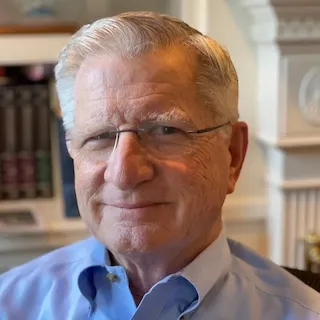
Thomas B. Cochran — Former Senior Scientist and Director of the Nuclear Program at the Natural Resources Defense Council
For clarity, this transcript includes minor edits made by Thomas B. Cochran and footnotes provided by Columbia University, AC4 research institute.
Andrea Bartoli
Welcome, Tom, welcome, Jeff. This is a wonderful opportunity for us to work together. I leave the floor to Jeff, and the oral history project is continuing in a great way.
Jeffrey L. Hughes
Well, good morning. It's January 2026, and we're very appreciative of having Dr. Tom Cochran with us today to reflect on the origins and pre-origins of the HEU Deal, otherwise known as the “Megatons to Megawatts” agreement. Columbia University has undertaken, beginning in June of 2025, an Evaluation Project to further document the history of the deal, and to provide an additional basis to reflect on that two-decade agreement of cooperation that resulted in the permanent elimination of 500 metric tons of highly enriched uranium [HEU] and turned it into nuclear energy without carbon, equivalent to roughly 20,000 Hiroshima bombs.
And Dr. Cochran was very involved in the early cooperative steps with the Soviet Union that provided an important basis for the agreement being able to take place. Dr. Cochran has multiple degrees from Vanderbilt University, with a PhD in physics. He served in the Navy in the 1960s and then proceeded back to his town of birth in the Washington, DC area, and worked for multiple NGOs, including the Natural Resources Defense Council[1] for many years, where he worked with the government and as a constructive critic of the government.
With that preface, noting also that the Columbia University Megatons Evaluation project will be where this interview will be archived, and links provided to his biography and CV, as well as other materials that he chooses to place there. So with that, Tom, thank you again for not only appearing today, but also for coming to the workshop in June of 2025 to kick this project off. So with that, if there's any general statement that you'd like to make at the beginning, that's great. Otherwise, we'll roll the tape back in time to begin to sort of recreate some of the early, perhaps seemingly quite unlikely steps at the time, that led to some early cooperation with the Soviet Union on arms control, which proved very important in multiple ways that we'll explore.
Thomas B. Cochran
Well, let's go.
Jeffrey L. Hughes
Okay. Well, actually, and even before diving right into the history, I was intrigued by the importance of scientist-to-scientist cooperation in some of these early periods where you're a physicist -- you've got credentials of a PhD. And you had that long before your early outreach to the Soviet Union. I was curious… What got you into physics to begin with? I mean, this individual-to-individual, scientist-to-scientist cooperation is such a big part of the story that I'm just curious, as a young man, what led you to that pathway?
Thomas B. Cochran
Well, it wasn't pre-planned. My father and brother were electrical engineers, and my father worked for the General Electric Company. So, I thought I was going to be an electrical engineer.
Jeffrey L. Hughes
I saw your undergrad degree was in that …
Thomas B. Cochran
Yes. I tried to get into Rice University but was not accepted. Vanderbilt University was my second choice. I had a lot of relatives that went there. When I was a junior at Vanderbilt, I had to take a course in physics in the College of Arts and Sciences. My physics professor got me a job in a laboratory where I was paid $1 an hour. I would go over in the afternoon and work in this laboratory where they were doing radiation experiments. There were a lot of graduate students in this lab. It was a radiation chemistry lab, and they all had these Atomic Energy Commission[2] fellowships. So I just applied and got one, and was able to defer my Navy commitment and stay at Vanderbilt and get a master's degree in physics. And in the course of that, the opportunity came along to take the preliminary and qualifying exams to get into the PhD program, and I passed those. So I again deferred my Navy duty and stayed at Vanderbilt.
There was a group from Brookhaven[3] – a bubble chamber group. When the head of the group retired, he brought his group to Vanderbilt to start a bubble chamber group there. I was their first student. So that's how it all rolled out. And I'll tell you a joke that kind of carries me through the next several jobs. When I was at Vanderbilt in the PhD program, I thought I wanted to be a professor, because that looked like an ideal job—being a physics professor. Then when I went into the Navy, I became a professor at the Naval Postgraduate School, I discovered being a professor was not that easy! You know, preparing for classes almost every day. A couple of jobs later, I was at Resources for the Future,[4] a think-tank in Washington, DC, and I said, Ah, this is like being a professor without having to teach: This is great! And then my next job was at NRDC. At the time, I went over there thinking I was just going to help out while I looked for a real job. And then I teamed up with these phenomenal young lawyers, one of whom was Gus Speth[5], who had been a Rhodes Scholar and went on to become chairman of the CEQ (Council on Environmental Quality).[6] I discovered that, unlike think tanks where you write these scholarly papers that nobody reads, and if policy makers read them, because they have their own policy objectives, they're not going to follow yours. But if you team up with an attorney and sue the government, the policy makers have to read what you say, and they have to respond to it. So the ideal job turned out to be working with attorneys at the Natural Resources Defense Council and taking on the Atomic Energy Commission and others. My career there, which was about 38 years, was a combination of litigation against, and working with, the government, often as an advisor on various government committees. And it was a great, great job.
Jeffrey L. Hughes
Well, as an aside there, I can remember you and NRDC colleagues coming in the 1990s into see the deputy secretary of energy, or later in the, I guess again, in the 2000s, I remember coming in to see Secretary Moniz[7] and Secretary Richardson[8] on another topic we might get to on the Non-Proliferation Trust initiative.[9] So anyway, I was actually seeing you in action.
Thomas B. Cochran
Actually, I was offered a job by Hazel O'Leary[10] to do the proliferation work at DOE. And I was fired before I got there because I had made some remark to a reporter about the Clinch River breeder reactor[11] and the breeder reactor program. And that didn't sit well with O'Leary, so we parted ways. But I was a great fan of hers. She did a good job. She did a lot of declassification work too, which was great.
Jeffrey L. Hughes
Right, right. I remember that vividly. Well, thank you for that. And it resonates with me. Not to take much time on this, but I remember my father, after World War Two, came back and rapidly completed his undergraduate and graduate education, kind of making up for lost time. His dissertation, which was like 1949 or 1950, was actually supported in part by funding from the Atomic Energy Commission,[12] It was work on boron. He found the crystal structure of that. So anyway, the tentacles of the AEC go way back.
So here you are then as a physicist. And you've made your way back to Washington after a stint in industry, I believe, and you mentioned the Resources for the Future. And next, you're at your longtime platform of the NRDC for the portions of your multi-faceted engagements on nuclear issues over the years.
And the part that we're focusing on here is sort of the prequel to the HEU Megatons to Megawatts agreement. And of particular importance were the number of initiatives that you were involved in, fundamentally in the Gorbachev[13] period. There was the CTBT (Comprehensive Test Ban Treaty) [related][14] verification experiment, which would be wonderful if you could talk to. There were other engagements with the distinguished Soviet scientist, Velikhov,[15] and there was a follow-on Black Sea experiment.[16] And all these were, in retrospect, kind of building blocks that lead forward to other initiatives that you were involved in that sort of run-up to the door of the HEU agreement. So it would be wonderful to kind of walk through those in whatever level of detail you think is appropriate. But moreover, before just simply diving into the -- I think it was 1986 to 88 endeavors on the CTBT – how did you get to know the people that were involved in that, like Velikhov or John Holdren?[17] How did you know Holdren? How did you create this community that ended up being able to work on these initiatives in the new times of Gorbachev?
Thomas B. Cochran
Well, I spent the first 10 years at NRDC, beginning in 1973, working primarily with Gus Speth, but also one or two others, fighting the Clinch River breeder reactor and on the proposed use of plutonium as a commercial fuel. That was a 10-year fight that ended with Congress cutting funds for the Clinch River reactor. In 1981 Ronald Reagan became president. He started beefing up the weapons program. And I thought I wanted to get into… that line of work and analysis. I realized that no one would listen to an environmentalist regarding nuclear weapons. In those days, it was people that were in the Arms Control Association that were listened to; an environmentalist would not be listened to. So I knew I had to get my credentials, and I was fortunate enough to find and team up with a man named Bill Arkin, William Arkin,[18] and we started writing a series of books called the Nuclear Weapon Data book series. We just laid out all that was publicly known about the nuclear weapons in the US arsenal and the delivery systems and so forth. And it was just a sort of a data book for…
Jeffrey L. Hughes
Transparency from the outside.
Thomas B. Cochran
Not a lot of pontification [in those books]. In fact, none. But the Ford Foundation was funding us, and McGeorge Bundy[19] read it and gave us a great review in the New York Times Book Review, and that put us on the map, and we got funds to continue that work! And we were working on a second volume, which subsequently became the second and third volumes, on the US production complex for nuclear weapons.
And that got us into the issue of nuclear testing. One issue was trying to find out how many tests there were. And in those days, there were secret tests. And we would meet -- Bill Arkin and Stan Norris,[20] who was part of that project, and myself -- would meet in Stan's office. And I came across a document by Ray Kidder[21] at Lawrence Livermore Laboratory[22] on muffling explosions in caverns to reduce the seismic signal. He had a graph in his paper that he had, for classification reasons, made less accurate than it otherwise would be. I used that graph to back out the number of secret tests. In Stan’s office we talked about secret tests and how to make them “un secret.” We talked about verification. And I thought, you know, we could site seismic stations around the Nevada Test Site,[23] because you wouldn't have to be on the test site to identify the low-yield tests. But I realized nobody would fund such an effort because it was one-sided. It would look like you're favoring the Soviet Union. And one of my colleagues suggested, well, why don't we do this in both countries?
So, I decided to draft letters to Reagan and Gorbachev, identical letters, and recommend that they allow citizen scientists to set up seismic stations around each test site. This was in January of 1986, after Gorbachev had declared his unilateral moratorium on testing and challenged the US to do the same. The Reagan administration’s response to the Soviet test moratorium was that it was all propaganda and could not be verified, and so Reagan didn't want to join it. So, I was going to write to the two heads of state and ask them the same question: Would you let us do this [mutual verification experiment]? And a reporter I knew, John Fialka,[24] got me a meeting with Vitaly Churkin,[25] who was a young counselor in the Soviet embassy in Washington. We went to lunch at the Iron Gate restaurant in Washington, and I presented these two draft letters to him. Churkin, as you know, later became the UN ambassador for the Soviet Union years later, as he climbed the ranks.
Jeffrey L. Hughes
Very good English, if I recall…
Thomas B. Cochran
Yes, a very nice guy. I met him several times informally at Fialka’s house. Churkin insisted that I put in the letters to the two presidents a call for the US president to join the test moratorium. And so he basically scuttled the idea. I knew about the Federation of American Scientists,[26] and Jeremy Stone,[27] and Jeremy’s meetings with Soviet scientists, primarily from the Soviet Academy.[28] I called Jeremy and asked him, “How do you talk to Soviet scientists?” And as a consequence, he said, you know, we're going to have a meeting down in Virginia, a place called Airlee House.[29]
Jeffrey L. Hughes
Oh yeah, it's beautiful…
Thomas B. Cochran
And we're inviting a delegation from the Soviet Union to this meeting, and I will invite you to come along. So, I went. And at this meeting was a Soviet delegation led by Andre Kokoshin.[30] Later, he became head of the industrial side of the Soviet weapons program and their Atomic Energy Program. At the Airlie House meeting I made a presentation about doing seismic work in both countries. And afterwards, Kokoshin and I spoke privately. He thought it was a great idea. Frank von Hippel[31] was at this meeting. I went and talked to Frank informally after the presentations. Frank said he was going to Moscow shortly with the Parliamentarians for Global Action. And you have the whole story of his interactions previously with Velikhov.[32] So he goes off to Moscow. I had given a letter to Kokoshin, a handwritten letter to take back, which recommended a workshop, but I have no evidence anything came of this. Fortunately, Frank goes to Moscow and meets with Velikhov. As a consequence of their discussions Velikhov agreed to organize a workshop. Frank comes back to the United States and immediately calls me up, and we talk about who should go and who's going to pay for whom, and so forth. And that's how that 1986 delegation ended up in Moscow in May 1986.
And I was fortunate that the chairman of the [NRDC] board, Adrian DeWind,[33] wanted to go along. He was a New York attorney with a long history of civil rights litigation. DeWind helped draft and then signed the agreement with Velikhov, the agreement between NRDC and the Soviet Academy of Sciences.
Other than the meetings with Kokoshin, I didn't really know any Soviet scientists. Churkin wasn't a scientist. When I got to the workshop, that's where I first met Velikhov. As Frank [von Hippel] has related, there were several presentations. But the NRDC presentation that I made was the only one that had the political content as well as the joint seismic verification aspects that attracted Velikhov and his team. And of course, they didn't have permission to proceed and needed permission! But Velikhov was a risk-taker, and he was willing to invite us before he got all the permissions he needed. And in fact, he never got them!
After the workshop they sent us off to St Petersburg for a couple of days of “vacation,” while Velikhov tried to get it organized on his end. When we got back, he invited us into his office, and he said, “I've got a meeting with some Bulgarians this afternoon, so why don't you go with my staff to my office and work up an agreement? We'll sign it tonight at seven o'clock.” And that's what we did.
DeWind had the foresight to immediately -- well, we actually went to the Bolshoi[34] first – but after that, immediately went to the [Moscow] New York Times office and briefed Philip Taubman, the bureau chief, on what we had. And the next day, The New York Times reported: “New Yorkers Sign Soviet Test Pact”[35]When we came back to New York, and just by stroke of luck, there was a meeting of funders in New York City. We walked in and told them what we had done. And then walked out the door with half a million dollars each from three foundations, and later we got a lot more!
Velikhov had said, I want you back in by the end of June, within a month. I didn't have any expertise in seismology, so in Moscow I turned to Charles Archambeau,[36] who was one of the participants in the meeting. I asked Charles to help me by organizing the seismic team. And he said he would. He became our scientific advisor. He put the team together, he recruited them. We had an initial team that met Velikhov’s requirement to be back within about a month. And then we had a team from the Scripps Institution of Oceanography,[37] led by John Berger,[38] that ran the program for the next four or five years. Mikhailov,[39] who, of course, was later Tom Neff’s[40] counterpart in Megatons to Megawatts, was at the meeting, but nobody knew him. I mean, he was sitting there with Velikhov, but he was just another Soviet guy there. He didn't speak or say anything.
Jeffrey L. Hughes
By which time Mikhailov had probably, you know, supervised 100 nuclear tests, so you had the right guy in the room…
Thomas B. Cochran
Yes, and we quickly, with Archambeau's help, pulled together a team and 20 tons of equipment. I should back up and tell you that prior to going to Moscow the first time in May of 1986, Adrian DeWind was concerned about what the administration was going to say. He knew Whitehead (John C. Whitehead),[41] who was deputy Secretary at the State Department. And so we went over to the State Department, DeWind and I, to meet Whitehead, Paul Nitze[42] and Jim Timbie[43] and briefed them.
Jeffrey L. Hughes
Well, Nitze was the head of policy planning at State when they were writing the containment strategy back in the, you know, 40s and 50s, and later became the arms control negotiator with the Soviets. So you again had the fortune to have the right guy in the room.
Thomas B. Cochran
He was. And Whitehead wrote DeWind a short letter that did not say, “Don't go to Moscow,” rather he said keep in mind our policies. While he did not endorse the project, he did not oppose it.
Jeffrey L. Hughes
Tacit consent!
Thomas B. Cochran
So we took that to mean we had a green light to go to Moscow, and so after Archambeau organizes the team, we go back to Moscow in early July. We arrived in Moscow on the third of July. On arrival, Velikhov was sick, and he's in the hospital. We're then told we don't have permission to go to the test site. We had 20 tons of equipment in Moscow! I negotiate with a guy named Vladimir Keilis-Borok,[44] who's a member of the academy, who prepared a “Memorandum of Understanding” signed by Velikhov and me, where we agreed that “the recording of the tests of nuclear weapons is not necessary to the success of the joint research being undertaken.” So that took away an issue enabling them to get permission from their superiors. After that they let us go out to Karkaralinsk, a site in the vicinity of Sempalantinsk[45]— some 180 kilometers from the [nuclear weapons] test site. That's where our team was able to set up their initial temporary instrumentation. And Jon Berger comes out a day or two later and works with the Soviets to pick out the sites for the three stations they would operate for the next several years. Soon then we had a lot of press. We would get front-page coverage in the New York Times. That's when it dawned on me that demonstrations really make a big difference in this game (or doing something like Neff later did). I mean, you get more attention than simply writing scholarly papers, etc.
Jeffrey L. Hughes
You wrote a lot of them in your time!
Thomas B. Cochran
I did. You don't always get support from the administration when you write a paper, but when you perform an international demonstration, it gets on the front page of the newspaper, and you get the attention you need to the issue you're trying to push. And so that led to—three years later—the Black Sea Experiment. Also, Velikhov was using us to promote Gorbachev's “glasnost” policy.[46] After we set up the stations [for verification for tests] we took three congressmen over [to Russia] the following year, and Velikhov used that opportunity to take us to the Krasnoyarsk radar station.[47]
Jeffrey L. Hughes
A matter of dispute in [US-Soviet] policy…
Thomas B. Cochran
It was built in the wrong place, in violation of the treaty.
Jeffrey L. Hughes
The ABM treaty.[48]
Thomas B. Cochran
Yes, it was. It was built inland. It should have been built on the edge of the Soviet Union, and because it was built inland near ICBMs (intercontinental ballistic missiles) fields, the DoD was saying it was a battle station radar; not an early warning radar, and it was a violation of the ABM treaty. And they were right, it was a violation. Velikhov, by taking us out there and put the spotlight on it, and a couple of years later it was terminated. But while we were there, we were able to go in and measure the distance between the receivers, which would have been a quarter wavelength or half wavelength, whatever. And so we could show that it wasn't a battle management radar because the wavelengths were too long.
Jeffrey L. Hughes
Technical proof that it wasn't the worst fears confirmed…
Thomas B. Cochran
And then we had a lot of trouble getting Richard Perle[49] at DOD to let the Soviets come to the stations that John Burger set up around the Nevada Test Site.
Jeffrey L. Hughes
For reciprocity…
Thomas B. Cochran
… On private and public lands.
But after those obstacles were cleared, we took Velikhov and a Soviet delegation to Nevada to duplicate what he had done for us in Kazakhstan, and Berger set off a chemical explosion to test the sensitivity of the instruments.
On the plane back to DC from Reno, Nevada, Velikhov and I were sitting together having a conversation. He says: Well, what are we going to do next? And we went through a bunch of ideas and settled on the Black Sea experiment because previously. Frank [von Hippel] had invited me to join joint studies they were doing with the Soviet group on how far away one could measure the gamma rays from warheads and detect them. And somebody in the Soviet Academy had told Velikhov that he had an instrument that could detect these warheads from a mile away. And everybody knew that was not true. And so this FAS-Soviet group wrote a paper showing it wasn't true. And so I said, Velikhov, let's prove it. You know, let's do some experiments to test the sensitivity of radiation detection of warheads on ships. There was a big effort to get warheads off of surface ships, but problems in verifying that. I knew you couldn't verify it, but I used this as an opportunity to do some experiments. And so Velikhov agreed we would; he would get a ship, and we would do these experiments. I spent the next year figuring out what equipment to buy and put together a really good team of scientists to do the measurements. And I called up Velikhov, or emailed him, and said, I'm about to spend $100,000 on equipment. Are you sure you're going to get the ship? And he said, yes. And so we went ahead.
Jeffrey L. Hughes
Risk-taking on both sides.
Thomas B. Cochran
In all there were six experiments. And of all of them, the Soviets had probably the best one, which was a helicopter measuring the neutrons with tritium in a helicopter, and they could fly alongside a ship and detect the plutonium in warheads. They couldn't necessarily count [the warheads] but they could “see” warheads. And we again took three congressmen to witness the Black Sea experiments. And Velikhov again used that as a glasnost opportunity, and took all of us [next] to Chelyabinsk, where their first plutonium production reactors were located -- akin to our Hanford reservation,[50] where we made plutonium for warheads.[51] There we toured the first plutonium production reactor, and then we went to Sary-Shagan[52] and toured a facility that had a laser for tracking aircraft. DOD said it was being developed for shooting down aircraft and missiles. But it was really for tracking aircraft.
The seismic test verification program sort of ran its course, and the seismologists collected so much data that in two or three years that they wanted to move the stations, which they did. Chris Paine,[53] who at the time was working for Senator Ted Kennedy,[54] drafted legislation that quietly moved the verification project to the oversight and funding by the Air Force. Berger’s team at Scripps was then paid by the Air Force and continued their work for another year or two. NRDC was no longer involved.
We then started [joint NGO/Soviet technical] workshops -- actually, the FAS and two Soviet Academy groups started the first one in late-1990 in Moscow --but working with FAS between 1990 and 1993, we, NRDC and FAS, organized -- I say “we,” but Chris Paine came over to NRDC between the first and second workshop, and he was doing a lot of the organizing. But we did these workshops, and we got to know Mikhailov who was invited to the workshops.
Jeffrey L. Hughes
… While it was still the Soviet Union then....
Thomas B. Cochran
Yes. And after the first workshop, we were in the period where the Soviet Union is collapsing,
Jeffrey L. Hughes
The August coup attempt against Gorbachev in 1991, for example.
Thomas B. Cochran
Yes, and there was a lot of interest in protecting, not only in reducing the arsenals, but also securing the arsenals and securing the fissile materials—and all of these verification issues. So we addressed these issues in this series of workshops that went back and forth between DC, Moscow, and Kyiv. And that's where Tom Neff met Mikhailov and secured the grandest arms control deal, Megatons to Megawatts.
Jeffrey L. Hughes
The October 1991 meeting was while the Soviet Union still existed. But not for much longer. You mentioned that Tom [Neff] was at the meeting. Who were the types of folks that were at that October meeting from the US side as well as the Russian side? You mentioned Frank [von Hippel] and Tom [Neff] as non-governmental scientists, and then we had Mikhailov there. What was the other mix of characters there?
Thomas B. Cochran
Well, they were mostly non-government scientists, but we always had some government representation, either retired scientists and people like Ray Kidder…
Jeffrey L. Hughes
Retired weapons lab people…
Thomas B. Cochran
Weapons lab people…
Jeffrey L. Hughes
So they had the kind of credibility that would help Mikhailov feel he was among kindred spirits…
Thomas B. Cochran
Right, and in fact, as you know, and as Frank [von Hippel] has mentioned, those workshops were the forerunner of the big lab-to-lab cooperative agreements that Sig Hecker[55] talks about in his two volumes…
Jeffrey L. Hughes
Doomed to Cooperate.[56] But you remind me, we perhaps can circle back in time before we get to the lab-to-lab cooperation, much of which is after the post-Soviet collapse. You remind me that we had the Joint Verification Experiment [JVE][57] that the labs did that was sort of an outgrowth of the earlier work that you and Velikhov were helping develop on verification. And as a footnote to that, just for other later readers and viewers, if I recall, I mean, the verification issue was so important, even in the 1950s, the reason we had a Limited Test Ban Treaty,[58] and not a Comprehensive Test Ban Treaty was remaining suspicions that the other side might be able to cheat and get away with underground tests and not be detected. And so, in a sense, that was the issue that you and Velikhov and others were trying to refine, so that confidence might be increased, that people couldn't get away with secret tests and…
Thomas B. Cochran
Right. And the labs were working on that. Los Alamos,[59] I believe, had a project called CORRTEX (Continuous Reflectometry for Radius vs. Time Experiment), where you basically drill a hole down next to the hole where you put the warhead that you're going to test and measure. A shock wave comes out from the explosion of the warhead. You can measure the speed of the shockwave in an electrical line in a nearby borehole. The labs were pushing that as a more accurate way to measure the yield of a nuclear test, and DOD Richard Perle was using that as a basis for not letting the Soviets into man our stations around the Nevada site. He demanded that in order for the Soviets to get visas, they must go to Los Alamos and hear a presentation about CORRTEX, and so forth. The issue ultimately got resolved, and we got the visas, and they came over. But, you know, I think it was 1988 they the two sides actually agreed, the US and the Soviets agreed to do these CORRTEX experiments, both in the US and the Soviet Union.
Jeffrey L. Hughes
In the Joint Verification Experiments (JVE).
Thomas B. Cochran
And we [at NRDC] had, through John Burger’s Scripps team, seismic stations in the Soviet Union. And of course, there were seismic stations in the US as well. It turned out that, according to the seismologists, the seismic measurements gave a more accurate yield than the Lab experiments, though I don't know if that's true. I assume that's true, but that's an interesting sidebar that came out of those experiments.
Jeffrey L. Hughes
Yes. I mentioned the JVE, and I interrupted the flow of the drama to the HEU agreement, only because I recall that Mikhailov was a part of that experiment, along with Sig Hecker, for example, and that's where they met. And that was a platform as well for the lab-to-lab cooperation that unfolded after the Soviet Union collapsed. And so anyway, I didn't mean to interrupt the flow to October meeting, but it seemed too important a point to pass up: that Mikhailov had that experience already in his mind, of being out in Nevada, talking to the US Labs, to Los Alamos and Livermore counterparts, that I think gave him a new perspective on the art of the possible with the US and its scientists.
Thomas B. Cochran
Once Mikhailov and Sig Hecker started out inviting each other to the laboratories in the Soviet Union and then the United States, and then later organized this cooperative agreement. Once they started getting together, we [at NRDC] were no longer needed.
Jeffrey L. Hughes
You had been a helpful catalyst…
Thomas B. Cochran
Yes, our role in these international workshops sort of was taken over by the government cooperative agreements.
Jeffrey L. Hughes
As a footnote, and perhaps then we can cycle back to the October 1991 meeting. I was in the Department of Energy in early 1994, for example, when the first gathering of the Russian laboratories to talk about materials protection and control and accounting was held at the Kurchatov Institute,[60] where Velikhov presided. So even after you had done your work as a helpful catalyst, there he was [once again] involved in being able to bring in the hinterlands of the Minatom nuclear complex and socialize the idea that having Americans come to your facility with ideas and money on how to better secure nuclear materials, without all the Communist Party watchers watching watchers, could be a wonderful transition. But to come back to the October 1991 meeting, are there any recollections that you might have of the subsequent December meeting in Moscow? Do you recall talking with Neff or Mikhailov at the NRDC-FAS October meetings? Or any reflections on the one in Moscow? I think you were there when the Soviet Union was collapsing…
Thomas B. Cochran
Yes, at the third workshop in December 1991, in Moscow, which then moved to Kyiv.
But in the second one in October 1991, is where Neff and Mikhailov get together.
Jeffrey L. Hughes
In Washington?
Thomas B. Cochran
In Washington in October 1991, I remember Neff being there. I remember him making a presentation. I wasn't in the hall when [Neff] was talking to Mikhailov [about the HEU Deal idea]. Afterwards, we took Mikhailov around the Hill and introduced him around. I think -- you probably know this better than me -- if my memory is correct, he was looking for funding for a facility [in Russia] to secure warheads, a storage facility that the US was willing to help pay for. And so we took him around the Hill. But I was not privy to the private discussions between Tom [Neff] and Victor [Mikhailov].
Jeffrey L. Hughes
Well, I was always wondering about that, because in my book manuscript,[61] I did find newspaper reporting about Mikhailov going and talking to senators and congressmen, [Senator] Nunn.[62] And then Mikhailov being on the record about saying, “We need your help.” And it was contemporaneous with your NRDC-FAS meeting in October. And so that was my intuition, but I had not seen it confirmed anywhere. What you just said -- that you and perhaps Chris Paine and others were kind of shepherding the Deputy Minister of Atomic Energy of the Soviet Union around to various parts of the Congress. And Mikhailov's saying, remarkably: I need your help and money is… I mean, what a change of tune.
Thomas B. Cochran
You know, in arms control, it was the glory days. I mean, you just can't do that today. Today, you have Putin, Xi, Trump, North Korea, and Iran. In the late 80s and early 90s, particularly during the Gorbachev era, there was a great friendship and desire to work together and solve these problems that you just can't do anymore. And it's sad.
Jeffrey L. Hughes
Yeah. It's interesting because in the first Reagan term, like you said earlier, there was the DoD [arms] build-up and the “evil empire,” but then maybe it was after Abel Archer[63] and the like, President Reagan did a shift as well in terms of Reykjavik[64] and so on. The same individual can have a gestalt change, in the same way one would have never predicted the HEU deal in 1993, if you were in 1983. There was this sort of turning of the Titanic around for a different kind of openness to possibilities of what might be tested and achieved.
Thomas B. Cochran
Yes, I agree. The workshop in December 1991 really overlaps with the collapse. Now we're starting to work in terms of organizing these workshops more closely with the Foreign Ministry than with the Academy [of Sciences]. The foreign ministry basically organized the December 1991 workshop in Moscow. And then we all got on a plane to go down to Kyiv [shortly after the collapse of the USSR]. At that meeting, what NRDC was trying to do, and Steve Fetter[65] was working with us, was to propose verification measures. This was an opportunity to initiate a joint verification scheme for warhead dismantlement, which we've never had. So the Soviets -- or now the Russians -- don't go to Pantex[66] and watch us take apart the warheads, and we don't do the same in Russia. But there was an opportunity, with Ukraine giving up its weapons, to initiate a joint [US-Russian] verification project for warhead dismantlement. Steve Fetter spent a lot of time, and I worked with him on how to create a verification scheme that allows you to verify that you're taking the material out of the warheads without revealing anything about the structure of the warhead or the yield or anything like that. That was our purpose in those two meetings to try to initiate this joint verification of warhead dismantlement. It was the first time, when we went to Kyiv, that the head of the Russian 12th main directorate, which was in charge of warheads, except when they were mounted on the missiles or in the bombers, met with his Ukrainian counterpart, who now had “inherited” the Soviet missiles in Ukraine, and all the warheads on these missiles. And the US government was also there in Ukraine, in Kyiv, to try to convince the Ukrainians to give up and send it back to Moscow: all the warheads, telling the Ukrainians that the warheads were more trouble than they were worth, and they weren't worth anything, and you should just give them all to the Russians. And we were trying to set up the verification effort, but the Soviet General said, "We won't do the cooperative dismantlement unless the US government is directly involved.” We go back to the US government, say, there's the opportunity here… But the US didn't want Russians mucking around with US warheads. So that was the end of our proposed cooperative effort to dismantle warheads. I mean we couldn't sell it, which was a shame, but that's life.
Jeffrey L. Hughes
A number of things are interesting here. One is that Kyiv did give back their tactical nuclear weapons relatively promptly, to have them shipped back to Russia, but then later, by mid to late summer of 1992, when the idea that the HEU might actually have value, suddenly, the Ukrainians said: Wait a minute! You know, they haven't given back their strategic weapons yet. But they said, well, if you're paying Russia, what about us? So that became a negotiating issue…
Thomas B. Cochran
Let me interrupt you. When I was in Kyiv, I learned that the American delegation was telling the Ukrainians that the warheads had no value… that it would cost them more to take them apart, etc., than they were worth. And I said, no, no, no, they have a lot of HEU in them. They're worth a lot, and you should get paid for the HEU! So, I don't know if that sank in.
Jeffrey L. Hughes
In the same vein, I had met Neff when he came to see me at the State Department in late 1991, and he later sent me a memo, which I cite portions of in my book manuscript, covering the trip in Moscow and Kyiv, and he mentions he spoke to Ukrainians of the value of the HEU. But it didn't penetrate to the political level, to a higher level, until later. But both you and Tom Neff were calling it as it was.
The other thing that occurs to me about your verification discussions is that you mentioned it didn't play out as you might have hoped for verification on a broader scale. But it strikes me that the HEU Deal itself actually had aspects of what you were talking about on warhead verification. Because without a lot of fanfare or controversy, ultimately procedures were developed for the US Lab officials to be at facilities in Russia where they could verify that the HEU was coming out of a warhead, and then [Minatom] would chip it up, and then they would downblend it. And so some of the discussions that you had earlier on verification may have been played out in the lab context in a way that was sufficient to do the HEU transparency verification of warheads.
Thomas B. Cochran
I think that's correct. But that was a one-time deal. And yes, we're now in an era where there's no verification. It’d be very difficult today to get some joint agreement, to get to really low numbers [of weapons and warheads], because obviously no one would trust the leadership in either country on the numbers.
Jeffrey L. Hughes
Unfortunately… but at least there was a 20-year proof of concept [of verification] in the HEU Deal. The other thing this actually reminds me of is that -- it must have been around 1994 or 1995 -- and Velikhov, again, was involved. I can remember being in Secretary O'Leary's conference room. And there was a joint demonstration, I think it was between Argonne[67] and the Kurchatov Institute. And they instrumented HEU vaults in both places with camera monitoring, motion and sensitivity detectors, and so on. And so it only struck me years after the fact that, you know, here again is Velikhov, and he's basically trying to demonstrate technical transparency in a way that proves that HEU in “X amounts” is there and not being moved or used, in a reciprocal way.
Thomas B. Cochran
That's interesting. I was not aware of that.
Jeffrey L. Hughes
So anyway, there are some models out there that might be relevant again in the future. And you reviewed what I characterized as you having provided this catalytic role, doing all that you did at NRDC and that your colleagues could do, on the initial front that had been started with the Soviets. And so then the Soviet Union collapsed, and you mentioned the opportunities to reach out on arms control with the Clinton administration coming in 1993, which kind of had a blank slate to deal with this novel problem of the collapse of a nuclear empire. What were the types of… I mean do you recall the HEU agreement, getting up and running? Did you focus on HEU, or did you pivot to plutonium? What were your thoughts on that?
Thomas B. Cochran
Well, my memory is a little weak in this area. But after Gorbachev left office, Yeltsin comes in, and slowly, the [NGO] ability to interact [with Russia] deteriorates. But we move on to other issues because NRDC is outside of the government…
Jeffrey L. Hughes
So government relations increased, and then NRDC recalibrated…
Thomas B. Cochran
We had to go find other work. So, I would say, in part, because of the inability for non-governmental organizations like us to interact with the government under Yeltsin,[68] and the fact that the two governments were beginning to cooperate. You know, there wasn't a role for us in that. And so we moved on.
And then later, of course, the next big ticket item is 9/11. Let me back up. Before 9/11 I had spent a couple of years working with [Matthew] McKenzie[69] at NRDC. I thought that the last big secret was the SIOP[70](Single Integrated Operational Plan) that hadn't been revealed publicly. We'd been through a period where it became clear how nuclear weapons were made, and then how the hydrogen bomb was made, and so forth. But one big secret still remaining was what was in the “[nuclear] suitcase” in terms of targeting, and what would be the effect of a nuclear war. So Matt McKenzie, who is this extraordinary computer guy in NRDC and a physicist, and I started a project to replicate the SIOP. I spent my days at NRDC collecting targeting data. You know, where all the missile silos and other nuclear sites in the Soviet Union and in the United States are, and so forth, and putting them all in a big spreadsheet. Matt McKenzie wrote the code for calculating the effects of nuclear weapons--blast, fallout, and so forth. We do this big study, publishing a report in June of 2001. But then we have September 11, 2001… the 9/11 destruction of the World Trade Center. Nobody cared about the SIOP anymore. It was all about terrorism. So our report is on the shelf somewhere, and maybe somebody will come back to it. And in fact, the National Academy of Sciences has returned to this issue recently. But after 9/11, the big issue of the day was the security of weapons and nuclear materials in the former Soviet Union. We turned to this issue.
Jeffrey L. Hughes
If I could take you back again to the early 1990s, there was a National Academy report on plutonium disposition. I remember you had some focus on plutonium. And you and Chris Paine came in to see Secretary Curtis[71] about the significant quantity of plutonium maybe needed to be thought through in a different way than the IAEA (International Atomic Energy Agency) standards. And so I was just wondering, if you know the HEU Deal was off in a good way, that you were then kind of focusing on the plutonium counterpart.
Thomas B. Cochran
Well, just to back up a little bit...
Jeffrey L. Hughes
I know it was a long time ago…
Thomas B. Cochran
Much earlier, I'm trying to remember how this went, but there was an effort funded by, I think, the Ford Foundation.
Jeffrey L. Hughes
In the mid-1970s, I think that was partly McGeorge Bundy, [Ford Foundation report].
Thomas B. Cochran
Well, there was the [even earlier] effort that led to Willrich[72] and Taylor[73]… Do you remember a book by Ted Taylor…
Jeffrey L. Hughes
Right.
Thomas B. Cochran
On the safeguards and the lack of security of safeguards of nuclear materials. And I got to know Ted Taylor. And Ted Taylor had gone out to Los Alamos as a scientist, and he designed the largest fission warhead ever tested, at least by the US--500 kilotons. And he designed the smallest warhead ever fielded, the bazooka. He knew how to design nuclear weapons.
Jeffrey L. Hughes
John McPhee[74] profiled him in an interesting way.
Thomas B. Cochran
He taught me a lot. And he taught me enough that in 1995, I wrote a paper with Chris [Paine] about how much plutonium it takes to make a warhead and relate that to the yield of the warhead.[75] And although I know the formula, for security reasons, I have never publicly revealed the formula, but it was the basis for the [graph] curves in this report that Chris and I wrote.
Jeffrey L. Hughes
For your safety, we'll say you've forgotten it now…!
Thomas B. Cochran
And so it turned out that back in the day, when the IAEA was first created [in 1957], the US supplied them with the numbers for the minimum amount of plutonium and the minimum amount of highly enriched uranium you would need to make a warhead, based on the idea that you're talking about a first warhead by a country that's just getting into the business, as the US did in the 1940s. And so the plutonium number was eight kilograms, because the “Fat Man” warhead, the first US warhead, had just over six kilograms of plutonium in it. Eight [kilograms] sounded like about the right number for the minimum amount, allowing for a little scrap. And the amount you needed to make a warhead out of uranium, highly enriched uranium, typically about 90% enriched uranium, was 25 kilograms U-235[76] in the highly enriched uranium. It turns out in more recent times the US and the Soviets were exploding warheads, they were made with around one kilogram of plutonium, eight times less than the IAEA number. And with probably around three to five kilograms of HEU, you can make weapons. So we wrote this report, and then we drafted a letter, sent it to the State Department, and said: You need to advocate to the IAEA to lower the numbers, which were technically wrong.
And the person at the State Department who reviewed that issue stated. Well, first, DOE said we're willing to go down to four kilograms, because that's under our classification rules. So, scientists at the labs are allowed to say you can make a nuclear weapon with four kilograms of plutonium. We can't talk about anything less than that in an unclassified way, so we'll go down to four. But the guys at the State Department decided, and I don't know who they talked to, that it would be an inefficient use of IAEA funding if they did this, because too much money would be spent in the wrong areas of safeguarding. So the State Department didn't do anything.
And so even today, the international community is operating with safeguards that are technically wrong. And even in the case of Iran today, you remember before Trump bombed the Iranian nuclear facilities. You were getting all these press reports about why the Iranians didn't have enough yet for a nuclear weapon. Actually, they didn't have enough for a nuclear weapon one could mount on a missile. But you could have made a nuclear weapon with what they had. It would be a big, clumsy bomb, and you wouldn't want to do it, even if you were Iranian. You would want to spend a few more days and enrich the 60% to 90% in the isotope U-235 so that you can make several weapons and mount them on missiles. But everybody in the press was making technical errors, saying they didn't have enough uranium to make a nuclear warhead, and in any case, the safeguards today, in my judgment, are totally inadequate, because everybody knows how to make fission warheads with much less. It's just that the yield goes down.
Jeffrey L. Hughes
I mean, it's the fissile material: that's the real barrier. I guess that perhaps your point at the time was with respect to plutonium. It was sort of a comment on the plutonium fuel cycle. And, at the time, there was already excess plutonium around the world. And perhaps the concern was less with [weapons] materials at various facilities per se, but more of the civil cycle.
Thomas B. Cochran
It was all about the civil use of plutonium in these nuclear reactors around the world because of the inability to safeguard it accurately. If you implemented, in my judgment, safeguards that were technically correct, you wouldn't have civil use of plutonium. Because you just simply can't adequately safeguard the manufacturing and reprocessing, in all of the places where it's used, though it's in a different form from just a nice little metallic slug. The accuracy of the inventories is insufficient to detect the theft of one warhead’s worth of plutonium.
Jeffrey L. Hughes
Do you recall ever talking with Velikhov about plutonium? Because he later, I recall, around 1996, tried to get the Russians to disposition plutonium, to put it into spent fuel, as opposed to the form you were just referring to.
Thomas B. Cochran
No, I never talked to him about that.
Jeffrey L. Hughes
Because there was a Holdren-Velikhov dialogue. That was basically because the Russians still were kind of in love with plutonium and felt it was a path forward to useful nuclear energy fuel. With the US, they sort of grudgingly would agree to make MOX fuel[77] and put it into spent fuel, if we paid for it. And so that was what Velikhov was working with Holdren to try to find that overlap space that they could put weapons plutonium into disposition, into spent fuel. Did you ever stay in touch with Velikhov after that, or did he get pulled in different directions?
Thomas B. Cochran
No, I didn't.
Jeffrey L. Hughes
Just out of curiosity. How about with Neff? Did you cross paths with him over the years that the HEU Deal was being implemented?
Thomas B. Cochran
No, he was too busy! No, that was just a great success story. I mean, looking back, you know, I once gave a talk at Princeton about what I'd learned in all of this business. And one of the things I would say to young people coming up is to spend 95% of your time on your day job, but spend 5% of your time trying to do something that really…
Jeffrey L. Hughes
… moves the needle.
Thomas B. Cochran
Assume your chances of success in pulling off a really big deal are one in 20. Still, it's worth it, because if you score, it's worth it.
In my experience, it's unpredictable whether you will be successful. At Resources for the Future, I wrote a book about the breeder reactor program as a consequence of attending a seminar. I went to a seminar given by Milton F. Searl,[78] who was a uranium economist. He made an offhanded remark: “Well, if the price of uranium doesn't go up, the breeder is not going to be economical.” I thought that was novel. I spent several months studying the economics of the breeder, and then wrote a draft paper. Allen L. Hammond[79] at Science magazine got hold of the draft -- I probably sent it to him -- and he wrote a two-page “news and comment” section in Science magazine on this draft paper coming out of Resources for the Future.[80] And then something hit the fan, as we say, at Resources for the Future. Some of the staff were mad as hell because they had a whole Energy Program. I was in the Environmental Program, and there was a whole energy program that was funded in part by the AEC, and this caught them off guard. It resulted in me having to spend the rest of my career at Resources for the Future writing the book about the breeder, which is not what I've been hired to write about! And then as a consequence, I ended up teaming up with attorneys at NRDC and spending the next 10 years trying to kill the breeder program. None of that could have been predicted, nor was any of this work with Velikhov predictable. Also, success is really the work of a coalition of people, and it's just fortunate when everything comes together. The same with Tom Neff. His success was unpredictable. It never would have happened, probably, if Neff hadn't been in the hallway with Mikhailov while he was smoking a cigarette.
Jeffrey L. Hughes
Thank You for Smoking. It's a movie!
Thomas B. Cochran
Well, it reminds me - in my days when I would go visit Mikhailov in his office, I took him a carton of Camels, cigarettes, and I told him that secretly I was trying to kill him!
But, turning back to young people, you need to do your day job, but you need to spend some time doing working on the big ticket items, because, with a little bit of luck, it may just turn out that it comes out right for you, and that's been the sort of story and luck of my career.
Jeffrey L. Hughes
Well, one of our discussions earlier was on how the networking among scientists happened. There was an open-mindedness to try something new and take a risk. And so, I mean, the way that kind of coalition was built was very interesting. And you know, on your part as well, Mikhailov and Jeremy Stone’s…
Thomas B. Cochran
That's also my advice. If you're not in the coalition, you need to start one. You can't win these issues without a coalition. I mean, the test ban issue was a huge coalition that predates my involvement, including the freeze movement. I remember going to a meeting decades ago with several guys from the Kennedy administration. I think it was the atmospheric test ban that we're talking about. From the discussion you would think that the only people involved in achieving the atmospheric test ban were the administration--government people. Linus Pauling[81] was not in the picture. A lot of the government programs originate in the government, but a lot of them also originate because people outside of the government are pushing the issue, and then it gets picked up by the government. And when you end up reading these histories – except for yours -- histories of these programs often are about how the President did this, or the President did that, and they don't tell you about the coalition of people that carried that movement up to the President and made it happen.
Jeffrey L. Hughes
And I think there's an interesting book to be written on the role of science and policy in cooperation, where, Eisenhower -- I believe it was James Killian[82] -- he created the role of a science advisor, to kind of have another point of view on these sorts of nuclear issues. And it gave Eisenhower sort of an independent point of purchase with the AEC in many respects. And there was a genuine argument on the verification issue, if I recall, between the skeptics like Teller[83] and von Neumann[84], and on the other side, Hans Bethe and others, who were trying to look at the evidence about what were the detection tradeoffs and so on. And in the skeptics' view, you can never trust the Soviets, while then there were those who viewed that well, with the right technical evidence, you can come to arms control agreements. And to some extent, those sorts of tensions continue to play out to this day. The skeptics are not entirely wrong, because you can end up returning to dark ways, like during Putin. But then again, the science-based approach, where you can engage technically and build platforms for cooperation, has merit and has proven itself as well. So there's a sort of ongoing dialogue between distrust and trust through science cooperation that plays out to this day.
But I can't resist -- you mentioned being in Mikhailov’s office more than once, and his smoking. I mean, do you have any other kinds of recollections?
Thomas B. Cochran
I don't remember when I first engaged with Mikhailov. It was probably at the first workshop in Moscow that the FAS organized. But I have no memory of that engagement with him over the years. Other than we knew him, and invited him, and he came, and he was great to work with.
Jeffrey L. Hughes
You wrote a history of this of the Soviet/Russian weapons program [1995]. I wonder, did he ever comment on that? Or, I'm trying to remember, I forgot the year of the publication, but…
Thomas B. Cochran
No, I don't, I don't remember talking to him about it.
Jeffrey L. Hughes
I'm sure he took a look at it.
Thomas B. Cochran
I’m sure he did, laughing at it…!
Jeffrey L. Hughes
No… Well, we've taken a lot of your time here.... Do you have any closing remarks and advice to the next generation? As a grandfather myself now -- I know you are a grandfather -- you know that the shadow of the future extends further, and your hopes for the future. So I’d appreciate your advice.
Thomas B. Cochran
I would add one other piece of advice to young people: get an advanced degree. You know, if you’re leaning towards science, at least get a Master's, but preferably get a Ph.D. That really opens the doors for you in terms of being able to move the needle even if you're not a great physicist like Albert Einstein. I was never a great physicist.
Jeffrey L. Hughes
You have a lot of physics papers in reputable science journals. So don't…
Thomas B. Cochran
Yeah, but you know, I mean, I was always amazed at the geniuses that I met, like Richard Garwin[85] and Ted Taylor, and I was never close to being in that category.
Jeffrey L. Hughes
Well, but you found your strengths.
Thomas B. Cochran
Another piece of advice to young people is go to work with really smart people, because you'll coauthor papers with really smart people. And when you get the opportunity, hire people that are smarter than you are, for the same reason. I had great opportunities throughout my career of being in and around people that I thought were much smarter than I was, particularly at NRDC. They were very smart lawyers, and there were very smart people on the Board. And when you create coalitions or join coalitions, there will be very smart people you can work with. So, get a good education, get your Ph.D., get yourself associated with very smart people, and spend a little bit of your time working on the really big issues. That's my advice.
Jeffrey L. Hughes
I recall this picture of you and Velikhov out at the Kazakhstan test site. And I was thinking, I was asking myself when I was looking at your CV, I was wondering if having been in the Navy, and been around the world, made any difference in how your sense of courage and willingness to go out into the world. But then I thought, well, I saw you were a sailor from a young age. I mean, maybe you kind of earned your spurs and sense of being able to go out on the big ocean and confront the elements there…
Thomas B. Cochran
Well, yes. My father started sailing, and we started when I was a kid. And when I grew up, I was a late bloomer and kind of behind everybody in school in terms of growth, and so I couldn't excel in sports. So I ended up in the Boy Scouts and camping. Then I took up sports like spelunking and sailing, and then I got into scuba diving, flying, and skydiving. Lucky to be alive, I guess!
Jeffrey L. Hughes
But that's engaging life on your terms?
Thomas B. Cochran
Yeah, I gave up most of that when I got married.
Jeffrey L. Hughes
Different risks! Well, well, thank you so much, Tom, for your time…
Andrea Bartoli
I would like to ask a few closing questions to Tom. I'm fascinated by the way you speak. So I must say that it's lovely to hear what you have to say, not only what you are saying, but also the way you're saying it. And one thing that really strikes me in your presentation is this very plain, very clear sense of inquiry, right? You mentioned several times that the situations that you were encountering were new, where things that were not known, you know, right? But you were taking risks and trying to work things out, and that was clearly not what you were expecting. So it's an interesting reframing of planning, right? More than planning, there is a sense of dedicated inquiry. And I was curious if you could elaborate on this point and how this inquiry, in your estimation, affected the cooperation on the Russian side, on the American side. You know, when you speak about coalition forming and so on, could it be that other curious people like you join forces in trying to address these things that were not clear?
Thomas B. Cochran
Well, I'm not sure I would frame it quite that way, and I'm not sure quite how to frame it. In a lot of my work, particularly at NRDC, you're basically trying to change society in one way or another, improve the safeguards, or get to one thing or another. And so you're always looking for the methodology of how to make it work, how to get it done, and creating social change [which contrasts with] my work writing scientific papers where you really are spending all your time trying to discover some new aspect of science. Instead, you're trying to figure out how to move people, move people's minds, and so you're thinking about what's the issue you want to work on, and then how you're going to take that issue and make an impact.
Now I'll give you an example. After 9/11, one day a producer from ABC News came to my office, and she said, I'm just looking for ideas. And I said: Well, I have a slug of uranium in the closet in the other room… In 1979, I'd been reading the regulations of the Nuclear Regulatory Commission in the Code of Federal Regulations, and I discovered that anybody could own up to 15 pounds of uranium for educational or experimental purposes. And so, I called up a company and said, I want to buy 15 pounds of uranium, and it turned out it was a metal slug. The guy asked me, what shape do you want? And I said, I don't care. Just send me 15 pounds of uranium. And he said, Well, I'll cut it off the billet. His company was making aircraft bullets for shooting tanks. So he sent me in a box all labeled with radiation stamps and so forth, a box with this cylinder of uranium. It turned out it would fit perfectly in a 12-ounce Coca-Cola can. So I take a Coke can -- two Coke cans, one I cut the bottom out of one and the top out of the other, and slid the two together with the uranium inside. And in the early 1980s. I used to give talks about plutonium. And I would take this Coke can and I'd put it on the lectern, and I would give my talk. And then I'd say, Oh, by the way, this is actually uranium, but if it were plutonium, it would be one bomb's worth. You know, this is enough to make the Fat Man bomb. I used the uranium in the Coke can as a prop.
And so I told this producer from ABC News -- this was after 9/11. And what happened after 9/11 was that everybody in the government became worried about terrorists, and they worried about terrorists bringing in, smuggling in, a nuclear weapon. So they created the Department of Homeland Security; a new department built it out of about 13 other pieces of the government, and they gave it a mission to prevent ... One of the missions was to prevent the smuggling of nuclear weapons into the country. So the Department of Homeland Security went to the weapons labs and said, how do we do this? And they said, well, we'll tell you how to do it. You build these big, flat-panel gamma-ray detectors, big plates that can detect gamma rays. Put them alongside the road, and the truck drives between the flat plates. If there's any plutonium or uranium in the truck, we'll detect it with these huge plates of gamma-ray-detecting material. And I said to the producer, those are not going to work. Here's a piece of uranium. Take it over to Europe, bring it back, and take it through these detectors and show that the detectors don't work. And they did that, and they smuggled the uranium through the detectors at Staten Island, opened up the truck filming all of this. They showed the results on the ABC Thursday night show, on the anniversary of 9/11: President Bush gives his speech, and in the next hour, ABC runs this program on smuggling uranium into the country. Six or eight months later, they said, we want to do it again! And so this time, they take the uranium to Bali. A few weeks earlier there had been a terrorist attack at a hotel in Bali. The ABC brings it back through Hong Kong, and smuggles it into the US at Long Beach, California, filming opening the truck--same thing. So you know, again, it's a demonstration. If I'd written a paper, nobody would have done anything. Well, they didn't do anything anyway, but at least it got the government's attention. And in fact, they put me on a watch list…
Jeffrey L. Hughes
Provocateur!
Thomas B. Cochran
Yeah, Congressman Markey got me off the watch list. He wrote to Homeland Security, and four months later, they said they were pleased to report that Dr. Cochran is no longer on the watch list. But that's what you should look for—demonstrations. I had already done demonstrations with the Soviets, so I knew the power of demonstrations over just talking about the issue; showing it in a way that will get picked up by the press. That gets the attention of the government.
Jeffrey L. Hughes
If I’m not mistaken, you also took the Coke can to Congress.
Andrea Bartoli
But in a way, Tom, it seems that demonstration requires certain assumptions. Right? One assumption is that you can demonstrate something that you believe is true and can be demonstrated by your doing.
Thomas B. Cochran
Yes.
Andrea Bartoli
The second thing is that you trust that the person that is on the other side will see the demonstration and accept what is true, what the demonstration demonstrates.
Thomas B. Cochran
You hope…
Andrea Bartoli
The point is that there is an assumption about us as human beings. It is independent of being an American. I'm not trusting you because I'm an American. I'm trusting the demonstration because the demonstration demonstrates something that is true, period, right? It is what I'm saying.
The point that I'm trying to make here is that what I'm trying to do with CNDSI (Cooperative Nuclear Disarmament and Sustainability Initiative)[86] is to carve a space of knowledge that is prior to advocacy, right? So there is a lot of danger, I believe, in certainty. When I believe something that I believe is certain, I have two problems: one, that I don't verify what I think is certain, and two, that I'm not asking what I don't know yet.
And I think that what Megaton to Megawatts does, and what your work does, is to demonstrate that one, what we know is always uncertain. We think that we need eight kilos of plutonium to do a bomb. And then we discovered actually that with a kilo we can do one, and that therefore if anybody can do a bomb with one kilo of plutonium, hence the challenge of non-proliferation is very different, right? So knowing and not knowing have a significant difference. The other thing is that you have a lot of things that you don't know. You simply do not know. The space of the unknown is enormous. And what I hear over and over again from your presentation is that seeking, inquiry, trying, searching, these are all attitudes that really mark your life story, but also mark the cooperation moments, when you found somebody on the other side -- Velikhov, Mikhailov -- that were, in a way, in sync, and saying: Oh yeah, yeah, let's try this. Because we didn't know this, right? And then you see on the Jeff [Hughes account of M2M from within government][87] that this works also on the bureaucratic side because when you have a hurdle, when you have an obstacle, you can see the obstacle as a way to say, Oh, by the way, I'm certain that this is not going to go anywhere. It's too risky for me. I don't want to take a risk on the bureaucratic side, or you take it as an invitation to seek a way out, you know, to work like the air, like the water, you know, to find a new direction to flow to another solution. So my invitation to you is to elaborate on this certainty-uncertainty dilemma, if you want.
Thomas B. Cochran
I think that's beyond my capability. I think I'm going to leave that to you to explore. You're challenging me to something that would require me to think about for about a day or two,
Andrea Bartoli
Happy to go back in a couple of days.
Thomas B. Cochran
It's interesting because you have an approach and an interest and then an inquiry that's different from mine, and it's a different focus. It doesn't mean it's incorrect or anything. It's just that I haven't thought about the things that you're thinking about now, and any way to offer any meaningful advice.
Jeffrey L. Hughes
One quick comment is that the CNDSI project that Andrea is talking about is related to, but separate from, our Megatons to Megawatt evaluation project, and is sort of interested in examining different cases of cooperation and when they work and when not, so it's related and overlaps.
Thomas B. Cochran
Yeah, I have never thought about it very much, but I don't see so much of a formula. What I see is you have all these opportunities and obstacles, and what works sometimes is just serendipity. You're at the right place at the right time, and that's what made Tom Neff successful. He had the right idea, and he was at the right place, at the right time, and it all came together. And if you're missing one of those ingredients, you’re toast. If your idea is wrong, if you don't get there at the right time, and if you're not at the right place, you can't, and you don't control two-thirds of that. You might control coming up with the right idea, but...
Jeffrey L. Hughes
One example, Tom, and I mentioned it earlier, and I forgot to come back to it, is the Non-Proliferation Trust idea, which was a very good and compelling one.[88] It almost worked in Russia, but for environmental law. But I don't know if you would care to comment at all on the Non-Proliferation trust idea, which has an analog to the HEU agreement in terms of trying to generate cash for security.
Thomas B. Cochran
That's an example of something I worked on for a while that didn't work,
Jeffrey L. Hughes
But it was close…
Thomas B. Cochran
But it was worth it. I mean, I say you should try to go after the big things, and perhaps one in 20 of them will meet success. This was a case where a gentleman who came to my office at NRDC with the proposal that he was going to store nuclear waste on an island in the Pacific. He was going to solve the waste problem by taking it, collecting it, buying an island, or getting an island, and taking it all out there and storing it in a dry cask on an island away from everything.
Jeffrey L. Hughes
An island that was already contaminated by nuclear tests…
Thomas B. Cochran
Yes, Bikini Island in the Pacific.[89] So he came and pitched this idea to me, I think, hoping that I would buy into it. I thought about it, and I went back to him and said, No, I don't think that's a good idea. But here's another idea: let's collect all this waste from what we want to avoid by keeping the South Koreans and Japanese from reprocessing all this spent fuel and building a plutonium economy. So let's take all this and bury it in Russia. Get Russian cooperation. And so the group that included the former head of the Naval Reactors,[90] and it included Judge Webster.[91] For a while, they thought, well, we'll do both ideas, push both ideas simultaneously. But eventually, they drop the island idea. And we pursued an effort to get Russian cooperation to take the waste and make money taking it, but not reprocess it. It would have to be buried. But, you know, we never pulled it off.
Jeffrey L. Hughes
I remember you came in and you briefed the DOE, and, you know, they basically supported the concept, I think, was Admiral Bruce DeMars,[92] who had been head of Naval Reactors, Judge Webster also had been head of the CIA by then. So, I mean, it was a very credible, distinguished group. And if I recall, Minister Adamov,[93] Mikhailov's successor, was very supportive of the idea, but fundamentally, it was the opposition, ironically, within Russia's NGO community, that killed it. So you live by the sword, you die by the sword![94]
Thomas B. Cochran
Yeah, I don't remember the details of what killed it.
Jeffrey L. Hughes
Adamov pushed it within Russia. But it was the unknown, previously unknown, environmental opposition within Russia to this big moneymaker on the scale of the HEU agreement, despite your best efforts, the US government, as well as the Iran issue.
Thomas B. Cochran
We needed a Tom Neff!
Andrea Bartoli
I'm delighted by this. I apologize, in a way, for bringing us in a different direction. But I do think that it's fascinating to see how the success of Megaton to Megawatts is organized, and how you put it rightly in a much larger context, right? But what I'm interested in, in a way, is what I see over and over again, confirming that it is a fundamental role about human choice, that history is made by people choosing.
Thomas B. Cochran
Yes.
Andrea Bartoli
When Newton saw an apple falling, he had a eureka moment; another countryman gets an apple falling and simply eats it. What you describe as a serendipitous moment necessarily has a human component. And the human component, I argue, has to do with curiosity, has to do with attentiveness, has to do with the disposition of questioning what you already know, of encountering whatever you are seeing as a challenge to know more, and therefore to cooperate with this reality that is in front of you, not something that confirms only what you know already, but rather as an invitation to inquiry.
Thomas B. Cochran
Yeah, that's significant upfront at the beginning, but then there are these other elements that come into play.
Jeffrey L. Hughes
Determination, perseverance, imagination, grit.
Thomas B. Cochran
I think you would be smart to recognize on an initiative that if you're going to be successful, it's probably going to take 10 years at least.
Jeffrey L. Hughes
Long time horizon...
Thomas B. Cochran
You have to be persistent and work at it and realize that there's also a big chance that it won't be successful for many reasons. I'll give you another example of a failure of mine.
Several years after the Chernobyl accident,[95] I went to Chernobyl. Most of the fallout from Chernobyl didn't land in Ukraine. It landed in Belarus, which was to the north because of the way the winds were blowing. So I was in Belarus, and by chance, I found this company that sold radiation detectors. They were making radiation detectors, and I could buy them. This was a company that was making, I was told, instruments for tanks. And it had this little handheld radiation detector, and I could buy it for a 10th of the cost I would have to pay if I were in the United States. And so an idea popped into my mind: why don't I buy 1000 of these and hand them out to the high school physics teachers across Belarus, and organize a two-week or one-week training program in Minsk to show them how to use these instruments for measuring radioactivity. And there was a little box you could buy so you could actually measure the radioactivity in food and things like that. And we would teach the physics teachers how to use the instruments, and they would go back to the schools and show the students, and do some experiments, and could actually do some measurements in their community. And I found a guy in Minsk that would organize to do the teaching, and that part of it, and all I had to do was buy the instrumentation, and it fell apart because the guy that was going to do the teaching found a better opportunity working with some Germans who were going to give him some other kind of equipment to do something else and so forth. So he backed out of the project. And, yes, I didn't renew my interest.
Andrea Bartoli
Things happen, but the idea was great, right? And so there is not only the inquiry, but also this building, creating, as Jeff was saying, the grit, and the determination and the perseverance. One last element, and then I’ll definitely close: on verification, it comes back over and over and over again, right? That you need to do things. You need to have this first moment. You need to continue thinking, trying, grit, perseverance, and so on. But if you don't verify, nothing happened, right? And verification must be done cooperatively. To do it only partially, you may verify, but you are always open to the two positions, right? I believe that I can trust this result, or I don't believe that I can trust this result, then it becomes a game of feelings more than science. So I was curious if you could elaborate on the role of verification in the whole story?
Thomas B. Cochran
Well, most, not all of my work, had this element of verification. The verification element entered when we started doing the work on the [nuclear] test ban, and that had all the elements you described. I mean, you have to have an idea. You have to pursue it. You have to get to the right place at the right time and the right people to get the cooperation, and there's a lot of luck in all of that. And the way I saw it was not so much the role of verification, because that idea was already well recognized. I mean, since the early days in nuclear testing, there was always the issue of verification for that Threshold Test Ban Treaty,[96] the Comprehensive Test Ban Treaty, and so forth. It wasn't so much the verification that was important. It was the demonstration. It was showing that the scientists in the United States and Russia could cooperate and work together, trust each other, and get the data out of the Soviet Union, and get the data out of the US to the Soviet Union. It was the demonstration that had an impact, and that's what led me for the rest of my career to keep looking for demonstrations. You know, how can we amplify what we're trying to sell through demonstrations? And so, I think it takes a little of all of these elements…
Jeffrey L. Hughes
The scientific method as a means to cooperation.
Andrea Bartoli
Yeah, Jeff, your last words.
Jeffrey L. Hughes
I was saying it was the scientific method as a means to establishing cooperation and trust…
Thomas B. Cochran
You need the scientific method to get people to believe what you're doing. I mean, if it's otherwise, it's a game. It's not, it's not real. So you need this. Science is an important element. The demonstration is an important element. The human dimensions of people cooperating are an important element. You need to pull all that together, and you can't do it alone. You've got to have a coalition. And if it doesn't already exist, you've got to invent it.
Jeffrey L. Hughes
Well, we'll leave that as perhaps the last word. And again, thank you so much, Tom, for your time and for reviewing these many decades. And you have a lot to be proud of. And we're looking forward to continuing our association as the M2M Evaluation Project continues. So many thanks again, Tom, Dr Cochran.
Thomas B. Cochran
Thank you.
[1] Natural Resources Defense Council (NRDC)
US environmental and security advocacy organization. NRDC scientists, notably in nuclear test-ban verification and seismological monitoring, worked directly with Soviet counterparts in the 1980s. These collaborations built technical trust and verification practices, and relationships, later vital for US-Soviet experiments and the HEU Deal.
[2] Atomic Energy Commission (AEC)
US federal agency (1946–1974) responsible for nuclear weapons development, nuclear power, and regulation; later abolished and divided into successor agencies including the Department of Energy (DOE) and the Nuclear Regulatory Commission (NRC).
[3] Brookhaven National Laboratory of the US Department of Energy
A US Department of Energy research facility in Upton, New York.
[4] Resources for the Future
US nonprofit think tank focusing on environmental, energy, and natural resource policy.
[5] James G. (Gus) Speth
American environmental lawyer and advocate; former administrator of the US Council on Environmental Quality.
[6] Council on Environmental Quality (CEQ)
US government office advising the President on environmental policy.
[7] Ernest J. Moniz
American physicist; US Secretary of Energy (2013–2017) and Under Secretary of Energy (1997-2001); was very involved in the HEU Deal.
[8] Bill Richardson (1947–2023)
US Secretary of Energy from 1998–2001 under President Clinton; previously US Ambassador to the UN, congressman, and later governor of New Mexico.
[9] The Non-Proliferation Trust
A non-profit NGO formed in the 1990s, endeavoring to generate funds for nuclear security and other purposes in Russia for their services in storing US and other nations spent nuclear fuel in Russia.
[10] Hazel R. O’Leary
US Secretary of Energy (1993–1997). O’Leary supported transparency, lab-to-lab cooperation, and alternative approaches to nuclear stewardship during the 1990s.
[11] Clinch River Breeder Reactor
A proposed US fast breeder nuclear reactor project in Tennessee intended to demonstrate plutonium-based fuel cycles. The project became a focal point of debate over nuclear safety, proliferation risks, and economics before being canceled in 1983.
[12] https://en.wikipedia.org/wiki/Robert_E._Hughes
[13] Mikhail Sergeyevich Gorbachev (1931–2022)
General Secretary of the Communist Party of the Soviet Union (1985–1991) and first President of the Soviet Union. Gorbachev’s policies of glasnost (openness) and perestroika (restructuring) transformed Soviet politics and enabled unprecedented arms-control initiatives, including test moratoria and deep US–Soviet engagement.
[14] US-USSR Nuclear Test Ban Verification Project (1986-1988)
The purpose of the emergent project, as described later in the interview, was to reinforce the quest for a Comprehensive Test Ban Treaty (CTBT), which would be a multilateral treaty banning all nuclear explosive tests.
[15] Evgeny P. Velikhov (1935–2024)
Soviet and Russian physicist; long-time vice president of the Soviet Academy of Sciences and founding director of the Kurchatov Institute. Velikhov was a key bridge between Soviet nuclear scientists and Western counterparts.
[16] Black Sea experiment
A series of joint US–Soviet scientific tests carried out in July 1989 off Yalta aboard the Soviet cruiser Slava to evaluate whether various radiation‑detection technologies (gamma and neutron detectors, including helicopter‑borne sensors) could reliably identify the presence of nuclear warheads on ships. The project aimed to explore practical verification methods for potential limits or bans on sea‑launched cruise missiles (SLCMs) as part of broader strategic arms reduction talks, breaking new ground by allowing US scientists to take measurements close to an operational Soviet nuclear armament.
[17] John P. Holdren
American physicist and science policy leader; Director of the White House Office of Science and Technology Policy under President Barack Obama.
[18] William M. Arkin
An American journalist, military analyst, and nuclear weapons expert, who at the time was director of the Arms Race and Nuclear Weapons Research Project at the Institute of Policy Studies in Washington, DC.
[19] McGeorge Bundy (1919–1996)
US National Security Advisor during the Kennedy and Johnson administrations; later president of the Ford Foundation.
[20] Robert S. Norris
Senior analyst at the Natural Resources Defense Council (NRDC), expert on nuclear weapons policy.
[21] Ray Kidder (1923–2019)
American nuclear weapons physicist at Lawrence Livermore National Laboratory.
[22] Lawrence Livermore National Laboratory
A US Department of Energy research nuclear weapons design and research facility in Livermore, CA.
[23] Nevada test site
US nuclear weapons testing area in Nevada, active primarily during the Cold War.
[24] John J. Fialka
Veteran journalist at the the Wall Street Journal, known for reporting on energy and environmental issues.
[25] Vitaly Churkin (1952–2017)
Russian diplomat and UN ambassador.
[26] Federation of American Scientists (FAS)
Founded in 1945 by Manhattan Project scientists, FAS is a US nonprofit dedicated to reducing nuclear dangers and promoting science-based policy.
[27] Jeremy J. Stone (1935–2011)
American civil society leader; long-time president of the Federation of American Scientists (FAS). Stone was instrumental in reopening US–Soviet scientific dialogue after periods of political rupture, including advocacy for Andrei Sakharov and support for early test-ban and arms-control engagement.
[28] Soviet Academy of Sciences
The Soviet Union’s central national scientific institution, which coordinated major research institutes and advised the Soviet government on science and technology policy, including matters related to nuclear research and arms control.
[29] Airlie House
Conference center in Virginia frequently used for policy and scientific workshops.
[30] Andre A. Kokoshin
Deputy Director of the Academy’s Institute in the US and Canada; Russian defense and security expert; former government official.
[31] Frank N. von Hippel
American nuclear physicist and Senior Research Physicist and Professor of Public and International Affairs emeritus at Princeton University. For see our interview with Frank von Hippel conducted in 2025 and published in January 2026. https://ac4.climate.columbia.edu/content/frank-von-hippel-oral-history
[32] For more details, see our interview with Frank N. von Hippel. https://ac4.climate.columbia.edu/content/frank-von-hippel-oral-history
[33] Adrian W. DeWind (1913–2009)
Adrian W. DeWind was a cofounder of NRDC, NRDC Board chair when it was formed in the early 1970s. He was a lawyer, tax expert, Chief Counsel of the House Ways & Means Committee, and founder of Human Rights Watch.
[34] Bolshoi Theatre
Bolshoi Theatre in Moscow, Russia, a world-renowned opera and ballet theater and a prominent cultural institution during the Soviet period.
[35] Philip Taubman, “New Yorkers Sign Soviet Test Pack,” New York Times, May 29, 1986, Sec. A, p. 3.
[36] Charles B. Archambeau (1933 – 2020)
Geophysicist known for research on nuclear test monitoring.
[37] Scripps Institution of Oceanography
Leading oceanography and earth science research center at UC San Diego.
[38] Jonathan Berger
Emeritus scientist at the Institute of Geophysics and Planetary Physics, Scripps Institution of Oceanography.
[39] Viktor N. Mikhailov (1934–2011)
Russian nuclear physicist and Minister of Atomic Energy (MinAtom) of the Russian Federation (1992–1998). Mikhailov was responsible for running and safeguarding Russia’s nuclear complex during the chaotic post-Soviet transition.
[40] Thomas L. Neff (1943–2024)
Thomas L. Neff was a physicist at MIT’s Center for International Studies who proposed in an October 1991 op-ed that the USSR convert highly enriched uranium (HEU) from dismantled Russian nuclear warheads into fuel for American power plants.
[41] John C. Whitehead (1922–2015)
Former US Deputy Secretary of State and lawyer.
[42] Paul H. Nitze (1907–2004)
US diplomat and Cold War strategist; key figure formulating the strategy of containment in NSC-68 in 1950 to wear down the USSR until it mellowed or cracked, and later during the late Reagan administration on arms control discussions.
[43] James P. Timbie
Physicist and longtime US State Department official, serving in positions on nuclear issues from the 1970s to 2016, including deep involvement in the HEU Deal.
[44] Vladimir Keilis-Borok, a theoretical geophysicist, founder and director emeritus, of the International Institute of Earthquake Prediction Theory and Mathematical Geophysics, Moscow.
[45] Sempalantinsk
One of the Soviet nuclear test sites, located in present day Kazakhstan.
[46] Glasnost
A Soviet policy of political openness and transparency promoted under Mikhail Gorbachev, enabling greater public debate and international engagement.
[47] Krasnoyarsk radar station
Soviet-era early warning radar facility in Siberia.
[48] Anti-Ballistic Missile (ABM) Treaty
A 1972 US–Soviet treaty limiting missile defense systems to preserve strategic deterrence; widely regarded as a cornerstone of Cold War arms control.
[49] Richard N. Perle
Assistant Secretary of Defense, 1981-1987, well known for his opposition to any US arms control deal with the USSR.
[50] Hanford nuclear site
A US Department of Energy site in the state of Washington was built during the Manhattan Project to produce plutonium for weapons.
[51] Chelyabinsk
Now called Ozersk in Russia. Established in 1948 to make plutonium for weapons.
[52] Sary-Shagan
A Soviet ABM test site in Kazakhstan.
[53] Christopher Paine
Senate staffer for Senator Ted Kennedy and later nuclear researcher and then director of the nuclear program at the Natural Resources Defense Council (NRDC).
[54] Ted Kennedy (1932–2009)
US Senator from Massachusetts; influential in domestic and foreign policy.
[55] Siegfried (Sig) S. Hecker
American nuclear scientist; former Director of Los Alamos National Laboratory. Hecker played a major role in post-Cold War US–Russian lab-to-lab cooperation, materials protection, and nuclear security initiatives.
[56] Siegfried S. Hecker, Doomed to Cooperate: How American and Russian Scientists Joined Forces to Avert Some of the Greatest Nuclear Dangers (Los Alamos, NM: Bathtub Row Press, 2016).
[57] Joint Verification Experiment (JVE), “Lab-to-Lab Joint Verification Experiment,” Arms Control Association / Nonproliferation.org, https://nonproliferation.org/lab-to-lab-joint-verification-experiment/.
[58] Limited Test Ban Treaty
1963 treaty, by the US, the Soviet Union, and the UK, prohibiting nuclear tests in the atmosphere, outer space, and underwater.
[59] Los Alamos National Laboratory
A US Department of Energy nuclear weapons and science facility, formed initially during the Manhattan Project, in Los Alamos, NM.
[60] Kurchatov Institute (Russia)
One of Russia’s leading nuclear research centers, founded in 1943, located in Moscow, where Velhikov long played a leading role.
[61] Jeffrey L. Hughes, Megatons Into Megawatts: The Deal Eliminating 20,000 Atomic Bombs (New York: Advanced Consortium on Cooperation, Conflict, and Complexity, Climate School, July 15, 2025), 41–42, https://doi.org/10.7916/0kyf-he85.
[62] Sam Nunn
US Senator from Georgia and co-author of the Nunn–Lugar Cooperative Threat Reduction Program.
[63] Abel Archer
NATO military exercise in 1983 simulating nuclear conflict scenarios during the Cold War which was viewed with alarm by the Soviet politburo.
[64] Reykjavik
Reference to 1986 Reykjavik Summit between Reagan and Gorbachev on arms control where Reagan raised the issue of abolishing nuclear weapons, and developing SDI jointly.
[65] Steve Fetter
Physicist and policy expert; served in Clinton and Obama administrations; Dean & Associate Provost at University of Maryland.
[66] Pantex
US Department of Energy facility for nuclear warhead assembly and disassembly in Amarillo, TX.
[67] Argonne National Laboratory
US Department of Energy facility originally associated with the Manhattan Project, now focused on nuclear science and energy research.
[68] Boris Yeltsin (1931–2007)
First President of the Russian Federation, overseeing early post-Soviet nuclear cooperation.
[69] Matthew McKenzie
Senior Director for Data & Policy Analysis at the Natural Resources Defense Council (NRDC), focusing on nuclear policy and environmental science.
[70] Single Integrated Operational Plan (SIOP).
The primary US nuclear targeting plan guiding strategic nuclear war planning from 1960 to 2003. Since 2003, it has been replaced by the more flexible Operations Plan 8044.
[71] Charles B. Curtis
American lawyer, former FERC Chairman, who served as Under Secretary, Deputy Secretary, and Acting Secretary of Energy in the 1990s.
[72] Mason Willrich (1965-1979)
US nuclear policy expert and attorney.
[73] Theodore B. Taylor (1925–2004)
US physicist; designer of compact nuclear weapons at Los Alamos; later an energy researcher and environmentalist.
[74] John A. McPhee
American author and journalist known for science and environmental writing.
[75] Thomas B. Cochran and Christopher E. Paine, “The Amount of Plutonium and Highly Enriched Uranium Needed for Pure Fission Nuclear Weapons,”(Washington, D.C.: Natural Resources Defense Council, revised April 13, 1995).
[76] Uranium-235
Isotope of uranium used in enrichment to different levels for fuel in nuclear reactors and nuclear weapons.
[77] MOX fuel mixes some reprocessed plutonium, from spent nuclear fuel, with newly enriched uranium, from natural uranium. This “recycling” is more costly for producing fuel for civil reactors than using simply newly enriched uranium fuel, thus accounting for the hundreds of metric tons of unused, accumulated reprocessed (weapons-usable) plutonium worldwide, stored at great expense, and used primarily in France and Russia.
[78] Milton F. Searl (1922–2009)
US energy researcher and editor of Energy Modeling: Art, Science, Practice (1973), whose work in energy system modeling and policy analysis has informed discussions on energy supply, nuclear fuel projections, and long‑range planning.
[79] Allen L. Hammond
US science writer, editor, and policy analyst.
[80] Allen L. Hammond, “The Fast Breeder Reactor: Signs of a Critical Reaction,” Science, 176, 4033, April 28, 1971: 391-393, https://www.jstor.org/stable/1734383. The thrust of the article was critical of the AEC push for a breeder reactor,
[81] Linus Pauling (1901–1994)
Chemist and peace activist; Nobel laureate for chemistry and peace.
[82] James Rhyne Killian Jr. (1904 – 1988)
American engineer, academic, and science advisor; first presidential science advisor under Eisenhower (head of the Science Advisory Committee).
[83] Edward Teller (1908–2003)
Hungarian-born American theoretical physicist recognized as the "father of the hydrogen bomb" for his pivotal role in developing thermonuclear weapons.
[84] John von Neumann (1903–1957)
Mathematician, physicist and polymath who contributed much to computing and nuclear strategy.
[85] Richard Garwin (1928-2025)
Physicist; nuclear weapons designer and arms control advisor.
[86] Housed in Columbia University’s Advanced Consortium on Cooperation, Conflict, and Complexity (AC4), the Cooperative Nuclear Disarmament and Sustainability Initiative (CNDSI) focuses on actual cases of cooperative nuclear disarmament and their impacts on sustainability. For more information, visit https://ac4.climate.columbia.edu/CNDSI.
[87] Jeffrey L. Hughes, Megatons Into Megawatts: The Deal Eliminating 20,000 Atomic Bombs (New York: Advanced Consortium on Cooperation, Conflict, and Complexity, Climate School, July 15, 2025), https://doi.org/10.7916/0kyf-he85.
[88] Non-Proliferation Trust, https://grokipedia.com/page/non_proliferation_trust. The key obstacle proved to be Russia’s nuclear cooperation with Iran, trying to sell nuclear reactors, and the resulting lack of an agreement for nuclear cooperation with the US that would enable Russia to take in US origin spent nuclear fuel.
[89] Bikini Island
Site of US nuclear tests in the Pacific Ocean during the 1940s–1950s.
[90] Naval Reactors
US Navy program for development and management of nuclear propulsion for ships and submarines.
[91] William H. Webster (1924 – 2025)
Former judge, director of FBI and CIA.
[92] Bruce Demars (1935–2024)
Admiral, US Navy.
[93] Yevgeny Adamov
Russia’s Minister of Atomic Energy from 1998 to 2001, succeeding Viktor Mikhailov. He played a central role in US–Russia nuclear cooperation in the late 1990s, including efforts on plutonium disposition and weapons complex conversion, but was also committed to developing nuclear commerce with Iran.
[94] Minatom’s policy of pursuing nuclear cooperation with Iran was an even more persistent obstacle, preventing a “123 Agreement” that would have enabled US or allies to spend nuclear fuel going to Russia for cash.
[95] Chernobyl accident
1986 nuclear reactor disaster in Chernobyl, Ukraine, then part of the USSR.
[96] Threshold Test Ban Treaty (TTBT)
A 1974 US–Soviet treaty limiting underground nuclear weapons tests to yields below 150 kilotons, later supported by intrusive verification measures.