
Steve Fetter Oral History
Inside the Black Sea Experiment and the HEU Deal
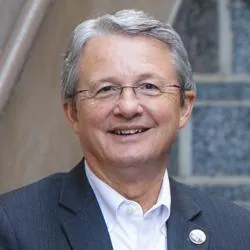
Steve Fetter — Professor of Public Policy at the University of Maryland; Former White House Science and Technology Policy Official
For clarity, this transcript includes minor edits made by Steve Fetter and footnotes provided by Columbia University, AC4 research institute.
Andrea Bartoli
Our project at Columbia University emerged from Jeff's work on the Megatons to Megawatts.[1] The observation was that the Megatons to Megawatts agreement was not well known enough – especially the synergy among the political elements, the scientific elements, the economic elements, and the environmental results, was not studied enough. And so at Columbia, we started assessing this case: it's good to realize that disarmament was done with good results. We all understand that world tendencies at the moment are not necessarily going in that direction; but perhaps exactly for that reason, it's a good case to study. And Steve, your experience is phenomenal. It's very important for us to hear your voice, and we are delighted that Jeff is going to be the interlocutor. Jeff has the floor now, but I will come back at the end, if you have time, to inquire more about cooperation in general. The entire 20-year Deal could not have been a success unless cooperation was sustained. Sustaining cooperation is a complex dimension in human experience. And so I remain curious, being the conflict resolution person in the room, if you could share some larger reflections on these themes at the end. Jeff will do the interview on Megatons to Megawatts itself, and then perhaps we'll have a moment to reflect on these other elements.
Jeffrey L. Hughes
Thank you, Dr. Steve Fetter, for spending time with us today. For the benefit of future viewers I’ll just say this is part of the Advanced Consortium on Cooperation, Conflict and Complexity at Columbia University, where we established, in 2025, a project on the so-called “Megatons to Megawatts” agreement, which refers to a 1993-2013 deal that rid of 500 metric tons of highly enriched uranium from Russian nuclear weapons by diluting it and selling it to the United States for use in civil nuclear power plants. And the net result was the ridding of 20,000 or more atomic bombs' worth of weapons-usable materials. The idea was originally proposed by MIT/Stanford physicist Thomas Neff, but it was also built upon relations forged by academicians in the 1980s during the darker times of the US-Soviet relationship. And one of the questions in the background is: how did that come about? And what can we learn, not only from the successful deal itself, but also from how this consequential cooperation was built and sustained? And we'll use the terms “HEU Deal” and “Megatons to Megawatts" interchangeably. Past presidents used the term “HEU Deal,” but Megatons to Megawatts is the more public metaphor for a Swords to Plowshares endeavor.
A few words about Steve's background. He's a physicist. He's been a longtime professor at the University of Maryland since 1988, while serving in multiple roles there, from being a dean and associate provost. He was an MIT undergrad in physics with the highest honors, and later a PhD at Berkeley in 1985. He has also worked at Lawrence Livermore Lab in the mid-1980s, had postdocs at Harvard and Stanford, and, in his spare time, also worked at the State Department, Department of Defense, and later for five years at two tours in the Office of Science and Technology Policy [OSTP].[2] And I've had the good fortune to cross paths with him in a number of roles over the years. He has an enormous range of writings on technical areas of nuclear policy, missiles, and climate over the past 45 years. And indeed, it was kind of a course in itself, Steve, just to go through your vita with publications going back to 1981 at least. And there'll be a link next to the video on our webpage that will go to the CV with more details about all the papers you published. And awards and so forth.
Before starting the interview proper, let me just paint some of the possible areas we might talk about. You were directly involved with some interactions with the Soviets in the 1980s, such as the 1989 Black Sea Experiment[3] – which I've been intrigued to learn more about in preparing for this interview, some very interesting adventures there – and potentially any insights you have on the building of relationships before that 1989 event. We would be interested in your insights and experience on the US side: John Holdren, a Stanford physicist, later at MIT and elsewhere, Frank von Hippel, Ernie Moniz, Tom Neff – physicists all.[4] On the Soviet side, you've obviously had interactions with Roald Sagdeev and Evgeny Velikhov and others who played important roles in developing these “building blocks” for cooperation in the 1980s.[5] Indeed, to my later surprise, Velikhov was actually instrumental in important ways for some of the initial surfacings of the ideas for the HEU Deal. And then, looking to your involvement at the cusp of the HEU Deal; you were at the State Department in 1992, and we may have even crossed paths in the hallway, because I was there before I went over to the Department of Energy. And then you were at the Department of Defense with physicist Ash Carter[6] (later a Secretary of Defense), while he was building the Nunn-Lugar programs,[7] the federal government counterpart, in some respects, to the HEU Deal, which was more market-driven. And then perhaps, we could review your later service on OSTP and some of the broader lessons you might derive from that.
With all that as a preface, a question I have to ask you is: how did you become a physicist? Because it was intriguing on your CV, you mentioned that you were the first in your family from central Pennsylvania to graduate from high school, and then, four years later, you're the first in your class at MIT in physics. So, how did you get interested in physics? What was the inspiration for that?
Steve Fetter
I think it was partly luck. But what was important was having just one teacher who took an interest. I think that's true for many people. In my case, it was my fifth-grade teacher, Marjorie Baker, who I think would see that I was a little bored, and she gave me her college textbook on astronomy. It was probably an “astronomy for poets” course, but for me, it just seemed incredibly advanced. And from that moment on, I wanted to be an astrophysicist. You know—all these unsolved problems about the origin and nature of the universe. My parents did not only not go to college or graduate from high school. They just had no idea how you got into college or how you paid for it. But in high school, I had friends whose parents were encouraging. And when they asked about my interests, they said you should go to MIT. You should apply to MIT. I was lucky enough to get in, and there I met all sorts of interesting people. I really was focused on physics. But one of the interesting things about MIT was that a lot of the physics faculty were also engaged in policy problems. There were many former Manhattan Project scientists, like Bernard Feld, Philip Morris, and Vicki Weisskopf. And Henry Kendall; he wasn't a former Manhattan Project Scientist, but he was the co-founder of the Union of Concerned Scientists.[8] Their first issue was on anti-ballistic missile systems, and the second issue was on reactor safety. And I grew up just not far from the Three Mile Island reactor,[9] and MIT was really a hotbed of activity, because the chair of the nuclear engineering department, Norm Rasmussen, had just completed the reactor safety report just a year or two before the accident at Three Mile Island. Henry Kendall, who then became my thesis advisor at MIT, my undergraduate thesis advisor, was one of the key critics of the method of analyzing reactor safety. So I had all these role models, including, I should mention, Kosta Tsipis,[10] another physicist at MIT, who, around that time, was doing early work on missile defenses, including particle-beam weapons.[11] And this is before SDI [the Strategic Defense Initiative].[12]
Jeffrey L. Hughes
I remember that Tsipis had a book called Arsenal.
Steve Fetter
Yes, I still use it as a textbook for a course I teach.
Jeffrey L. Hughes
It's got a red jacket cover on it. I can picture it right now. Well, that's great. That is a remarkably young age to know what you want to do! I believe somewhere there's a reference to Einstein being fascinated by a compass, and just the mysteries of what are these forces that are moving the compass. And I guess you had a similar kind of an epiphany looking at astronomy.
Steve Fetter
Yes, I built telescopes. I got books from the library. We didn't have any money, so I ground my own mirrors for my telescopes and spent time outside every clear night. I was not much of a social person. I grew up in the countryside, never learned how to drive a car, or had a car. So I spent a lot of time gazing up at the sky. I was also an amateur radio operator, so when it was cloudy, I could sit and listen to people on the other side of the country or the world.
Jeffrey L. Hughes
Amazing. Well, thank you for that. Often it just comes down to having a couple of teachers. And it can change your life.
Well then, if I may, turning to the pre-HEU deal timeframe, and the building of some of the bridges of cooperation. Do you recall some of your first interactions with Soviet academicians?[13] Maybe it was at the Black Sea experiment in 1989, or maybe you had some experiences before that?
Steve Fetter
Well, some of my mentors had earlier experiences. John Holdren, who was my PhD advisor, had been engaged with Velikhov on nuclear fusion from the 1970s. So John would tell me about that. I didn't have any personal experience until – probably it was 1987, I'm thinking – when the Federation of American Scientists,[14] led by Jeremy Stone,[15] who was the CEO, but Frank von Hippel probably was the president at the time that he was invited to Moscow. Frank would have all the details on this. It's all written up in his memoir.[16] I think as part of Gorbachev's effort– some people referred to it as a peace initiative –, he was trying to find a way to engage the Reagan administration in arms control negotiations to ratchet down the pressure on the Soviet Union to keep up with the arms race that was well underway by the Reagan administration at that time. And Gorbachev already had made several overtures. And I think it was probably Velikhov, some combination of Velikhov and Sagdeev, who identified the Federation of American Scientists as an interlocutor. The title “Federation of American Scientists” sounds very high and lofty, almost like a National Academy of Sciences, but really it was just this small operation. But Jeremy Stone was very entrepreneurial, and again, they would have all the details, but I think they outlined kind of an agenda, ideas to explore, and then I was recruited as one of the people who would actually do some of the technical research on things like… in the START negotiations,[17] as I recall, one issue on the Soviet side was whether Sea Launch Cruise Missiles [SLCMs][18] should be included in the treaty limits. And the US position was “no,” that verification was impossible, because you could not count weapons that were deployed on a ship. And so that raised the issue of, well, can you detect a nuclear weapon if it is on a ship? If someone says there are no nuclear weapons on this ship, can you confirm that that's the case? Or if they say all the nuclear weapons are here, there's no others, could you verify that? And so I think that was one of the first projects that I became engaged with.
There were, of course, other projects later, but I was pretty young at the time. It would have been about 1986, I was either finishing up a postdoc at Harvard, or then I started at Maryland in 1988, so around that time frame, and Frank would arrange meetings with Soviet scientists. There were meetings both in the United States and in Russia. I think I traveled for the first time to the Soviet Union, to Moscow in 1988, but I believe there were meetings before that, and they were rather technically focused. And it was just a terrific opportunity. And I should say, at the time, I just was too young to realize what a special time this was in history, but also what a unique opportunity it was for me. I was a little too matter-of-fact about it all.
Jeffrey L. Hughes
You remind me, I remember being in Moscow in 1988 for the purposes of negotiations on the Nuclear Risk Reduction Center,[19] which Shultz and Shevardnadze had signed an agreement on in the Rose Garden a year prior.[20] And so we were working to implement it. And it was a little bit jarring… you had Gorbachev’s glasnost, but yet when we arrived in November with the celebrations for the Russian revolution. And so there's these huge banners in Red Square of Lenin and Stalin. So you had this sort of two eras that hadn't quite dealt with each other yet, and it was hard to reorient one's own thinking to what changes might happen.
Steve Fetter
Well, I'm glad I got to experience the old Soviet Union. I've sometimes joked that, like, we have an old Sturbridge village or a colonial Jamestown[21] where you can see what it was like, the clothes people wore, the jobs they had. There really should be a Soviet version of this. I just remember wandering around Moscow and going into grocery stores where there would be nothing on the shelf, or certainly nothing you would want to buy. Long lines. I remember joining a line, and when I finally got to the front, it was just bars of soap, things like that. There must be people who romanticize that things were better in the old days. It would be nice if that were somehow preserved.
Jeffrey L. Hughes
So, from what you've said, even before the 1989 black sea experiment, you were already interacting with some of the Soviet academicians that Frank von Hippel and perhaps Tom Cochran had helped organize.
Steve Fetter
Yes. Particularly with Sagdeev, who was the director of the Russian Space Institute [IKI],[22] and he had two or three people on his staff, Stanislav Rodionov, Oleg Prilutsky, and another person on the Russian side [Valery A. Frolov], were kind of my counterparts, the people who would do the technical analysis.[23]
Jeffrey L. Hughes
And they were academicians… But I think some of them also had ties to the atomic weapons complex as well. So they were kind of maybe dual-hatted a little bit??
Steve Fetter
I think that came later. I'm trying to think, and probably also more through Tom Cochran, who was working with Velikhov to do things like establish the seismic monitoring equipment at a Russian test site. I was not engaged with that directly. Tom had gotten some seismologists to work on that and to buy the equipment. The Black Sea experiment was kind of a follow on to these demonstrations.
Jeffrey L. Hughes
We interviewed Tom, and he did cover that. And so I was just probing your interactions with the Soviets, before the Black Sea experiment, which you were definitely also directly involved in with Sagdeev. I don't know if you care to say anything about a kind of astounding account of the experiment I recently read about you, and perhaps Tom Cochran, climbing up on this SLCM missile launcher on the Slava, the Soviet boat out in the middle of the Black Sea, and doing gamma ray detection on it. It's just a wonderful image of kind of straddling the missile, like at the end of Dr. Strangelove!
Steve Fetter
Again, I wish I could go back in time and kind of remind myself, or give a nudge to the young Steve Fetter that, you know, this is really a very special thing!
Jeffrey L. Hughes
Your kids didn't know you were Indiana Jones!
Steve Fetter
But, yeah, I would say I was maybe rather too matter-of-fact about it. You know, I just did the calculations, learned how to use the detector and the multi-channel analyzer, and I wrote my own codes to take the spectrum, find the peaks, and correlate them with isotopes. That grew out of my PhD research, which was on the doses from various radionuclides. So I knew how to identify gamma ray lines, correlate them with isotopes, to determine the composition of materials.
Jeffrey L. Hughes
Well, that was enabled, I believe, because of Velikhov's initiative… the experiment went forward based on his own kind of bold steps. But then there was back pressure right near the timing of your measurements, and yes, they were going to limit your time to like 10 minutes. And I believe that somehow you and Tom fooled them into 24!
Steve Fetter
Well, the limit was five minutes. And there were people from Arzamas, from the nuclear weapon laboratory, and maybe also the Chelyabinsk lab, right? And they did not approve of this measurement.[24]
Jeffrey L. Hughes
Nor did Khariton himself, who was the Arzamas -16 head.[25]
Steve Fetter
But Gorbachev overrode this. He said that they were going to go ahead with this, and it was a pretty dramatic demonstration of transparency. And almost equally, or perhaps in some ways even more transparent, that experiment was followed then with a trip to the production site at Chelyabinsk – the plutonium production reactors – and then to the radar, the ABM radar in Siberia.[26] So this was really part of a broader peace offensive by Gorbachev that I think was effective in changing people's views, changing views in the United States about the willingness of the Soviet Union to engage in serious arms control verification. Because, you know, historically, verification, especially on-site inspection, had always been a non-starter for the Soviets, and so this was a really dramatic opening. And I particularly remember that several of the Soviet scientists that I met, the weapon scientists, that this was the first time they had ever met an American. This was really a big deal for them, and there were opportunities to chat informally. I don't remember any significant exchanges, just beyond the fact that they were, I think, rather stunned by this dramatic opening.
Jeffrey L. Hughes
Do you think that they knew that you had spent a year at Livermore?[27] I mean, did that kind of burnish your credentials with those scientists? He's not just a physicist. He's been, you know, a Livermore guy…
Steve Fetter
I am assuming that they had briefed their people on our backgrounds. Of course, we were a non-government group, so we did not have any of that support, and that turned out, I think, to be important later.
Jeffrey L. Hughes
So on this Black Sea follow-up adventure at Chelyabinsk and radars and the like, I think, if I recall correctly, Cochran and others invited congressmen along as well. So not only Gorbachev was demonstrating openness, but I think there was an effort to show Congressman what the demonstration was and take that news back.
Steve Fetter
Yes, Congressman Spratt of the House Armed Services Committee,[28] and other congressmen.[29] There were also two reporters, Bill Broad from the New York Times and Jeffrey Smith from The Washington Post, who covered the story.
Jeffrey L. Hughes
Interesting, I remember Smith was later at the December 1991 FAS/NRDC meeting too, because I remember reading a press piece about one of the follow-on meetings in December to the one in October 91. But before leaving the Black Sea adventure, you definitely met Velikhov on that trip. And so you saw him in action and the like.
Steve Fetter
Oh, yes, yes. He's one of these larger-than-life characters.
Jeffrey L. Hughes
Yes, there was an interview with you and Frank von Hippel and Tom Cochran. And I think Tom said about Velikhov: he's my hero, which was interesting. I've met Velikhov a few times as well over the years, and so I have my own favorable impressions of him. And there was also a report about a picnic after the Black Sea and other trips too.
Steve Fetter
Well, if you haven't heard Jeffrey Lewis's interview, I think it's called “Skinny dipping in the USSR.”[30]
Jeffrey L. Hughes
I did see that. I think Cochran skinny dipped, right? But no Congressman…
Steve Fetter
I don't think so. I think they were wise.
Jeffrey L. Hughes
I won't ask you that question. Was Chris Paine there, by the way, because we want to interview him, too?
Steve Fetter
Yes.
Jeffrey L. Hughes
Paine was, I believe, then working for Senator Kennedy.[31] And so [the Black Sea experiment and follow-on trips] had these interesting ties back to House Armed Services, and then Senator Kennedy and so forth. It was an interesting array of actors.
So having demonstrated a kind of “Bona fides” of this experiment, I believe the first workshop of NRDC and the Federation of American Scientists with the Soviets was in 1990, and then one particularly relevant for the Megatons to Megawatts deal was in October 1991, in Washington. I don't know if you had the opportunity to attend that meeting or not… do you recall?
Steve Fetter
I think so. I'm very bad on dates. I probably would have been invited to every meeting.
Jeffrey L. Hughes
Okay, yeah. I know you were at the following meeting that we'll get to in December 1991, because there's a presentation listed on your CV that you and Tom Cochran provided on verification transparency. But I was just wondering if there were any recollections about Mikhailov,[32] because that was the meeting where he came to town. He was then First Deputy Minister of what was then known as MAPI,[33] pre-MINATOM,[34] if you will. And it was in the hallway at the workshop that Neff, Tom Neff, pitched his idea to Mikhailov that was soon to be published in the New York Times in October 1991 on the HEU deal. So I don't know if you have any recollections of when you first either met physicist Neff or physicist Minister Mikhailov or not.
Steve Fetter
Of course, I remember both. It's hard to forget Mikhailov! The chain-smoking Mikhailov. But you know, I do remember early discussions among the US group of a possible HEU Deal, and discussions of presenting this idea to the Russians. But I can't remember if I was there at that meeting.
Jeffrey L. Hughes
We'll ask Chris Paine, who may have some of these records. But it's interesting. That's the October meeting Chris Paine wrote up [in high-level summary form,] and it was published, I think, in The Bulletin of the Atomic Scientists, a review of that meeting at which the HEU deal was discussed. And that probably would have been the earliest occasion for it to be discussed. And Mikhailov didn't make that many appearances in the US in that time period. So anyway, it's a high likelihood that you were part of that.
Steve Fetter
I'm pretty sure, though, that there were earlier discussions, earlier meetings, just of the US group. That makes sense. I'm sure Tom wrote a paper that he presented and that we discussed.
Jeffrey L. Hughes
Yeah, Neff gave a two-pager to Mikhailov, or a three-pager, that elaborated on the upcoming op-ed. So that may have been what was shared with a larger group. So, that proposal was written when the Soviet Union was still kind of rocking on its last legs. But then there's a meeting in December 1991 in which you and Tom Cochran gave a presentation in Moscow to the same FAS/NRDC group [meeting with the Russians], and it's at the same time that the Soviet Union is coming undone. Do you recall what it was like being in Moscow at the end of the Soviet Union?
Steve Fetter
Well, I think in fact, we were in Kyiv the day that Ukraine became an independent country. I remember toasting with sparkling wine the birth of this new country. Again, I wish I knew at the time how momentous this all was, you know, how very interesting. And I remember there was a great deal of excitement and optimism, particularly in this sphere of nuclear arms control. It really just seemed like everything was possible… that this was going to be a new era. And, I suppose, that feeling continued for another six or seven or eight years. And, as you know, then [nuclear cooperation] became an official activity. There were lots of lab-to- lab engagements. There was the Cooperative Threat Reduction Program[35] which then engaged US government officials, lab scientists in these activities and discussions. But at that time – I think this is just still the H.W. Bush administration –It was largely a non-government activity. At least everything that I did, or Frank or Tom did, was all a non-government activity on our part.
Jeffrey L. Hughes
Right, right, but perhaps as an outgrowth of the the Velikhov-Cochran-von Hippel efforts on the seismic testing there came the “Joint Verification Experiment,” [JVE], which was some of the earliest involvement of the DOE national labs — weapons labs – with Mikhailov, for example, in the [JVE] in in Nevada, and in Kazakhstan as well as in Nevada.[36] And I think that in some of Mikhailov’s recollections and musings, that was a time when he first met the US weapon scientists, and spent time in Nevada, and it made him rethink… Like he's on the [nuclear] targeting committee in the Soviet Union but knows the people at the receiving end of it. And there was a sense of camaraderie, competitive camaraderie, in the interactions on the JVE that, perhaps without which, you wouldn't have some of those other programs like the MPC&A and the lab-to-lab cooperation that emerged in the early Clinton period.[37]
Steve Fetter
Yes. Do you remember when the JVE occurred?
Jeffrey L. Hughes
It was 1988, and I believe it was completed by 1989. And amazingly, who is there both in Kazakhstan and in Nevada? It is Velikhov! And he's elected the temporary mayor of [a nearby] Nevada city!
Steve Fetter
You know, I just did recall – at these later meetings – maybe in 1990, the one you're referring to, was it 1990 or 1991 in Moscow?
Jeffrey L. Hughes
There was December 1991, the one right before Kyiv. Then I think that trip segwayed over [from Moscow] to Kyiv.
Steve Fetter
So there were some lab observers. There was at least one, maybe two people. They were observers. They – and I can't even remember their names – they never said anything, but they were at the table, or maybe in the back row, just to hear what was going on.
Jeffrey L. Hughes
It may have been David Hafemeister.[38] I think Carson Mark was also at the Washington October meeting. He was the retired former head of the Theoretical Division at Los Alamos.
Steve Fetter
Right. But I mean a current weapon scientist was there. But I can't remember his name. I just remember he wasn't very happy with me.
Jeffrey L. Hughes
He must have been from Los Alamos then, just on principle, [given your former association with Livermore Lab, its rival]!
Steve Fetter
Well, one of the things, of course, we were investigating, or trying to discuss, was whether you could verify the dismantling of a nuclear warhead, whether you could tell that something was a warhead, whether you could verifiably dismantle it, whether you could tell that a nuclear weapon component, a pit or a secondary, can sub-assembly, and whether those came from nuclear weapons. So this was, you know, part of the discussion at that time.
Jeffrey L. Hughes
I happen to have the title of the paper that you and Tom Cochran presented at that meeting: “Verifying the Authenticity of Nuclear Warheads Without Revealing Sensitive Design Information,”[39] right?
Steve Fetter
And so it turns out to be very difficult. As you know, there was the “template approach” and the “attribute approach,” and both were discussed. I was always more attracted to the template approach because you really could be highly confident – especially if you use the gamma ray signature -- that this component matched a previous component, which suggested you had high confidence that it came from a nuclear weapon. But then the problem was that the template had a lot of information embedded in it, and how could you protect that information? How could you compare the measurement with the template and protect the sensitive design information?
Jeffrey L. Hughes
And you’d have to have people crawling over ships reciprocally… Before we leave the Black Sea experiment entirely, wasn't there an associated Soviet neutron-based detector that was more removed from the weapon that had some benefit?
Steve Fetter
The Soviets had a big Helium-3 neutron detector in a helicopter that could easily detect the nuclear weapon on the ship from, I forget exactly, from how far off, flying over which I think they had developed that equipment so that they could monitor the presence of nuclear weapons on US ships, perhaps as they sailed through the Dardanelles or other straits.
Jeffrey L. Hughes
From maybe, like 75 meters or something, right? I think there was some skepticism that the US Navy would ever let them get that close. But I guess there were examples of that happening, with crews waving at the overflights.
Steve Fetter
And there were some interesting cases in Sweden, too, that you may know of, where Soviet subs got very close and too close to Sweden, and the Swedes used neutron detectors to detect the presence of nuclear weapons on those subs.
Jeffrey L. Hughes
I was reading through the table of contents of all the Science & Global Security issues this morning, and it's just a fascinating publication.[40] I didn't realize how threaded you are throughout it. From issue number one. My first reasons for going to it were reading some early pieces by Neff on the HEU agreement, and Oleg Bukharin, and later Jim Timbie. But now I notice that you had published there with Sagdeev in 1990.[41] I was just even trying to think operationally, how did that work? We didn't have the emails and the faxes then. I mean, call and talk on the phone, or did we have email?
Steve Fetter
No, we had email. I think I worked mostly with the staff at IKI – the people I mentioned before –- who I think were co-authors, Stanislav Rodionov, Oleg Prilutskii.[42] I’m pretty sure that we used email to send drafts back and forth. I might be wrong about that… But there was cooperation, space cooperation, I think, between the US and the Soviet Union. So there probably were open channels of communication.
Jeffrey L. Hughes
Just mentioning space cooperation reminds me that, well, the first one had Velikhov proposing fusion circa 1985 to Gorbachev and Mitterrand[43], and it happened…
Steve Fetter
That's why we have ITER…[44]
Jeffrey L. Hughes
We may get to fusion in other ways first. But, continuing the Velhikhov thread, next comes space cooperation…
Steve Fetter
I should say “Space Science.”
Jeffrey L. Hughes
Well, then, taking space science to space cooperation, when I was reading declassified presidential memcons of the Camp David Summit in February 1992, the first time presidents Yeltsin and Bush meet, Velikhov is with Yeltsin because Milhailov was sort of in limbo, awaiting his appointment as Minister, and Velikhov has enormous prior summit experience. And according to the records, Velikhov had a one-pager on space cooperation that he showed to Yeltsin on the helicopter from the White House on the way to Camp David! And upon arrival, Yeltsin, with Velikhov at his side, just hands the proposal to Bush and says it basically has his endorsement for US-USSR space cooperation. Then Bush passed it to Scowcroft[45] for action [and the cooperation later materialized]. And then in their summit meeting, Yeltsin pitches the HEU Deal idea to President Bush, [to include also willingness to sell plutonium], and there's some back and forth. And Velikhov, you know, is supporting it. So anyway, it's just astounding. These kinds of big initiatives – and big initiatives don't always work out exactly as planned, like they take longer, like ITER – but other ones do come to fruition, and they do have lasting impacts.
Steve Fetter
So both of those [space and HEU initiatives] led to really important assistance for the Soviet Union and then Russia, and they provided things that were of value to the United States.
Jeffrey L. Hughes
So we turn now to the cusp of 1993 and 1994. And you've gone from the State Department over to the Department of Defense and are working for Ash Carter, who had been part of the advocacy in the timeframe of late 1991 to get the Nunn-Lugar legislation passed. I mean, there was a Harvard report, Carter and Perry briefing the Congress, getting support.[46] So now Carter's in office, and he's got an important responsibility for helping a Russia that doesn't have all the capability it needs to secure its materials. Do you have any recollections from that, from the standpoint of your work with Carter and being at the Department of Defense?
Steve Fetter
Well, I was mostly working on other issues. My title was “Special Assistant,” which can mean lots of things, but in my case, it meant I did whatever Ash wanted me to do at the moment, which was fortunate for me in that that was usually the hot item of the time. And so that was mostly North Korea. Later, it was the Nuclear Posture Review. I think it was Gloria Duffy, who mostly handled the Cooperative Threat Reduction portfolio.[47] Occasionally I would be drawn into discussions of particular issues, but I did not do a lot of work myself on nuclear material security or the disposition of nuclear materials, although I was aware of what was going on. And in fact, I think I had attended meetings earlier about plutonium disposition and I had favored the blend [option] with waste and geological disposal.
I do remember visiting the Kurchatov Institute[48] – what year would this have been [ in the early 1990s] – and being struck by the [poor] level of security at the facility. I recall there was a portal detector. But because we were “distinguished visitors,” we were waved around the portal. We went inside this building, and I remember seeing quite a bit of HEU in the form of little discs, right? Washers. I don't recall that they had markings on them…
Jeffrey L. Hughes
They were probably from [or like those at] Obninsk, the Obninsk discs…[49]
Steve Fetter
Okay, but I don't think they had any unique identifiers on them. And I had the impression that I could have put a handful of this in my pocket and walked out… and I remember the fence, the weeds that were growing up along the fence, right? And this is in suburban Moscow, where there are lots of people around. And it was such a contrast: I had worked at Livermore, where we had a plutonium facility with an extremely high level of security, where there were armed guards, where they regularly had exercises to protect the plutonium. And so I do remember on at least one visit being struck by the low levels of material security and the need to do something about that.
Jeffrey L. Hughes
[Kurchatov] was one of the first facilities DOE went in to do that. It was in early 1994, based on analyses of the types of vegetation and so forth [overhanging perimeter fences] that you were describing, derived from satellite images, trying to look at where's the HEU and plutonium, and what might the vulnerabilities be, from literally the 30,000-foot level, since most of the sites are in the hinterlands. But the thing about Kurchatov was, as you say, it's in Moscow, and it's headed by Velikhov and Ponomarov-Stepnoi, his loyal deputy.[50] And so Charles Curtis[51] — first undersecretary, later deputy secretary, and then Acting Secretary of Energy – went to the Kurchatov Institute in early 1994, and with Velikhov and others’ help, they invited all the MINATOM labs and production facilities to come to Kurchatov. And then some US/DOE labs demonstrated some ways that MINATOM could use technology to secure the material that no longer had [communist party] watchers over it. And Curtis had started it out, with a reprogrammed $2 million, to put on this problem. It was the demonstration at Kurchatov that, I think, made the sale at the other facilities that, you know, hey, these Americans are reasonable people. They've got technical solutions. It could be a pathway to scientific cooperation. And that's when the DOE budget for MPC&A started to go from two, 2 million to 15 to 100, 200 million dollars annually in the coming years, at many sites starting from one. So the Kurchatov Institute was the proving ground for MPC&A in the first instance.
Steve Fetter
I also recall the early discussions of a plutonium storage facility or a pit storage facility. I do remember Mikhailov saying, if you just send me $400 million I will get it built. Here's the bank account number you should send the $400 million to. It was a, you know, long discussion after that…
Jeffrey L. Hughes
Yes, I remember Charlie Curtis went to a meeting with Ash Carter and Mikhailov [in this early period]. And the report was – I mean, Mikhailov had a time urgency problem, and that in order to, ironically, live up to the arms control agreements that had been fashioned under Bush 41, they were downloading all these warheads, and they didn't have a place to put them. And the Army Corps of Engineers[52] had their set ways that they would build facilities, and you had to have the right kind of drains by the side of the road and stuff. And so, yeah, Mikhailov just wanted to get the money on the problem in Russia, at a lot cheaper cost. He actually – I was intrigued, when I was putting together my book manuscript on this – that he actually proposed putting up more HEU as collateral outside the HEU agreement, so if the funding accounting wasn't right, or whatever, you can get yourself paid back.
Steve Fetter
Oh, I didn't know that.
Jeffrey L. Hughes
So that was a sort of intriguing thing that I wish I had paid more attention to at the time. But in the end, I think Charlie Curtis offered to put up the money to have the labs do some of the early construction contracts [for the plutonium storage facility], to take it out of the DoD's hands with their permission. But yeah, it's a challenge to work on, work through, bureaucracy on one side, let alone two.
I’m curious, by this time you obviously knew Frank von Hippel [at OSTP], and John Holdren, who wasn't part of the administration at this juncture, but he was leading the National Academy of Sciences study on plutonium disposition published, I think in January 1994, and Matt Bunn became the Executive Director of that.[53] I don't know if you just sort of followed that intellectually while you were dealing with your day job in the Pentagon, or if you ever interacted with the network of your buddies from the 1980s.
Steve Fetter
Well, I think perhaps, along with Dick Garwin,[54] I wrote or gave some presentations on plutonium disposition at an earlier time. So we were certainly aware of the Academy study, of the issue of the disposition options, and the need for a careful study of this – although I was pretty sure what the answer should be. Of course, there were big uncertainties about costs and about the timeframe [for disposition]. But if you haven't spoken with John Holdren yet, he would, of course, be a good person to speak to, particularly about Velikhov, because his connection to Velikhov goes back to the early 1970s. You mentioned the fusion cooperation. That really was some of the earliest scientific cooperation between the US and the Soviet Union. And I think that goes back to the Eisenhower years, to the first nuclear test ban talks and the Atoms for Peace speech, when the US declassified fusion research.[55] But I think John met Velikov at IIASA, the International Institute for Applied Systems Analysis, in Vienna,[56] and was a co-author of a joint study on fusion and breeder reactors. I think that might have been the title of the study, fusion or fast breeder fission, which is the best….[57] So John knew Velikhov for a long time through the fusion connection, and Saharov[58] too, later. Because, you know, Sakharov was a very accomplished plasma physicist, very well known. So it was that plasma physics connection for John, and then John was chair of CISAC, but then also he was a member of Clinton's PCAST, the President's Council of Advisors on Science and Technology.[59]
Jeffrey L. Hughes
Where Ernie Moniz was part of that, too, right?
Steve Fetter
Yes. Ernie was my quantum mechanics professor. Also, I think it was the only physics course I ever got a “B” in. A lot of the same characters are present in this story for several decades.
Jeffrey L. Hughes
Well, that's part of the fascination of it, because in my book manuscript, I was intrigued to learn, at increasing levels of detail along the way, that at Stanford in physics, von Hippel was there as a Professor; you also had graduate students, Holdren, Moniz, Neff, Timbie, Meserve,[60] and more… And then, all later in their own responsible ways had important roles in public policy as well as in their academic careers. And so these “network effects,” both within the US as well as, as you've just pointed out, with the Russians, have these rich effects across nations as well, in some under some conditions, within them.
With Holdren, to pick up on your point about that long relationship with Holdren and Velikhov… There was a Holdren and Velikov Commission – as it was called in the mid-1990s – that was trying to bridge the gap between the Russians’ reluctance to dispose of plutonium in once-through MOX runs, and the US. The only place that the “Venn diagrams” crossed was on MOX fuel, where Russia was willing to proceed in that manner. And then, only if the US paid for it. So, it was, again, part of this sort of bridging activity to try to fulfill this by addressing the clear and present danger of plutonium.
Steve Fetter
Right, which then led to our, you know, ill-fated decision to go both routes in the United States….
Jeffrey L. Hughes
Right, and then we later threw then we threw away the down blend and with a high-level waste approach somewhere later. And then we lost the original plan too…
Steve Fetter
Right, right, and wasted billions of dollars on the MOX plant. And now, because of the effort to save that earlier investment, the US is trying to adapt it to a [nuclear weapon] pit production facility – probably spending more money to adapt it than we would have spent if we started fresh.
Jeffrey L. Hughes
Do you have any perspectives on plutonium? I mean, the HEU Deal got rid of roughly a third of the planet's weapons-usable material. I mean, what do we do about the plutonium dilemma in the long run? Civil plutonium is almost more worrisome in scale these days than the weapons plutonium, which, as you say, at least in the US, is under pretty tight security.
Steve Fetter
Well, I guess the first thing I would say is, let's not produce any more. You know, the French and Japan are still producing or planning to produce more, which is foolish. What's the expression, if you're in a hole, stop digging…right?
Jeffrey L. Hughes
Ernie [Moniz] often used that expression; I think it must be an MIT physicist thing!
Steve Fetter
I don't see any economically attractive use for the plutonium. That's something that Matt Bunn and I spent time showing that the economic case for demand for MOX [civil nuclear reactor fuel] is very weak, and likely to remain very weak, for as long into the future as we can see, almost regardless of what happens with the growth of nuclear power. It will be cheaper to make low-enriched uranium fuel than it would be to make MOX fuel, even if the plutonium were free. And so that's what led me to the conclusion that we should –, well, of course, the first priority is safe storage – but then we should blend it with waste and dispose of it in a geologic repository.
Jeffrey L. Hughes
Yes, “immobilization” is the word for that. I think. Yes, immobilization is the shorthand.
[Turning to some even broader questions, in the short time we have,] that you've thought about ….. You've written about the role of science in policy. We've been talking a lot about scientific relationships… that you know kind of helped scientific collaboration to lead to policy innovation. You've also looked at this in OSTP [between 2009 and 2017] about the two sides of the same coin: policy for science, science for policy. I don't know if you have any kind of insight in less than the 10 minutes remaining of your time. Do you have any thoughts on that? Or is that just too big a topic for the time remaining?
Steve Fetter
Well, it is a big topic. I do teach a course on it, but that's a whole semester! I always say it's vital that all policies be informed by the best available scientific information and analysis, but I know that policy is not going to be determined by that scientific analysis. It's just one factor, and there are lots of other factors: economics, politics, equity considerations, and international relations. And sometimes, [the country] does things that don't make any sense, because you have relationships with other countries that you're trying to facilitate.
ITER is one of those cases. I've never thought ITER made sense… to put so much money into that one concept…. If you want to explore, if you want to strive toward fusion energy as a practical solution for energy supply and climate change mitigation, you need something that is economically competitive with other sources. And that is never going to be the case for Tokamak [designs like ITER]… But ITER was a way of facilitating cooperation within the Soviet Union and with the other countries, advancing science. Very inefficient way of doing it but…
Jeffrey L. Hughes
Sometimes you just have to start somewhere…
Steve Fetter
And it would be different on every issue. If you look at Space, as we mentioned –space science, or space exploration – I personally do not think it makes much sense to put humans in space, and particularly not on other planets. But if you're going to do it, it makes sense to cooperate with other countries, and to try to do it in a way that makes the most technical sense.
Jeffrey L. Hughes
Just reflecting back on the Megatons to Megawatts experience, and how the cooperation was sustained, do you have any general thoughts about cooperation… You apparently have a role in the Doomsday clock.[61] Are you optimistic going forward?
Steve Fetter
I think you have to be optimistic. I always answer this by saying: I have children, I have grandchildren. I think we have no choice but to be optimistic and work towards solutions. I couldn't accept being fatalistic about our ability to [cooperate to solve problems]. You know, we created these problems. We created the weapons. In the case of climate change, we created the technologies that put the CO2 into the atmosphere. And I do think we are clever enough. I don't think it's a scientific or technical problem. It's mostly a social and political problem. But that's what I think we have to work on.
Andrea Bartoli
Well, thank you so much for your wonderful way to close the perfect interview, so we are very grateful.
Jeffrey L. Hughes
Yes, thank you! We could definitely go on longer. But we thank you for your time that you've taken out of your busy schedule. And it's been a great pleasure to work with you over the years. With your calm demeanor, but uncommonly thoughtful and independent perspective. You've assessed reactors and their risks. You've also recognized their modern potential role in climate change…You’ve let the verdict fall where the science says. So thank you for your time and your thoughts.
[1] Jeffrey L. Hughes, Megatons Into Megawatts: The Deal Eliminating 20,000 Atomic Bombs (New York: Advanced Consortium on Cooperation, Conflict, and Complexity, Climate School, July 15, 2025), 41–42, https://doi.org/10.7916/0kyf-he85.
[2] Office of Science and Technology Policy (OSTP)
White House office advising the President on science, technology, and national security policy.
[3] Black Sea experiment
A series of joint US–Soviet scientific tests carried out in July 1989 off Yalta aboard the Soviet cruiser Slava to evaluate whether various radiation‑detection technologies (gamma and neutron detectors, including helicopter‑borne sensors) could reliably identify the presence of nuclear warheads on ships. The project aimed to explore practical verification methods for potential limits or bans on sea‑launched cruise missiles (SLCMs) as part of broader strategic arms reduction talks, breaking new ground by allowing US scientists to take measurements close to an operational Soviet nuclear armament.
[4] John P. Holdren
American physicist and science policy leader; Director of the White House Office of Science and Technology Policy under President Barack Obama.
Frank N. von Hippel
American nuclear physicist and Senior Research Physicist and Professor of Public and International Affairs emeritus at Princeton University. The AC4 interview with Frank von Hippel conducted in 2025 and published in January 2026. https://ac4.climate.columbia.edu/content/frank-von-hippel-oral-history
Ernest J. Moniz
American physicist; US Secretary of Energy (2013–2017) and Under Secretary of Energy (1997-2001); was very involved in the HEU Deal.
Thomas L. Neff (1943–2024)
Thomas L. Neff was a physicist at MIT’s Center for International Studies who proposed in an October 1991 op-ed that the USSR convert highly enriched uranium (HEU) from dismantled Russian nuclear warheads into fuel for American power plants.
[5] Roald Z. Sagdeev
Soviet and Russian plasma physicist and science policy leader. Director of the Space Research Institute of the Soviet Academy of Sciences (IKI) for 15 years, he was a key figure in US–Soviet scientific cooperation during the Cold War. Sagdeev later became a professor at the University of Maryland.
Evgeny P. Velikhov (1935–2024)
Soviet and Russian physicist; long-time vice president of the Soviet Academy of Sciences and founding director of the Kurchatov Institute. Velikhov was a key bridge between Soviet nuclear scientists and Western counterparts.
[6] Ashton B. Carter (1954–2022)
US Secretary of Defense and former physicist with deep involvement in nuclear security policy.
[7] Nunn–Lugar Cooperative Threat Reduction (CTR) Program
A US Department of Defense program established in 1991 to secure and dismantle former Soviet weapons of mass destruction.
[8] Bernard T. Feld (1919–1993)
American physicist who worked at Los Alamos during the Manhattan Project and later became a long-time editor of the Bulletin of the Atomic Scientists.
Philip Morrison (1915–2005)
American theoretical physicist who helped assemble the atomic bomb at Los Alamos and later emerged as a prominent public intellectual, science communicator, and co-founder of the Federation of American Scientists.
Victor F. Weisskopf (1908–2002)
Austrian-born theoretical physicist who contributed to the Manhattan Project and later served as Director-General of Conseil Européen pour la Recherche Nucléaire (European Council for Nuclear Research).
Henry W. Kendall (1926–1999)
American particle physicist at MIT who co-founded the Union of Concerned Scientists in 1969 and received the 1995 Nobel Peace Prize (on behalf of the Pugwash Conferences on Science and World Affairs).
Union of Concerned Scientists
Founded in 1969 by scientists and students at MIT, the Union of Concerned Scientists is a US-based nonprofit organization that works to apply rigorous, independent science to public policy. It focuses on issues such as nuclear weapons, climate change, clean energy, and national security, advocating for evidence-based solutions and greater government accountability.
[9] Three Mile Island Nuclear Generating Station
A commercial nuclear power plant in Pennsylvania that was the site of the most serious nuclear accident in US history in 1979,
[10] Kosta Tsipis (1933–2020)
Greek-American physicist at MIT known for his influential technical critiques of advanced weapons systems, including missile defense and space-based weapons, and for his work advocating nuclear arms control through organizations such as the Union of Concerned Scientists.
[11] Particle-beam weapons
A class of proposed directed-energy weapons that would use high-energy beams of charged or neutral particles, accelerated to near light speed, to damage or disable targets such as missiles or satellites.
[12] Strategic Defense Initiative (SDI)
A US missile defense program announced in 1983 by President Ronald Reagan that aimed to develop space- and ground-based systems—including lasers and particle beam concepts—to intercept incoming nuclear missiles.
[13] Academicians
Elected full members of the Soviet (later Russian) Academy of Sciences, representing the highest scientific rank in the USSR.
[14] Federation of American Scientists (FAS)
Founded in 1945 by Manhattan Project scientists, FAS is a US nonprofit dedicated to reducing nuclear dangers and promoting science-based policy.
[15] Jeremy J. Stone (1935–2017)
American civil society leader; long-time president of the Federation of American Scientists (FAS). Stone was instrumental in reopening US–Soviet scientific dialogue after periods of political rupture, including advocacy for Andrei Sakharov and support for early test-ban and arms-control engagement.
[16] Frank N. von Hippel, Ending the Nuclear Arms Race: A Physicist’s Quest (Lynne Rienner Publishers, 2024).
[17] Strategic Arms Reduction Treaty (START)
A series of US–Soviet/Russian bilateral treaties, the first signed in 1991 designed to reduce and limit deployed strategic nuclear warheads and delivery systems, including intercontinental ballistic missiles (ICBMs) and submarine-launched ballistic missiles (SLBMs), through verified, legally binding caps and on-site inspections.
[18] Sea-launched cruise missiles (SLCMs)
Cruise missiles deployed from naval platforms such as submarines or surface ships, capable of carrying either conventional or nuclear warheads and flying at low altitudes to evade radar detection; widely developed during the Cold War as flexible and survivable components of naval strike and deterrence strategies.
[19] Nuclear Risk Reduction Center
Bilateral US–Soviet (later Russian) communication centers agreed to in 1987 to reduce risks of nuclear miscalculation.
[20] George P. Shultz (1920–2021)
American statesman; US Secretary of State. Shultz was central to the late Cold War shift toward engagement with the Soviet Union.
Eduard A. Shevardnadze (1928–2014)
Soviet Foreign Minister (1985–1990) and later President of Georgia. Shevardnadze supported arms control diplomacy during the Gorbachev era and facilitated engagement with Western scientists and parliamentarians, helping sustain momentum toward cooperative nuclear agreements.
White House Rose Garden
A landscaped garden adjacent to the Oval Office at the White House in Washington, DC, traditionally used for presidential press conferences, bill signings, and major policy announcements.
[21] Old Sturbridge Village
A living history museum in Massachusetts that recreates daily life in a rural New England community of the 1830s, with costumed interpreters demonstrating period trades, clothing, farming practices, and household work.
Jamestown Settlement (Colonial Jamestown)
A historical site and museum in Virginia that interprets the early 17th-century English colony of Jamestown (founded in 1607), featuring reconstructed forts, ships, and demonstrations of colonial-era life.
[22] Russian Space Research Institute [IKI]
Located in Moscow, operated by the Russian Academy of Sciences, and directed by Roald Z. Sagdeev from 1973-1988.
[23] Stanislav N. Rodionov (1929–2014)
Soviet/Russian physicist at the Space Research Institute (IKI) of the USSR/Russian Academy of Sciences who collaborated with Western scientists on late–Cold War technical studies related to nuclear arms control and space nuclear power systems.
Oleg F. Prilutsky (also transliterated Prilutskii)
Soviet/Russian physicist at the Space Research Institute (IKI) who participated in US–Soviet cooperative research on arms control, including studies on space nuclear reactors and verification issues.
Valery A. Frolov
Soviet physicist associated with the Space Research Institute (IKI) who took part in technical analyses with Western counterparts during late–Cold War arms control collaborations.
[24] Arzamas-16 (now Sarov)
Arzamas-16, located in Nizhny Novgorod, was the USSR’s first secret atomic weapons lab, in conjunction with the Kurchatov Institute, and was later acknowledged and renamed Sarov in 1993. Chelyabinsk-70, located in the Ural Mountains, was the second major Soviet nuclear weapons lab and was later acknowledged and renamed Snezinsk in 1993. Some have compared them by analogy to the US Los Alamos and Livermore labs.
[25] Yulii Borisovich Khariton (1904–1996)
Chief Soviet nuclear weapons designer at Arzamas-16, from about 1945-1992.
[26] Anti-Ballistic Missile (ABM) Treaty
A 1972 US–Soviet treaty limiting missile defense systems to preserve strategic deterrence; widely regarded as a cornerstone of Cold War arms control.
[27] Lawrence Livermore National Laboratory
A US Department of Energy research nuclear weapons design and research facility in Livermore, CA
[28] House Armed Services Committee (HASC)
A standing committee of the United States House of Representatives responsible for oversight and legislation related to the US Department of Defense, military operations, and national security policy.
[29] Other congressmen included Representatives Milton Robert (Bob) Carr (1943-2024), (D-MI) and James (Jim) R. Olin (1920-2006); trip documented at: https://scienceandglobalsecurity.org/archive/sgs01occreport.pdf), https://sgs.princeton.edu/sites/default/files/2021-06/Adventures-in-Nuclear-Arms-Control-PART4.pdf.
[30] Jeffrey Lewis, “Skinny-Dipping in the USSR,” The Reason We’re All Still Here, Season 3, Episode 2, podcast audio, September 20, 2023, https://share.transistor.fm/s/90f28674.
[31] Christopher Paine
A special assistant for arms control to Senator Edward Kennedy at the time of the Black Sea Experiment, who later became a longtime staff member of NRDC.
[32] Victor N. Mikhailov (1934-2011)
Russian nuclear physicist and Minister of Atomic Energy (MinAtom) of the Russian Federation (1992–1998). Mikhailov was responsible for running and safeguarding Russia’s nuclear complex during the chaotic post-Soviet transition.
[33] Ministry of Atomic Power and Industry (MAPI) of the USSR
The organization overseeing the Soviet nuclear weapons program spread across the country, as well as its nuclear reactors, through 1991.
[34] Ministry for Atomic Energy of the Russian Federation (MINATOM)
The organization was created in January 1992 to oversee the Russian nuclear weapons program, as well as its nuclear reactors, with Mikhailov becoming its Minister.
[35] Cooperative Threat Reduction (CTR) Program
The CTR became the later name of the expanded “Nunn-Lugar” program — passed by Congress not long after Mikhailov’s visit, in November, and signed into law in December 1991— which provided funds to the US Department of Defense to work with the Russian Ministry of Defense to help secure their nuclear weapons. See also: https://www.stimson.org/2023/soviet-collapse-and-nuclear-dangers-harvard-and-the-nunn-lugar-program/.
[36] Joint Verification Experiment (JVE), 1988
The JVE involved collaboration between US/DOE and Soviet/MAPI nuclear weapons labs to collaborate together at the US nuclear test site in Nevada, and a Soviet nuclear test site at Semipalatinsk (in present day Kazakhstan) to each measure explosive yields of nuclear tests, to calibrate their measurements as a verification mechanism, making possible verification of the 1974 Threshold Test Ban Treaty in 1990.
[37] MPC&A (Materials Protection, Control, and Accounting)
The Materials Protection, Control and Accounting (MPC&A) evolved beginning in 1994 between DOE national laboratories and MINATOM laboratories to secure the latter’s massive amounts of nuclear weapons-usable nuclear materials no longer guarded by layers of communist party guards, using US funds and technology. The work at these formerly off-limit sites in Russia was aided by such cooperation (and other broader scientific cooperation) being done by contracts between labs, rather than explicit government agreements.
[38] David Hafemeister (1934 - 2023)
A physicist who worked for Livermore Labs and was detailed to the Senate Foreign Relations Committee, and later the State Department, was at the meetings and recounts them: David W. Hafemeister, “Nuclear Weapons Arms Control,” January 2010, 9–11, https://digitalcommons.calpoly.edu/cgi/viewcontent.cgi?article=1382&context=phy_fac. He reports: “...the Executive Branch condoned the trip, which was accepted by Presidential National Security Advisor, Brent [Scowcroft]. The following individuals participated: former director of Los Alamos National Laboratory Harold Agnew, former director of the Los Alamos Theoretical Division Carson Mark, the former vice–president of Sandia National Laboratory Jack Howard, three nuclear weapons designers and a CIA scientist. The NGO scientists were Frank von Hippel, Tom Cochran, Tom Neff, Chris Paine, Steve Fetter and Alex DeVolpi (DOE Argonne) and myself from the Senate. This unique delegation was completed with three reporters: William Broad of the New York Times, Jeffrey Smith of the Washington Post and Jonathan Schell of Newsday and author of Fate of the Earth.
[39] Thomas B. Cochran and Steve Fetter, “Verifying the Authenticity of Nuclear Warheads without Revealing Sensitive Design Information,” presented at Third International Workshop on Verified Storage and Destruction of Nuclear Warheads, Moscow, 16–20 Dec. 1991, https://drum.lib.umd.edu/items/7d2d2e57-21a7-415d-8eaa-5591e7e3e2fc .
[40] Science & Global Security
A journal co-founded in 1989 by Frank von Hippel and Roald Sagdeev focused initially on the technical basis for US-Soviet arms control, enlisting scientists from both the USSR and the US, with an intention of expanding focus over time to energy and environmental issues, all volumes free at https://scienceandglobalsecurity.org/.
[41] E.g., Steve Fetter, Valery A. Frolov, Oleg F. Prilutskii, Stanislav N. Rodionov, and Roald Z. Sagdeev, “Fissile Materials and Weapon Design,” Science & Global Security, Vol. 1, No.
3–4 (1990), 255–263, and Steve Fetter, Valery A. Frolov, Marvin Miller, Robert Mozely, Oleg F. Prilutskii, Stanislav N. Rodionov, and Roald Z. Sagdeev, “Detecting Nuclear Warheads,” Science & Global
Security, Vol. 1, No. 3–4 (1990), 225–253.
[42] E.g., Steve Fetter, Oleg F. Prilutskii, and Stanislav N. Rodionov, “Detecting Nuclear Warheads,” in J. Altmann and J. Rotblat, eds., Verification of Arms Reductions: Nuclear, Conventional and Chemical (Berlin: Springer-Verlag, 1989), 48–59.
[43] François Mitterrand (1916–1996)
President of France from 1981 to 1995. During the late Cold War he supported scientific cooperation between East and West, including discussions with Mikhail Gorbachev on international collaboration in nuclear fusion research, which helped advance projects such as ITER.
[44] International Thermonuclear Experimental Reactor (ITER)
ITER is an ongoing multilateral effort (by 7 members: US, Russia, China, EU, India, Japan, South Korea) to build a large tokamak design fusion reactor located in the south of France. Gorbachev spurred interest in the project in 1985. For more information, https://en.wikipedia.org/wiki/ITER .
[45] Brent Scowcroft (1925–2020)
American military officer and diplomat; US National Security Advisor under Presidents Ford and George H. W. Bush.
[46] Ash Carter, Steven E. Miller, Charles A. Zraket and Kurt M. Campbell. Soviet Nuclear Fission: Control of the Nuclear Arsenal in a Disintegrating Soviet Union, Belfer Center for Science and International Affairs, Harvard Kennedy School, November 1991.
[47] Gloria Duffy
US national security expert who served as US Deputy Assistant Secretary of Defense for International Security Affairs (1993–1995), where she helped oversee policy related to the Cooperative Threat Reduction Program aimed at securing and dismantling former Soviet weapons of mass destruction.
[48] Kurchatov Institute (Russia)
One of Russia’s leading nuclear research centers, founded in 1943, located in Moscow, where Velikhov long played a leading role
[49] The Institute of Physics and Power Engineering (IPPE)
The Institute in Obninsk Russia built the USSR’s first nuclear power reactor, and its nuclear materials holdings, especially of HEU supplied by them, were considered of special concern in the 1990s. See, e.g., Matthew Bunn and Charles D. Ferguson, “Highly Enriched Uranium Security,” The Nonproliferation Review 17, no. 3 (2010): 25–26, https://www.nonproliferation.org/wp-content/uploads/npr/stern32.pdf.
[50] Nikolai N. Ponomarev-Stepnoi
Russian nuclear physicist and longtime deputy director of the Kurchatov Institute, where he worked closely with Evgeny Velikhov on nuclear energy and international scientific cooperation, including early US–Russian nuclear security initiatives in the 1990s. See: https://pircenter.org/en/experts/ponomarev-stepnoi-nikolai-n/.
[51] Charles B. Curtis
American energy and national security official who served in senior roles at the US Department of Energy, including Deputy Secretary.
[52] US Army Corps of Engineers (USACE)
A federal engineering agency within the United States Army responsible for public works and military infrastructure projects, including the design and construction of defense facilities in the United States and abroad.
[53] National Academy of Sciences, Management and Disposition of Excess Weapons Plutonium (Washington, DC: National Academies Press, 1994), https://www.nationalacademies.org/publications/2345.
Matthew Bunn.
Matthew Bunn is Professor of Practice at the Harvard Kennedy School and a former adviser in the White House Office of Science and Technology Policy; he served as Executive Director of the NAS study on plutonium disposition. See: https://matthewbunn.scholars.harvard.edu/.
[54] Richard Garwin (1928–2025)
American physicist and longtime science adviser on nuclear weapons and arms control; associated with IBM Research and widely influential in Cold War and post–Cold War scientist-to-scientist dialogues, including Pugwash and US government advisory roles on strategic weapons and verification.
[55] “Atoms for Peace” speech. Dwight D. Eisenhower, “Atoms for Peace,” address to the United Nations General Assembly, December 8, 1953, text available at https://voicesofdemocracy.umd.edu/eisenhower-atoms-for-peace-speech-text/.
[56] International Institute for Applied Systems Analysis (IIASA)
An international research institute founded in 1972 in Laxenburg, Austria to facilitate scientific collaboration between East and West during the Cold War. See https://iiasa.ac.at/.
[57] Fusion and breeder reactor study. W. Häfele et al., Fusion and Fast Breeder Reactors, Research Report RR-77-8 (Laxenburg, Austria: International Institute for Applied Systems Analysis, 1977). The report—co-authored by researchers including John P. Holdren—examined the long-term energy roles of nuclear fusion and fast breeder fission in global energy systems. Available at: https://pure.iiasa.ac.at/id/eprint/707/1/RR-77-008.pdf.
[58] Tokamak
A device for achieving controlled nuclear fusion by confining extremely hot plasma within a torus-shaped magnetic field; first developed in the Soviet Union in the 1950s, the tokamak became the dominant experimental design for fusion research worldwide and an important domain of US–Soviet scientific cooperation during the Cold War.
Andrei D. Sakharov (1921–1989)
Soviet physicist and Nobel Peace Prize laureate. Originally a key figure in the Soviet nuclear weapons program, Sakharov later became the USSR’s most prominent advocate for human rights and nuclear restraint.
[59] Committee on International Security and Arms Control (CISAC)
The Committee on International Security and Arms Control (CISAC) of the National Academy of Sciences provides expert advice on arms control and international security issues; see https://www.nationalacademies.org/units/PGA-CISAC-21-P-428.
President’s Council of Advisors on Science and Technology (PCAST)
The President’s Council of Advisors on Science and Technology (PCAST) is a US advisory body that provides the President with independent advice on science, technology, and innovation policy. See https://en.wikipedia.org/wiki/President%27s_Council_of_Advisors_on_Science_and_Technology.
[60] James P. Timbie
American physicist and policy analyst; former senior advisor at the US Department of State.
Richard A. Meserve
American attorney and nuclear policy expert; served as Chairman of the US Nuclear Regulatory Commission (1999–2003) and later as President of the Carnegie Institution for Science (2010–2017).
[61] Steve Fetter serves on the Science and Security Board of the Bulletin of the Atomic Scientists, which sets the Doomsday Clock. See the 2026 announcement: https://thebulletin.org/2026/01/press-release-it-is-85-seconds-to-midnight/.